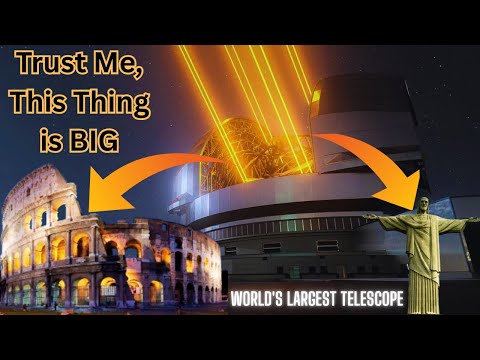
You ever just look up at the night sky and feel absolutely tiny? I mean, like, one minute you’re chilling on your porch, and the next you’re staring into the vastness of space. Crazy, right?
Well, here’s a fun fact for you: there are telescopes out there so big they could fit a small car inside them! Seriously. They’re like the mega-wonders of the science world, helping us peek into galaxies far away.
These giant telescopes do more than just make us go “whoa.” They’re secrets keepers of the universe. With their help, we’ve found new planets and even understood black holes a little better.
So grab some popcorn or maybe a cozy blanket because we’re about to dive into how these cosmic tools work and what makes them truly special.
Groundbreaking Discoveries of the Very Large Telescope: Unveiling the Mysteries of the Universe
So, let’s talk about the Very Large Telescope (VLT). This giant collection of telescopes is located in the Chilean Atacama Desert. It’s like the ultimate cosmic eye, peering deep into space and uncovering things we didn’t even know were there. You might wonder how this massive setup works its magic, so let’s break it down.
What is the VLT, anyway? It’s not just one telescope; it’s a set of four optical telescopes that work together. Each has a mirror that measures 8.2 meters across—like trying to look through a giant window! And because they can combine their light, they get ultra-sharp images of distant stars and galaxies.
Now, you’re probably curious about what kinds of discoveries the VLT has made. Well, here are some pretty mind-blowing ones:
- Exoplanets: The VLT has been key in finding planets outside our solar system. By studying how a star wobbles as planets orbit around it, astronomers can figure out if there are new worlds out there!
- Black Holes: Ever heard of supermassive black holes? The VLT helped spot one at the center of our Milky Way galaxy! It’s called Sagittarius A*, and it’s got a mass equivalent to millions of suns.
- The Universe’s Expansion: Using the VLT, scientists have measured how fast the universe is expanding. They’ve discovered some surprising facts about dark energy—a mysterious force driving this expansion.”
One emotional story comes to mind: imagine standing under a clear night sky in Chile, far from city lights. Just you and countless stars sparkling above! With each flicker, you realize that some of those twinkling dots are actually galaxies billions of light-years away, being captured by the VLT. It gives you chills thinking about all those distant worlds.
The tech behind this telescope is wild too! The mirrors are made of glass that’s polished to perfection—so smooth that light reflects off it clearly without any distortion. And when the images come back? They’re processed with advanced software that enhances them even further.
You might think all this complex machinery sounds intimidating, but it’s basically just people with lots of questions and really cool gear trying to understand our place in all this vastness. Honestly? The discoveries made by VLT not only fascinate scientists but also everyone else who looks up at the night sky wondering what lies beyond.
In short, thanks to telescopes like the Very Large Telescope, we’re peeling back layers on cosmic mysteries that have puzzled us for ages. That’s pretty awe-inspiring if you ask me!
Exploring the Cancellation of the Overwhelmingly Large Telescope: Implications for Modern Astronomy
The cancellation of the Overwhelmingly Large Telescope, or OWL for short, has sparked a lot of chatter in the astronomy community. This telescope was supposed to be an absolute game changer. We’re talking about a mirror that would’ve been around 100 meters wide! Just imagine how much clearer and deeper we could’ve seen into space. But, well, things didn’t pan out as planned.
First off, let’s consider what OWL would have brought to the table. For starters, it was designed to collect light from galaxies billions of light-years away with incredible detail. This means it could help answer some big questions about the origins and evolution of our universe. The idea was to detect faint signals from early galaxies, maybe even find planets that could support life. Sounds like something out of a sci-fi movie, right?
But besides the cool factor, the cancellation has real implications. Funding is one major issue here. Astronomy projects often rely on large investments from governments and institutions. With OWL’s budget ballooning out of control—like seriously over budget—they had to pull the plug. This begs the question: How can we fund such ambitious projects without breaking the bank?
Also, think about technology. The development work for OWL pushed boundaries in materials science and optics. Now that it’s canceled, we might lose some momentum in these fields. Researchers might miss out on breakthroughs that could benefit other tech areas too! Remember how fiber optics revolutionized communications? That kind of innovation often comes from pushing limits in astronomy.
And let’s not forget about the collaborative spirit involved in such massive projects. Astronomy usually unites scientists across different countries and backgrounds—so when one project gets shelved, that camaraderie can take a hit too. It’s like planning an epic road trip with friends and then just deciding not to go; you feel those missed experiences on many levels.
On a brighter note, this cancellation doesn’t mean modern astronomy is dead in the water! Other projects are still charging ahead—like the James Webb Space Telescope or plans for various ground-based observatories being developed all over the globe. It just shows us that while one door closes, many others remain wide open.
So yeah, while losing OWL is a bummer and brings some challenges along with it; it’s important to remember that curiosity won’t be silenced. Innovations will continue! And who knows? Maybe this setback will inspire even bigger dreams down the line; dreams we can’t even imagine yet!
Exploring the International Space Station: Advances in Space Science and Research
Exploring the International Space Station (ISS) is like stepping into a real-life sci-fi movie. Since its launch in 1998, it has served as a unique laboratory orbiting Earth, enabling scientists to conduct experiments that just can’t be done down here. The ISS helps us understand more about our universe and even ourselves.
First off, being in microgravity changes everything. On the ISS, researchers study how this environment affects living organisms. You see, our bodies were built for Earth’s gravity—so when astronauts float around up there, their muscles and bones weaken over time. This gives scientists a chance to figure out how to keep humans healthy during long space missions, like to Mars!
One huge focus of research aboard the ISS is understanding space radiation. On Earth, we’re protected by our atmosphere. But once you get outside that cozy bubble, you’re exposed to all kinds of cosmic rays. Astronauts on the ISS get dosed with these rays every day, and studying their effects helps improve safety measures for future deep-space missions.
And then there’s the unique opportunity for scientific collaboration. Scientists from all around the world work together on the ISS—like some giant global science experiment! They share resources and findings that can lead to breakthroughs we wouldn’t see if everyone was working alone.
Have you heard of those giant telescopes? Well, they actually work hand-in-hand with what happens on the ISS. For example, telescopes like the Hubble have given us stunning images of galaxies far away while gathering data that feeds into programs run on the station. The cool part? Sometimes they find something weird in space which spurs new experiments on board!
The research can be super varied too! You’ve got everything from
to
. Seriously! The way liquids behave up there is totally different than what we see here on Earth.
Also, let’s not forget how it helps with technology development. Many systems needed for life up there eventually trickle down as innovations for us back home—like water purification systems or even advancements in telecommunications.
So yeah! By exploring the International Space Station and pushing boundaries through exciting research and collaboration with tools like giant telescopes, we’re expanding our knowledge of both space science and everyday life here on Earth. You’re following me? Science isn’t just about solving problems; it’s about discovering new frontiers we didn’t even know existed!
You know, giant telescopes really are like the magical windows to the universe. I mean, just think about it for a moment. When you look up at the night sky, it’s kinda overwhelming, right? There’s this vast expanse filled with stars, planets, and who knows what else. But these colossal instruments help us see beyond what our eyes can catch.
I remember one time when my dad took me out to a dark spot away from city lights. We lay on the hood of his car and just stared up at all those twinkling stars. It felt like we were floating in space! But even then, I knew there was so much more out there that we couldn’t see without some high-tech help.
Giant telescopes come into play here. They’re not just any old binoculars; they gather light and other forms of radiation from faraway objects to let us peek into galaxies billions of light-years away. It’s like having a superpower that lets you reach out and touch the cosmos—or at least see it!
Take the Hubble Space Telescope, for example. This thing has been orbiting Earth for over 30 years! It’s given us iconic images of nebulae and distant galaxies that make you feel so small yet connected to everything around you. Every picture tells a story; every data point is like a breadcrumb leading scientists closer to understanding our universe’s mysteries.
And then there’s the new generation of telescopes being built right now—like the James Webb Space Telescope. Seriously, it’s wild how they can look back in time by capturing light emitted from stars when dinosaurs roamed Earth! Imagine catching glimpses of formation processes that happened billions of years ago!
But let’s not forget: these colossal tools are not only about looking outwards; they also remind us how fragile our own planet is. It’s crazy how exploring other worlds makes us reflect on ours—the beauty and also all the challenges we face here.
So yeah, giant telescopes are more than scientific instruments; they’re gateways to cosmic wonder and self-reflection. Each discovery opens up conversations about existence and our place in this grand universe—something we all ponder at some point while gazing up at those night skies filled with stars… or even just lying in a car hood with someone special by your side.