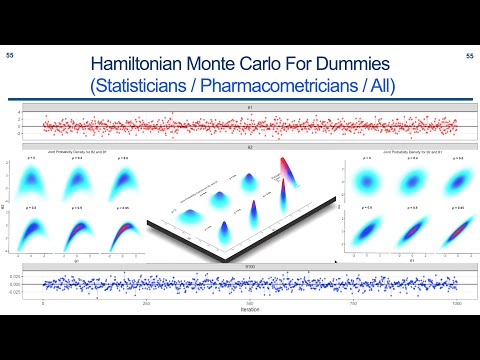
You know that feeling when you’re trying to figure out a puzzle? Like, the more pieces you add, the clearer it gets, but also, sometimes it just makes things messier? That’s kind of what scientific modeling is like!
Here’s a fun fact: Monte Carlo methods got their name from a casino in Monaco. Yup, all that number-crunching started with people gambling! Crazy, huh?
Now, Hamiltonian Monte Carlo is like the cool cousin of regular Monte Carlo methods. It doesn’t just throw random darts at the board; it actually strategizes! I mean, wouldn’t you rather play chess than bingo?
In this article, we’re gonna break down what Hamiltonian Monte Carlo is all about. So grab your favorite snack and let’s unravel this together!
Understanding Hamiltonian Monte Carlo: A Conceptual Guide for Scientific Applications
Understanding Hamiltonian Monte Carlo can feel a bit intimidating at first, but don’t worry! It’s a fascinating concept that mixes physics with statistics. So, let’s break it down into bite-sized pieces.
What is Hamiltonian Monte Carlo? Well, at its core, it’s a method used to sample from complex probability distributions. This is super useful in Bayesian statistics, where you’re often dealing with tricky models. Traditional methods sometimes struggle with high-dimensional spaces, but Hamiltonian Monte Carlo helps navigate these spaces more efficiently.
It’s inspired by principles of classical mechanics. You remember that feeling on a merry-go-round? When it spins fast enough, you kind of float outward. That idea of momentum and energy helps us understand how Hamiltonian Monte Carlo works. In this case, the “merry-go-round” is our parameter space.
Imagine you’re trying to walk through a foggy landscape where every step you take could lead to totally different places. If you randomly stumble around (like some other sampling methods), it might take forever to find what you’re looking for. Instead, Hamiltonian Monte Carlo uses physics concepts to guide those steps more intelligently.
Now let’s dig into how it actually works:
- Energy Conservation: In this approach, we think of each parameter as having “kinetic” and “potential” energy—kind of like how a ball rolls down a hill and bounces around.
- Momentum: The method introduces an auxiliary variable for momentum. This helps create a sort of dance between position (our parameters) and momentum.
- Leapfrog Algorithm: So here’s the fun part: using something called the leapfrog algorithm lets us simulate the dynamics over time without getting stuck in local minima.
The leapfrog algorithm takes small steps through the parameter space while keeping track of both position and momentum. Imagine hopping back and forth across a hill while carefully adjusting your speed—that’s kind of what we’re doing here!
Why should you care about all this? Well, it produces samples that are **more representative** of the target distribution than random sampling would be. By simulating trajectories effectively, this method can cover more ground without getting lost along the way.
Here’s another cool aspect: Differential Equations. They crop up in almost every model involving change over time—even in population models or predicting weather patterns! Applying Hamiltonian Monte Carlo allows estimates to be made on these changes without getting bogged down by overly complicated formulas.
If you’re diving into scientific modeling—like estimating parameters for ecological models or analyzing social phenomena—having tools like Hamiltonian Monte Carlo at your disposal can seriously save time and enhance accuracy.
In summary, understanding Hamiltonian Monte Carlo opens doors! It’s not just for physicists or statisticians; anyone working with complex data can potentially benefit from these ideas. So when you’re faced with daunting probability distributions again, remember this nifty mix of physics and stats is there waiting to help you navigate them smartly!
Mastering Hamiltonian Monte Carlo in Python: A Comprehensive Guide for Scientific Computing
So, Hamiltonian Monte Carlo (HMC) sounds pretty fancy, right? But at its core, it’s a method for sampling from probability distributions. Imagine you’re trying to find your way through a dense forest. You can’t see where you’re going, but you can feel the contours of the land beneath your feet. HMC is like having a map that helps you navigate those tricky paths. It uses the principles of physics—specifically Hamiltonian mechanics—to guide sampling in a more efficient way than other methods like random walk.
In the world of scientific computing, this technique is essential for tasks like Bayesian inference. It allows for exploring complex parameter spaces without getting too bogged down in the details. The key here is that HMC improves convergence speed and can handle high-dimensional spaces much better.
Now, if you’re looking to apply this in Python—great choice! Python has libraries that make HMC accessible without needing to dive deep into complex math right away. Here’s how you can get started:
- Import Required Libraries: You’ll often use libraries like NumPy for numerical computations and Matplotlib for plotting results.
- Define Your Target Distribution: This is basically where you want your samples to come from. You could use a simple Gaussian distribution or something more complex depending on your research needs.
- Implement Hamiltonian Dynamics: You’ll need to define the potential and kinetic energy functions. This step might involve some calculus, but don’t let it scare you!
- Add Leapfrog Algorithm: The leapfrog algorithm helps simulate the dynamics of your system over time by updating position and momentum iteratively.
- Tuning Hyperparameters: These include step size and number of leapfrog steps—you might have to experiment a bit here for optimal performance!
Okay, let’s make this tangible with an example! Imagine you’re working with a model that predicts disease spread based on various parameters—like contact rate and recovery rate. Using HMC, you’d set up your target distribution based on observed data about how the disease spread in similar populations. By effectively navigating this multidimensional space using HMC, you can efficiently sample those parameters.
Here’s where it gets interesting: once you’ve implemented HMC in Python, visualize those samples! Plotting them helps you see whether you’re converging nicely around the posterior distribution or flailing about aimlessly.
But it’s not just about coding; learning HMC means understanding its advantages and limitations too!
- Advantages: High efficiency in high dimensions makes it great for serious modeling tasks.
- Limitations: Some tuning is necessary; if done poorly, it might lead to poor exploration of parameter space.
In practice, remember: mastery comes with practice and patience. Playing around with examples available online can enhance your understanding while also improving your coding skills in Python.
So there we go! Hamiltonian Monte Carlo may sound all technical-like at first glance, but once you break it down into manageable pieces—and sprinkle some Python magic over it—you’ll be on your way to mastering one powerful tool for scientific modeling!
Advancing MCMC Techniques: The Role of Hamiltonian Dynamics in Scientific Computation
So, let’s talk about **Hamiltonian Monte Carlo** (HMC) and how it’s shaking things up in the world of scientific computation. You might be thinking, “What’s so special about this technique?” Well, grab a comfy spot and let’s break it down.
First off, HMC is part of this bigger family called **Markov Chain Monte Carlo** (MCMC). These techniques are kind of like a fancy way to sample from complex probability distributions. Now, why do we need that? Imagine you’re trying to figure out how likely different outcomes are in some experiment or model but the math behind it is super complicated. MCMC comes to the rescue by letting us sample from those distributions without needing to compute everything directly.
Now here’s where **Hamiltonian dynamics** comes into play. Think about it: traditional MCMC methods can sometimes get stuck in one area of the distribution, which isn’t great for exploring all possible outcomes. It’s like trying to find your way out of a maze but getting trapped in one corner. Hamiltonian dynamics helps by using physics concepts—basically treating our sampling process like particles moving through space—to guide us through the distribution more efficiently and effectively.
How does this work? Well, in HMC, we create an artificial momentum for our data points that allows them to leap around the space more freely. Imagine you’re on a skateboard, pushing off with your foot to zip down a path instead of walking slowly. This “push” helps avoid those pesky areas where traditional methods might just hang out without exploring further.
Another cool thing about HMC is how it uses gradients—basically, information about how steep or flat our probability landscape is at any point. Using these gradients makes the jumps smarter and reduces random “wandering,” which can waste time and computational resources.
Some people think of HMC as a more sophisticated chef cooking up samples quickly while also mastering flavor combinations (the different outcomes). It’s not just about speed; it’s also about tasting all those samples to get the best final dish!
Now let’s touch on some situations where HMC really shines:
- High-dimensional problems: In cases where there are many variables at play—think complex models in fields like biology or finance—HMC allows for efficient exploration.
- Robustness: Because it moves much smoother through parameter spaces compared to simpler MCMC methods, it’s less likely to get stuck.
- Simplicity in tuning: Once you get a hang of how HMC works, tuning its parameters tends to be less tricky than for other sampling methods.
But—and there’s always a but—HMC isn’t perfect! You’ll need to think carefully about how you set up your problem and tune those parameters. If done poorly, things can go sideways fast!
So what does all this mean for scientific modeling? By enhancing our ability to sample complex distributions effectively with HMC techniques rooted in Hamiltonian dynamics, scientists can better understand phenomena across various fields—be it physics, machine learning models or even climate science!
You see? When we connect physics with strong computational techniques like MCMC through HMC’s lens—it opens doors! It gives researchers better tools for prediction and analysis while allowing them to explore deeper insights into their data without getting lost along the way.
So next time someone brings up Hamiltonian Monte Carlo at a party—or hey, even if they don’t—you can nod along knowingly!
You know, when I first stumbled across Hamiltonian Monte Carlo (HMC), I was like, “What on earth is this mouthful?” But the more I dug into it, the more I realized it’s a total game changer for scientists. HMC is one of those tools that just makes you think, “Why didn’t I know about this sooner?”
So, let’s break it down. Picture a rubber ball rolling on a hilly landscape. The ball wants to find its way to the lowest point—just chilling in a comfy valley. In scientific modeling, that valley represents the most probable parameters of whatever you’re studying, whether it’s climate data or how proteins fold. HMC uses some cool physics concepts to help the ball explore this landscape efficiently—way better than traditional methods.
I remember sitting with a group of friends during our college years—some were math geeks and others were just trying to pass their courses. We were stumped on how we could model some complex phenomena accurately without getting lost in computation hell. Can you imagine? Hours spent running simulations that barely scratched the surface!
What happens with HMC is its brilliant use of momentum and energy, which guides our rubber ball across those hills smoothly rather than bouncing randomly everywhere. You start at a point and give it an initial push based on what you already know (that’s your current parameter estimate). As it rolls down into that valley, it create’s a trajectory that helps explore nearby areas before settling down.
And get this: Because of all this nifty physics involved, HMC can sample from complicated distributions much faster than other methods like traditional MCMC (Markov Chain Monte Carlo). The speed means we can iterate through models faster than ever before, letting us test hypotheses and refine conclusions quicker.
So yeah, think about how vital speed and accuracy are in research today! From predicting disease outbreaks to understanding financial markets—a robust tool like HMC can make all the difference. It feels pretty exciting to know we have something like this available now.
In short, Hamiltonian Monte Carlo might sound intimidating at first glance. But once you get past that initial hurdle and see how it operates under the hood, well—it opens up new ways to look at complex problems in science that just wasn’t possible before!