So, picture this: you’re trying to remember where you left your keys, rummaging through your bag like a detective in a comedic movie. You feel like Sherlock but with way less flair. Now, what if I told you there’s a type of neural network that kinda does the same thing our brain does when it comes to solving problems?
Hopfield Neural Networks are like those handy friends who help you find your way when your memory’s on the fritz. They’re not just about finding lost keys, though; they’ve got some pretty cool applications in pattern recognition and optimization problems.
But hold on for a second! Before we dive into the techy stuff, let’s take a little tour of how these networks actually work and why they could be your go-to problem solver in the future. Sounds fun, right? So let’s get into this brainy adventure together!
Exploring Hopfield Neural Networks: Applications, Principles, and Insights from Wikipedia
Sure thing! Hopfield Neural Networks are pretty fascinating, so let’s break it down.
What Are Hopfield Neural Networks?
At their core, Hopfield Neural Networks are a type of recurrent neural network. They were invented by John Hopfield back in the 1980s. The cool thing about them is they can remember patterns or data. Imagine storing your favorite songs in a playlist—you could recall any song by just remembering part of its title!
How Do They Work?
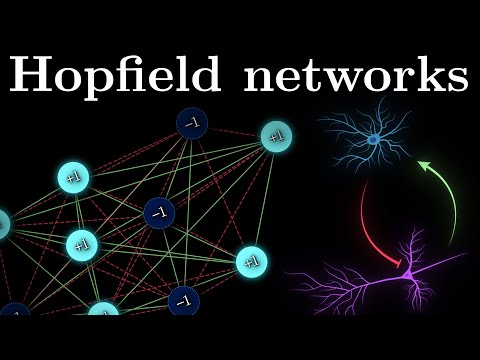
So, here’s the deal: these networks consist of a bunch of neurons that are all connected to each other. Each neuron can be either on (1) or off (0). When you present a pattern to this network, it spreads out and activates certain neurons based on the connections between them. Think of it like a ripple effect.
- Energy Minimization: The network minimizes its energy as it tries to find the closest stored pattern to what you’ve just given it.
- Attractors: If the input is a little noisy or incomplete, the network can still find the nearest stored pattern through these “attractor” states.
- Synchronous Update: All neurons update their states at once in one round, trying to reach equilibrium.
Applications Galore
You might wonder where you’d see these networks in action. Well, there are quite a few areas where Hopfield Networks shine:
- Data Retrieval: They’re great for recalling incomplete data—like how we sometimes remember a song but can’t quite recall all the lyrics.
- Pattern Recognition: Think about facial recognition software that needs to identify faces under different lighting conditions; these networks can help make sense of that!
- Cognitive Science: Researchers studying how our brains work might use them as simple models for how memories could be stored and retrieved.
One time I was working on an art project and had this blurry image I wanted to clean up. Somehow, that made me think of how Hopfield Networks could interpret those blurry parts and recall what they were originally supposed to look like.
The Limitations
It’s not all sunshine and rainbows with these networks. One big drawback is capacity—if you put too many patterns into them, they can get confused pretty easily. Plus, they sometimes take longer as more complex patterns increase.
But hey, that’s just science! We learn from limitations too.
A Final Thought
If you’re ever looking into neural networks or AI designs for your projects or just out of curiosity (because who doesn’t love knowing more?), keep an eye on Hopfield Networks! They represent such an exciting leap toward understanding how we think and remember things. It’s kind of like having your brain running simulations—pretty wild if you think about it!
Exploring Applications and Principles of Hopfield Neural Networks: A Comprehensive PDF Resource for Scientific Study
Hopfield Neural Networks are fascinating structures in the realm of artificial intelligence. They’re a type of recurrent neural network, which is a fancy way of saying they can remember previous inputs over time. These networks were introduced by John Hopfield in 1982 and are known for their ability to solve optimization problems and store patterns.
So, what’s the deal with these networks? Well, they work using associative memory. Picture it like this: if you’ve ever walked into a room and instantly remembered why you went there—maybe to grab your favorite snack—that’s kind of how Hopfield networks operate. They have the capability to recall data based on partial inputs. It’s sort of like a fuzzy memory but with some serious computational muscle behind it.
You might be asking, “What are some real-world applications?” Here’s where it gets exciting! Hopfield networks can be used for various tasks:
- Pattern Recognition: They excel in identifying patterns from noisy data. Let’s say you’ve got a blurred photograph; a Hopfield network can help reconstruct the original image.
- Combinatorial Optimization: Ever tried to plan the best route on a road trip? These networks can help tackle similar problems by finding optimal solutions among many possibilities.
- Content Addressable Memory: Instead of searching through files, imagine just giving part of what you’re looking for and having it pop right up! That’s what these neural nets do.
Now, let’s break down the principles behind them just a bit more, alright? Hopfield networks consist of neurons that are interconnected in such a way that each neuron communicates with every other neuron. When an input is presented, neurons fire based on their weighted connections—think about it as neighbors chatting about their favorite ice cream flavors until one flavor wins out!
The network has an energy-based framework. Essentially, it strives to minimize energy usage while recalling memories or solving problems. You can visualize this energy as someone trying to keep their balance on one foot: find that sweet spot where they’re steady without tipping over.
But how does training happen? Well, during training, you’ll present various patterns to the network that gets stored as weights between neurons. Over time, these weights become fine-tuned so that when you provide part of an image or information later on, the network fills in the blanks effectively.
You might wonder about limitations—oh boy, they exist! Hopfield networks can struggle with too many stored patterns or when inputs aren’t quite aligned with those patterns. It’s like trying to fit square pegs into round holes; sometimes it works but often leads to confusion.
In summary, Hopfield Neural Networks offer intriguing methodologies in working memory simulations and problem-solving capacities. Their principles mimic human memory processes but bring them into computational domains full of potential.
If you’re looking deeper into this topic—like detailed equations or specific algorithms—it would be great to check out academic papers or comprehensive resources (but not sure where they live?). Just remember: these neural networks are all about remembering and discovering complex solutions from simple inputs!
Exploring the Dynamics and Applications of Hopfield Networks in Computational Science
The world of artificial intelligence and neural networks can feel like a maze sometimes, right? One of the fascinating structures in this landscape is the Hopfield network. It’s named after John Hopfield, who introduced this concept back in the 1980s. So, what’s the deal with these networks? Let’s break it down.
A Hopfield network is a type of recurrent neural network. Unlike regular feedforward networks where information flows in one direction, Hopfield networks allow for connections that loop back on themselves. This creates a system that can store and recall patterns based on a set of binary values – think of it like a memory bank for very specific tasks.
The fundamental principles behind Hopfield networks are pretty cool. They operate on the idea of energy minimization. Each state of the network has an associated energy level, and the goal is to find the lowest energy state possible. When you introduce some data into this network, it tries to reach that relaxing state by adjusting its internal connections. It’s kind of like your brain trying to solve a puzzle—it looks for solutions until it finds one that feels “right.”
Now let’s talk about applications. These networks have some seriously interesting uses:
- Pattern Recognition: They’re great at recognizing patterns even when there’s noise involved, which can be super useful in image processing.
- Optimization Problems: Think about scheduling or resource allocation—Hopfield networks can help find efficient solutions.
- Memory Retrieval: Just like humans occasionally need a nudge to remember something, these networks can retrieve stored memories based on partial input.
One neat example: Imagine you’re trying to remember a face from a crowd but only see part of it. A Hopfield network would take that incomplete image and still find a way to fill in the blanks using its stored patterns.
You might also be curious about why they aren’t more widely used compared to other models like convolutional neural networks (CNNs). The thing is, while these networks are pretty efficient at certain tasks, they have limitations too. They tend to get stuck in local minima — which is just fancy talk for getting stuck on suboptimal solutions when optimizing.
In practice, researchers have tried enhancing Hopfield networks with approaches like deep learning. Combining them with newer architectures allows for greater capacity and flexibility in handling complex problems.
But what makes Hopfield networks particularly special? Well, they encapsulate some core ideas about learning and memory that resonate not just with computers but also with how we understand our own brains! There’s something almost poetic about machines echoing our cognitive processes—a reminder that science often mirrors nature.
So yeah, whether you’re programming AI or just geeking out over how similar algorithms mimic your own thought processes, remembering how crucial these little networks are can make all the difference!
Okay, so let’s talk about Hopfield Neural Networks for a sec. You might be wondering, what even are those? Well, they’re these cool types of recurrent neural networks that were invented by John Hopfield back in the 1980s. Basically, they’re designed to create associative memory—like how your brain recalls memories based on related ideas.
Imagine you’re flipping through an old photo album, and suddenly you get hit with a wave of nostalgia. When you see a picture of your childhood dog, it’s like all these memories come rushing back. That’s kinda what these networks do! They remember patterns and can return to them when given some input.
One thing that I find particularly interesting is how they tackle optimization problems. You know how sometimes you have to find the best route to avoid traffic or decide which restaurant to go to based on reviews? Hopfield Networks can help with those kinds of problems by finding the most efficient solution from a set of possibilities. It’s like having a clever friend who always knows the fastest way to get somewhere.
But here’s the kicker: these networks can actually get a little chaotic because they’re iterative, which means they update their states repeatedly based on certain rules until they settle down into a stable pattern. It reminds me of trying to get my puppy to sit still—it takes a few tries and maybe some treats before he finally calms down!
So, what are some real-world applications? Well, they’re used in image restoration, pattern recognition—even in solving puzzles like Sudoku! Just think about it: machines learning from past experiences and intelligently figuring things out is pretty incredible.
In terms of principles, these networks work on energy minimization—sounds fancy, right? Basically, each configuration has energy associated with it (like when you’re too full after dinner). The idea is that lower energy states are more stable. So through iterations, the network finds its way down that energetic slope towards stability.
I remember mentioning this concept in class once and someone asked if we could train our pets using something similar! I chuckled but seriously—it goes to show how curious minds make connections between seemingly unrelated things. We’re all wired for learning in different ways; sometimes it just takes a picture or a well-timed treat!
So yeah! Hopfield Networks might sound technical but at their core, they reflect some pretty neat ideas about memory and problem-solving—just like us humans navigating through life’s little challenges!