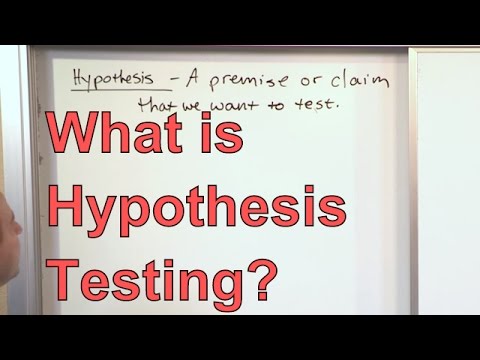
So, picture this: You’re at a party, and someone claims that drinking coffee makes you funnier. Yeah, right? But what if we could actually test that theory?
Welcome to the world of hypothesis testing! This is where science gets real. It’s like being a detective but with numbers and data instead of magnifying glasses.
You take your wild guess—like coffee equals laughs—and turn it into something you can measure. It’s not just for scientists in lab coats. Seriously, anyone can use it!
Let’s break it down with some practical examples from real research. You’ll see how hypothesis testing helps us figure stuff out and make sense of life’s zany questions. So grab your favorite drink (maybe coffee?) and let’s chat about how this all works!
Testable Hypotheses in Scientific Experiments: Examples and Applications
Alright, let’s dig into the world of testable hypotheses in scientific experiments. So, what’s a hypothesis anyway? Well, it’s basically an educated guess about what you think will happen in a particular situation. And more importantly, it has to be something that you can test. If you can’t measure it or observe it, then it’s just a wishy-washy idea.
Testable hypotheses are vital because they provide a clear direction for scientific inquiry. They help researchers focus their experiments and give them something concrete to analyze at the end. Think about it like making a bet on whether your friend can jump higher than a fence. You need to define how you’re measuring that jump — like using a tape measure or just eyeballing it.
So, let’s break down how these hypotheses are applied in real-life scenarios:
- An example from biology: Imagine scientists are curious if certain fertilizers make plants grow faster. They might propose: “Plants given Fertilizer A will grow taller than those without fertilizer.” This is pretty straightforward and testable — just grow some plants and measure!
- A classic psychology experiment: Let’s say researchers want to know if sleep affects memory retention. They could say: “People who get 8 hours of sleep will remember more words from a list compared to those who only sleep for 4 hours.” It’s easy to set up and analyze!
- Exploring weather patterns: Meteorologists might hypothesize: “Increased carbon dioxide levels lead to higher average temperatures.” Now they can look at historical data over time and see if there’s a pattern matching their prediction.
The beauty of these examples is how they lead to clear experiments you can perform or data you can collect. You set up your experiment, gather results, then compare them against your hypothesis. If the results don’t match your guess, then hey, maybe it’s time to rethink things!
You might wonder what happens when your hypothesis gets knocked down by the data. That’s totally cool! That means science is doing its job: refining ideas based on evidence instead of sticking stubbornly to beliefs.
A little personal note here: I remember once doing an experiment back in school where we tested if different colored light bulbs affected plant growth. We had this wild theory about blue light helping plants thrive better than red light. And while our hypothesis didn’t hold up – turns out all colors did pretty similar – we learned so much about the experimentation process! There’s always something valuable in testing your ideas.
If we circles back here, having testable hypotheses isn’t just important; it fuels the whole scientific method! It keeps scientists grounded and helps pave the way for new discoveries and understanding.
Comprehensive Guide to Practical Examples of Hypothesis Testing in Scientific Research (PDF)
Hypothesis testing is a really cool way that scientists figure out if their guesses about the world are right or wrong. Basically, it’s like a game where you come up with an idea or a guess (that’s your hypothesis) and then you test it to see if it holds up against reality.
First, let’s break down how this whole thing works. You start with two main statements:
Null Hypothesis (H0): This is what you think is happening when there’s no effect or difference. So, if you’re testing a new drug, your null hypothesis might be something like: “This drug has no effect on patients.”
Alternative Hypothesis (H1): This one represents what you hope to find — that there *is* an effect. Using the same example, it would be: “This drug does have an effect on patients.”
So here comes the fun part—the testing! You collect data and analyze it using statistical methods. This helps you find out whether to reject or not reject that null hypothesis based on the evidence.
Now, let’s take a look at some practical examples:
- A/B Testing: This is super common in marketing but also science! Let’s say you’re trying to figure out which version of a website leads to more sales. You’d create two versions (A and B), run them simultaneously, and see which one performs better.
- Medical Trials: Imagine you’re testing a new vaccine. You’d divide participants into two groups—one receives the vaccine while the other gets a placebo (you know, like fake medicine). Afterward, you’d check how many in each group gets sick to see if the vaccine really does protect people.
- Environmental Studies: If researchers want to see if air pollution impacts plant growth, they could measure plants in high-pollution areas versus low-pollution ones and analyze whether there’s any significant difference in their growth rates.
Ever heard of Type I and Type II errors? They come into play in hypothesis testing too! A Type I error happens when you wrongly reject the null hypothesis—it’s like saying your drug works when it actually doesn’t. A Type II error is when you fail to reject H0 even though H1 is true—like saying the drug doesn’t help when it actually does.
The power of your test matters too! Basically, that means how likely you are to find an effect if there really is one out there. Scientists aim for a power of around 80%, so they have decent odds of detecting real effects.
On top of all this, certainty levels come into play through p-values. A p-value helps determine significance; usually, scientists use 0.05 as a cut-off point. If p is less than 0.05, it’s like saying “Hey! There’s enough evidence here for me to think my alternative hypothesis might be correct!”
So remember: hypothesis testing isn’t just some dry mathematical process; it’s an exciting way scientists uncover truths about everything around us—from health breakthroughs to environmental changes and even social behavior! It’s kind of like detective work but with numbers instead of magnifying glasses!
Enhancing Scientific Research: Practical Examples of Hypothesis Testing in PowerPoint Presentations
What’s the deal with hypothesis testing? Well, imagine you’re at a picnic with friends, and someone claims that ants prefer sweet foods over salty ones. You might think, “How can we figure that out?” That’s where hypothesis testing comes in. It allows us to test ideas scientifically, sort of like being a detective but with numbers and experiments.
So let’s break it down. Hypothesis testing is all about making a guess (or *hypothesis*) and then seeing if the evidence supports that guess. It usually involves two main ideas: the **null hypothesis** (H0) and the **alternative hypothesis** (H1). The null hypothesis is basically saying there’s no difference or effect – like saying ants don’t really care whether their food is sweet or salty. The alternative, well, that’s where you’re claiming there *is* a difference – so in this case, that ants definitely have a sweet tooth.
Now here’s how you might use hypothesis testing in scientific research, especially when you’re making presentations. Picture this: you’re creating a PowerPoint to share your findings about that ant snack preference.
First off, start by clearly stating your hypotheses right on the slide:
- Null Hypothesis (H0): Ants show no preference between sweet and salty foods.
- Alternative Hypothesis (H1): Ants prefer sweet foods over salty foods.
This sets the stage for everything else you’ll present. After laying this out, you could add some data collection methods on another slide. Maybe you’re observing ants in various setups with both types of food available.
Next up, let’s talk about analyzing your data. You’d want to run some statistical tests – think t-tests or chi-square tests depending on what kind of data you’ve gathered. Make sure to explain this in simple terms; not everyone gets statistics right away!
In your PowerPoint, have a slide showing the results from one of those tests:
- P-value: A low p-value (usually
- Conclusion: If p
This keeps it straightforward while still being rigorous— great for keeping your audience engaged!
But here’s where it gets interesting. Let’s say after running your experiment and analyzing your data, you find out ants actually prefer salty snacks! You want to communicate that too without leaving the audience hanging. So maybe add a slide discussing why these results differ from common beliefs or previous studies.
You can even share an emotional story from your experimentation process—like when you set up an elaborate trap only to find squirrels raiding the buffet instead of ants! Sharing these moments can help connect with people; science isn’t just about numbers—it’s about curiosity and discovery!
In summary, make sure your PowerPoint slides are clear but packed with essential info—showing hypotheses, methods, analysis results really helps frame everything neatly! Hypothesis testing isn’t just dry stats; it’s an adventure into understanding our world better—whether that’s about ant diets or something way more complex!
So next time you’re faced with a question like whether fruits grow faster in summer than winter—or if ice cream makes people happier—remember: hypothesis testing has your back!
Alright, let’s chat about hypothesis testing in research. It sounds a bit heavy, right? But it’s honestly one of those things that can really shape how we understand the world. So, picture this: you’re hanging out with a friend who swears they can tell the difference between two brands of chocolate just by taste. You think, “Okay, let’s put that to the test!”
That’s your hypothesis—your friend can distinguish between those brands. You grab a couple of chocolate bars and set up a little blind taste test. You know what comes next: your friend takes a bite, makes all sorts of faces, and finally guesses… wrong! So, you say to yourself, “Well, maybe they can’t.” That’s basically hypothesis testing in action—making an educated guess and then seeing if there’s proof to back it up.
In scientific research, it’s similar but with a bit more flair and structure. Researchers often start with a hypothesis based on previous observations or theories. Let’s say scientists want to explore whether caffeine affects reaction time. They might hypothesize that drinking coffee will lead to faster responses in tasks like catching a ball.
To test this idea, they’ll set up an experiment: some people get coffee while others get decaf or maybe even no coffee at all. Then they measure how quickly each group reacts to various stimuli. This is where the magic happens! They take their results and use statistical methods to see if any differences are significant or just plain happenstance.
You see, it isn’t merely about saying “I think this will happen.” It’s about collecting data and analyzing it rigorously to find out if your guess holds water. And sometimes it doesn’t—and that’s totally okay too! Like my friend who bombed their chocolate test, many times hypotheses don’t pan out as expected. But every “failure” teaches researchers something valuable.
I remember sitting in on a lecture once where the professor shared his experience testing whether different plant fertilizers actually made any difference in growth rates. He had all these fancy controlled experiments set up! After weeks of observation and data crunching—turns out one fertilizer worked way better than the others! He was excited but also reminded us that sometimes results are unexpected—the ones he thought would outperform didn’t cut it at all.
So yeah, hypothesis testing isn’t just for scientists locked away in labs; it’s like our everyday problem-solving approach turned into a systematic method for understanding life around us! And honestly? It reminds you that curiosity drives knowledge forward—even when the answers aren’t what you hoped for.