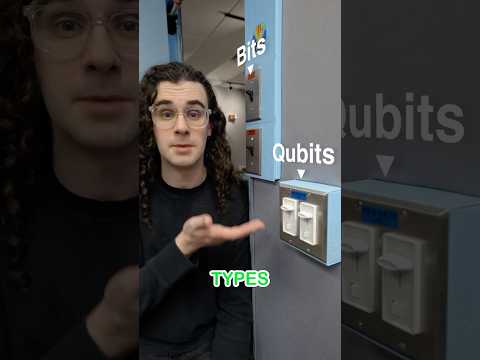
So, you know that moment when you’re watching a sci-fi movie, and they start talking about quantum stuff? It sounds super complicated, right? Like, what even is a quark? Honestly, I used to just nod along, pretending to get it.
But here’s the thing: quantum stuff isn’t just for nerds in lab coats. It’s like the secret sauce of our universe! You might not realize it, but quantum mechanics influences everything from your phone to how you see colors.
And that’s where science outreach comes in. It’s all about breaking down those wild concepts into bite-sized pieces. Because let’s face it—quantum analysis can sound like a conspiracy theory if you don’t have someone to explain it without the jargon!
So stick with me while we unravel this scientific mystery together. Who knows? You might end up impressing your friends with some mind-bending facts!
Understanding Quantum Analysis: Definition, Applications, and Significance in Science
Quantum analysis might sound like something out of a sci-fi movie, but it’s really just a way of using the principles of quantum mechanics to study and understand various phenomena in science. So, what exactly does that mean? Well, let’s break it down a bit.
What is Quantum Analysis?
At its core, quantum analysis involves looking at systems at the atomic and subatomic levels. You see, everything around us is made up of particles—atoms, electrons, protons, and so on. Quantum mechanics helps us figure out how these particles behave. Think of it like trying to understand the quirks of very tiny building blocks. It’s not always straightforward!
Applications in Science
There are tons of applications for quantum analysis across different fields! Here are a few:
Let me tell you a little story to connect all this to real life. Imagine you’re sitting in a cafe with your friend discussing how delicious your pastries are. Suddenly, your curious buddy starts asking about the molecular structure behind those flavors. Using quantum analysis in chemistry, scientists can explain how certain molecules interact with taste buds and how those chemical reactions happen during baking! It’s wild when you realize that our everyday experiences have such complex science behind them.
The Significance
So why is this important? Well, understanding these microscopic behaviors can lead to revolutionary advancements in technologies and medicine. For example:
– **Drug Development:** By using quantum mechanics scientifically to explore drug interactions at an atomic level, researchers can create more effective medications.
– **Energy Solutions:** Also, studying particles may help develop more efficient solar cells or batteries!
And let’s talk about outreach for a sec; sharing these concepts with people who aren’t scientists is crucial too! When you explain how much our lives hinge on such small things—like atoms—it makes science feel more relatable.
In summary, while “quantum analysis” might sound complex or intimidating at first glance, it’s really just about understanding the building blocks of everything we experience every day. Making this knowledge accessible through outreach initiatives can inspire future generations to explore science even further!
Exploring the Four Thematic Hubs of Quantum Computing in Science: A Comprehensive Guide
Alright, let’s wrap our heads around the cool world of quantum computing. It’s one of those terms that might sound like something out of a sci-fi movie, but it’s super relevant today. There are four big areas, or **thematic hubs**, that are worth diving into.
1. Quantum Algorithms
These are the heart and soul of quantum computing. Think about it this way: regular computers use bits to process information—0s and 1s, right? Well, quantum computers use **qubits**. And these guys can be both 0 and 1 at the same time! This property is called **superposition**, which allows quantum algorithms to solve certain problems way faster than classical ones can. A famous example is Shor’s algorithm, which can factor large numbers in no time—huge for cryptography!
2. Quantum Hardware
Now, you can’t really do much without the physical stuff that runs all these fancy algorithms. Quantum hardware includes everything from superconducting circuits to ion traps. It’s like building a mini universe where qubits can dance around and interact without going haywire due to noise or interference. The challenge here is keeping qubits stable long enough to perform meaningful calculations while minimizing errors. This field is growing fast, with companies and research labs racing to develop better and more efficient hardware.
3. Quantum Communication
Now picture this: if you want secure communication in a world full of eavesdroppers, quantum communication’s your best friend! Using principles like **quantum entanglement**, where two qubits become linked in a way that the state of one instantaneously affects the other—no matter how far apart they are—this tech aims to create unhackable communication channels. Imagine sending messages that no one could intercept without messing them up completely! Pretty exciting stuff!
4. Quantum Simulation
Here’s where it gets really interesting for scientists: simulating complex systems! Traditional computers struggle with simulating molecules or materials on a quantum level because there are just too many variables involved. With quantum simulators, researchers can mimic these systems more accurately than ever before, leading to breakthroughs in chemistry and materials science.
So there you have it! Those four themes bring together different aspects of quantum computing in science: algorithms that revolutionize processing power, hardware that’s always evolving, communication techniques ensuring privacy like never before, and simulations unlocking mysteries of the universe at an atomic level.
Each hub connects back to real-life applications impacting everything from security to drug discovery so yeah, keep an eye on this space—it’s only going to get more interesting!
Exploring the Scientific Evidence Behind Quantum Scans: A Comprehensive Analysis
So, quantum scans? That’s a pretty intriguing topic. It’s one where science meets some really cool tech. At their core, quantum scans use the principles of quantum mechanics to analyze things at super tiny scales. Yeah, we’re talking about particles like atoms and molecules!
What is Quantum Mechanics?
To get into this, you should know that quantum mechanics is the branch of physics that deals with the weird stuff at the atomic level. It’s like, things can be in multiple states at once until you look at them—like Schrödinger’s cat concept. Now, that’s a pretty trippy idea!
How do Quantum Scans Work?
Quantum scanning typically uses devices called quantum sensors. These sensors can measure changes in magnetic fields, temperature variations, or even gravitational waves with extreme precision. They often leverage something called quantum entanglement, where particles become linked and affect each other no matter how far apart they are.
- Sensitivity: Because they can detect minuscule changes in their environment, these scans could revolutionize fields like medicine or environmental science.
- Resolution: The detail they provide is just astounding. Think of it as zooming way into a photo and still seeing everything clearly.
Imagine being able to detect diseases way before symptoms show up! Doctors could use this tech to screen for issues like cancer or Alzheimer’s by scanning your body on a quantum level without invasive procedures.
The Scientific Evidence
Okay, so what does the research say? Well, studies support that these quantum sensors have proven effective in various scenarios. For instance, scientists have successfully used them for biological imaging by tracking single molecules within cells—a breakthrough moment!
And here’s another example: Researchers have been able to measure extremely small magnetic fields generated by the brain using these advanced tools. This opens doors to understanding more about neurological disorders.
The Outreach Aspect
Now let’s chat about outreach initiatives; they’re basically efforts to get this complicated science out into the world in an understandable way. This is crucial because not everyone speaks ‘science’ fluently. Creating accessible content is key so folks grasp what’s happening without feeling overwhelmed.
What happens is that workshops, talks, and social media campaigns help educate people on how quantum technology impacts daily life—from addressing health issues to improving technology we already rely on.
In a nutshell? Quantum scans are a frontier in scientific exploration with real-world applications waiting around the corner. Just think about how incredible it would be if we could catch diseases early or better understand our universe—all thanks to some tiny particles behaving in mind-bending ways!
You know, it’s pretty wild to think about how we’re using quantum analysis these days. I mean, seriously, this isn’t just something you read about in sci-fi books or see in a movie. Quantum mechanics dives deep into the tiny particles that make up everything around us—like atoms and photons—they’re just so bizarre and mind-bending.
I remember the first time I stumbled upon quantum physics. It was during a late-night study session in college. My buddy tossed me a book full of complex equations and weird concepts. At first, I thought, “What even is this?” But as I read on, it started to click! Those little particles behave in ways that totally flip our everyday logic upside down—like they can exist in multiple states at once or even be connected over vast distances without any visible link. Wow, right?
So when we talk about quantum analysis in science, we’re pretty much talking about trying to make sense of all those odd behaviors and finding ways to apply them. Researchers are using it for stuff like developing better batteries or improving medical imaging techniques. Like, can you imagine? Your next MRI scan could be sharper because of some funky quantum principles!
Now, on the outreach side of things, it’s a whole different ballgame but super important too! Scientists are trying hard to break down complex ideas into bite-sized pieces for everyone—because who wants to feel left out of science? Programs for schools and community workshops often tackle topics like quantum mechanics with cool experiments that get people engaged (sometimes with lasers!). They really want kids and adults alike to see how this stuff actually matters.
And let’s face it: when folks understand what quantum mechanics is about—even just a little—it opens up new conversations. You might find yourself pondering your own existence or even considering how interconnected we all are (thanks to those spooky action-at-a-distance particles).
But here’s the catch: While it’s great to spread knowledge like wildfire, there’s still this mountain of complexity associated with explaining such advanced concepts clearly and simply. So many people may end up scratching their heads instead of feeling inspired!
So yeah, as we move forward with both research and outreach initiatives in quantum analysis, let’s keep pushing for clarity while embracing those glorious quirks of the universe at the same time! It’s all connected; science is best when shared passionately and honestly! And who knows? Maybe one day you’ll find yourself chatting about entangled particles over coffee—it doesn’t get much cooler than that!