So, picture this: you’re sitting in a coffee shop, and out of the blue, your friend pulls out a tiny piece of metal from their pocket. They say it’s from an ancient spaceship! Okay, maybe that was a stretch. But what if I told you we can actually study materials down to the atomic level?
That’s where Rutherford Backscattering Spectroscopy (or RBS for the cool kids) comes into play. It might sound super technical, but seriously, it’s like giving scientists a magical lens to see what’s really going on inside materials.
Imagine peeling back layers to reveal hidden secrets. That’s what RBS does! It helps us understand everything from how semiconductors work to figuring out why certain metals are stronger than others.
Isn’t it wild that we can dive into the depths of materials and uncover their stories? Buckle up; we’re about to explore how this technique plays a huge role in material science!
Comprehensive Guide to Rutherford Backscattering Spectrometry: Techniques, Applications, and PDF Resources
Rutherford Backscattering Spectrometry (RBS) is a pretty cool technique used in material science to analyze the composition of thin films and surfaces. Basically, it helps researchers see what’s going on at an atomic level. You might be wondering how this works, so let’s break it down!
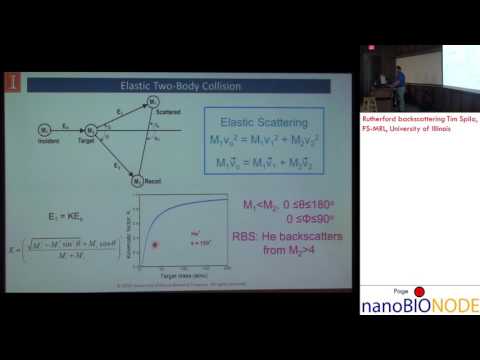
First off, the technique involves bombarding a target material with high-energy particles, usually helium ions. When these ions hit the atoms in your sample, some bounce back—this is where the name “backscattering” comes from. The amount and energy of these scattered ions tell scientists a lot about what elements are present and how thick the layers of material are.
Techniques involved in RBS include:
- Ion Source: A source generates helium ions that are accelerated towards your sample.
- Detectors: These measure the energy and number of backscattered ions.
- Data Analysis: The collected data is analyzed using software to quantify elemental concentrations.
Now, let’s talk about some applications. RBS isn’t just used for fun—it has serious scientific uses! Here are a few areas where it shines:
- Thin Films: It can help measure thickness and composition of materials like coatings or semiconductor layers.
- Nano-materials: Researchers use RBS to study nanoparticles, understanding their structure better.
- Semiconductors: It helps in characterizing materials essential for electronics—defects can be detected early!
You might also find this method being applied in research on solar cells to improve their efficiency. By analyzing layer compositions, scientists tweak materials for better performance.
And if you want to dive deeper into this subject, there are PDF resources available that cover everything from basic principles to advanced applications. Many universities publish detailed papers on their findings using RBS. Just search around; you’ll stumble upon a treasure trove of information!
In essence, Rutherford Backscattering Spectrometry is one powerful tool in material science that opens up discussions about atomic structures and compositions. Who knew bouncing particles could reveal so much? Always impressive how science strikes gold through simple ideas!
Understanding the Rutherford Backscattering Experiment: A Deep Dive into Nuclear Physics
Nuclear physics can seem pretty intimidating, right? But the Rutherford Backscattering Experiment really isn’t that complicated once you start digging into it. So, let’s break it down a bit.
The whole thing got its name from Ernest Rutherford, the guy who figured out that atoms have a nucleus. This experiment is basically about bombarding a material with high-energy particles—usually helium nuclei called alpha particles. When these particles hit a target material, they bounce back. Pretty cool, huh?
So, what does this bouncing around tell us? Well, it gives scientists tons of info about the material’s structure. It’s like asking an uncooperative kid to show you what’s in their backpack by tossing things at it and seeing what falls out.
Now here comes the fun part: how do we actually interpret those results? When an alpha particle hits an atom in the target material, it can either pass through or bounce back based on how tightly packed those atoms are. The amount of energy lost by the alpha particle during this process tells us about the elements and their concentrations in the target.
Here are some key aspects to think about:
I remember attending a lecture where someone described using this technique on ancient coins—fascinating stuff! If they could find out how pure certain metals were or if there were any contaminants, that could tell so much about history. Just think of all those hidden stories!
The data output from such experiments gets analyzed using computer simulations. Scientists compare what they measure against models to figure out exactly what they’ve got—like piecing together a puzzle but with some pieces missing.
Oh! And one more thing: while RBS is super handy for materials science, it’s also useful in other areas like semiconductor research and even archaeology! It’s amazing how something originally rooted in nuclear physics finds applications everywhere.
So yeah, understanding Rutherford Backscattering isn’t just about high-energy physics—it’s also about bringing together different scientific fields to figure out more complex questions from simple experiments! That’s what makes science so exciting: seeing how everything connects in our quest for knowledge.
Exploring Rutherford Backscattering Spectrometry: Key Applications in Material Science and Surface Analysis
Rutherford Backscattering Spectrometry (RBS) is one of those cool techniques that lets scientists look at materials in a super detailed way. Imagine having a magic eye that can peek into the heart of atoms and tell you what’s going on in there! With RBS, researchers can analyze the composition and structure of various materials. It’s like being able to read the ingredient list on a package, but for solid substances on the atomic level.
So, how does it work? Well, it all starts with bombarding a sample with high-energy ions—usually helium ions. These little buggers are shot straight at the material you’re examining. When they hit an atom in the sample, some of them bounce back. That’s where the name comes from: backscattering! The way these ions scatter off tells you tons about what’s inside your material.
Here are some key applications for this technique that really showcase its versatility:
- Surface Analysis: RBS is widely used to study surfaces because it can detect layers as thin as a few nanometers. Think of it like peeling back layers of an onion to see what’s underneath without slicing it up.
- Thin Films: In material science, thin films are everywhere—from electronics to coatings. RBS provides crucial data about thickness and composition, helping engineers create better products.
- Doping Profiles: When creating semiconductors, doping—adding impurities—is vital for tuning electrical properties. RBS can show how deep these impurities are embedded in the silicon layer.
- Material Characterization: Need to know if your alloy has just the right blend of metals? RBS can give insight into composition and help ensure quality control during production.
One time, I was chatting with a friend who works in semiconductor manufacturing. They mentioned how RBS helped them figure out why their chips were failing tests. Turns out, even a tiny mismatch in material composition can lead to major issues! So yeah, having tools like RBS is super important for making sure products are up to snuff.
Another interesting use is monitoring changes over time. Like if you’re testing how materials degrade or react to chemicals over long periods—RBS can track changes in composition without invasive methods. It’s non-destructive, which means you don’t have to wreck your sample just to find stuff out!
One thing worth mentioning is that while RBS gives great depth information, it can’t always tell you everything about specific chemical states or phases in a material. Sometimes other techniques will be needed alongside RBS for more complete data.
In conclusion… well actually no! Let’s keep this casual. What I’m saying is that Rutherford Backscattering Spectrometry is pretty awesome because it opens up all sorts of doors in research and development. Plus, the insight it provides plays a huge role across various industries—from making computers run faster to ensuring safety standards in aerospace materials.
So next time you’re wondering how scientists figure things out at such tiny scales—just think about those bouncing helium ions doing their job under smart microscope eyes! Pretty neat, huh?
So, let’s chat a bit about Rutherford Backscattering Spectroscopy, or RBS for short. It sounds super techy, right? But this method is really quite interesting!
RBS is all about understanding the composition of materials at a very tiny level. Imagine you’re an archaeologist, digging through layers of history; RBS kind of does that but with atoms instead of artifacts. It uses energetic particles—like helium nuclei—that smash into the materials you’re studying. When these particles hit atoms in your sample, they can bounce back, and that’s how scientists figure out what elements are present and even how thick layers of different materials are.
You know what’s cool? It’s not only about knowing what something is made of but also about exploring new materials for various applications. I remember this one time I was at a lab tour in university, and the scientists there were super pumped about using RBS to study new types of coatings for electronics. They were all excited about how these coatings could make devices more durable and efficient. It was infectious! You could just feel their passion for discovery.
But here’s the thing: while RBS sounds great in theory—getting super accurate details on material composition—it takes a lot of practice to master it properly. For many folks getting into material science, it might be overwhelming at first. There are so many variables to consider! Not just which materials you’re analyzing but also things like the beam energy and angle.
And honestly? The precision needed was mind-boggling for someone like me who loves hands-on experimentation but struggled with all those calculations! Still, seeing scientists rely on RBS to innovate was inspiring. It reminded me that sometimes you can dive head-first into something complex and slowly piece things together until it clicks.
So the next time you hear some scientific mumbo jumbo or read about new technology being developed using techniques like RBS, remember—it’s not just about making cool new stuff; it’s also exploring the fundamental building blocks of our world! Who knows? One day you might find yourself picking up where they left off or dreaming up your own discoveries based on those tiny atomic interactions! Pretty exciting stuff if you ask me!