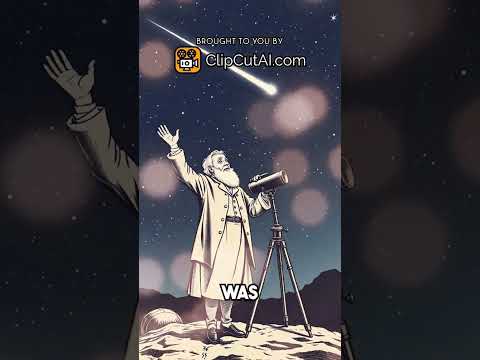
You know, it’s pretty wild to think that people used to look up at the night sky and just… guess what was going on. I mean, imagine trying to figure out when a comet would show up based on nothing more than your best hunch!
Enter Edmund Halley. This guy wasn’t just any old astronomer—he had this knack for celestial prediction that changed everything. Seriously, picture a dude with a telescope, madly scribbling notes, convinced he could figure out the secrets of the universe. And he did!
He was bold enough to predict the return of a comet years before it actually arrived. Can you imagine everyone waiting for it? It’s like telling your friends there’s gonna be an amazing surprise party and then showing up with balloons and cake!
Halley’s work didn’t just give us comets; it opened the door to a whole new era of understanding space and time. So let’s dive into his story and see how one curious mind left such a big mark on astronomy!
Unveiling Sir Edmond Halley’s Accurate Predictions: A Glimpse into Scientific Forecasting
So, let’s talk about this remarkable guy: Sir Edmund Halley. This dude was not just your run-of-the-mill astronomer; he was a real pioneer in the world of scientific forecasting. Born in 1656, Halley’s legacy is largely tied to his ability to predict the return of comets—most famously, Halley’s Comet.
Now, you might think of comets as those cool streaks of light that zip across the night sky. But back in Halley’s time, they were more like mysterious visitors. People were often freaked out by them. They didn’t know if it was a good or bad omen! But Halley changed all that with his groundbreaking work.
One of his key contributions was showing that certain comets returned after specific intervals. In 1705, he published a paper suggesting that what we now call Halley’s Comet comes back around every 76 years. Can you imagine figuring that out just by observing the skies? Seriously impressive!
- Data Collection: Halley diligently tracked historical records of comet sightings from various cultures and periods. He pieced together these observations like a cosmic detective.
- Mathematical Models: He used math to establish a predictive model based on gravitational forces and the elliptical orbits described by Kepler’s laws. Yup, it’s all about those curves!
- A Real-World Example: By predicting its next appearance for 1758, he not only confirmed his theory but also cemented his place in science history when it showed up right on cue!
This approach laid groundwork for what we now consider scientific forecasting. Instead of relying on myths or random guesses, he used empirical evidence and rigorous calculations—like a boss! Other scientists followed suit; they began applying similar methodologies to other areas like weather patterns and even economics.
A neat little story to illustrate this is when Halley positioned himself at an observatory in St Helena to witness the comet’s return. Imagine the excitement! The night sky finally illuminated with that familiar glow would’ve felt like waiting for an old friend to show up after years apart.
The significance of Halley’s work goes beyond one comet. It shaped how subsequent generations viewed celestial events and human understanding of time itself—like each appearance marked another cycle in our lives.
Cue modern times: Today we rely on similar principles when forecasting everything from weather patterns to space missions! So when you check your app for tomorrow’s forecast or hear about rocket launches? Just remember: it all has roots back to folks like Sir Edmund Halley who dared to look up at the stars and wondered what lay beyond.
This blend of observation, theory, and prediction highlights how science evolves through curiosity and dedication. Each leap forward opens new doors—not just for astronomy but also for any field where predicting outcomes is key!
Exploring Edmond Halley’s Intellectual Legacy: The Question of His IQ in Scientific History
So, let’s chat about Edmund Halley, the brilliant mind behind some incredible contributions to astronomy and science as a whole. You might know him for Halley’s Comet, that dazzling celestial showpiece that swings by Earth roughly every 76 years. But really, his legacy goes even deeper than that.
First off, Halley was not just a comet guy. He had this knack for making predictions based on solid observations. He pulled off something pretty impressive when he predicted the return of the comet in 1705, which is now named after him. By analyzing old records and using mathematics, he showed that these heavenly bodies weren’t just random; they followed patterns!
Now, let’s get into something a bit more curious: Halley’s IQ! So, do we have any idea about his intelligence? While we can’t exactly slap a number on it like we do today with IQ tests—those weren’t a thing back in his day—his work speaks volumes.
- Mathematical Prowess: Halley had an amazing grasp of mathematics. He worked alongside Isaac Newton and helped publish Newton’s groundbreaking “Principia Mathematica.” Now that’s collaboration with heavyweights!
- Astrophysical Insights: He didn’t just stop at comets; he did studies on the solar system and even suggested what causes the tides. Seriously! His ideas laid foundational stones for future scientists.
- Diverse Interests: Halley was also interested in many fields like geography and meteorology. His exploration of trade winds and ocean currents opened new doors for others to follow.
You know what’s interesting? Halley was also one of the first to use statistical methods in his research. Yeah! He used probability to predict things about life expectancy in London, which basically made him a pioneer of sorts in demographic statistics.
This leads us to think about legacy versus raw intellect. While we can’t box his smarts into an IQ score, it’s clear that he had critical thinking skills mixed with creativity—a combo that’s super valuable in science.
Some folks debate whether IQ is truly reflective of someone’s impact or genius level in their field. I mean, look at Halley—he may not have an official score attached to his name but his influence has lasted centuries.
From inspiring future astronomers to educating people about celestial events through his meticulous work, Halley’s mark on science is undeniable.
The bottom line? Edmund Halley’s intellectual legacy might not fit neatly into an IQ bracket, but it shines brightly through history—just like that comet! So next time you see it streaking through the sky, remember the brilliant man behind its name.
Evaluating the Accuracy of Halley’s Predictions in the Context of Scientific Discovery
Alright, let’s take a stroll through the stars and land on the fascinating world of Edmund Halley and his predictions. You know, Halley wasn’t just looking up at the sky for fun; he was diving into some serious scientific stuff back in the late 17th century.
Halley is best known for predicting the return of a comet, which now carries his name—Halley’s Comet. This wasn’t just random guesswork; he meticulously calculated its orbit based on previous sightings. So, what makes his predictions stand out in the grand scheme of scientific discovery? Let’s break it down.
1. The Mathematical Approach:
Halley used Newtonian physics, a concept not everyone was hip to back then. He applied gravity laws to determine how comets traveled through space. By analyzing data from earlier appearances of the comet, he predicted it would return in 1758. And guess what? He nailed it! It came back just as he said. Imagine how cool that must’ve felt for him!
2. Scientific Methodology:
At his core, Halley was a methodical thinker. You see, science is all about making observations, forming theories, and testing those theories against reality—like a detective solving a cosmic mystery! His ability to blend observational data with theoretical frameworks set the stage for future scientists.
3. Legacy Beyond Comets:
What Halley did wasn’t just about one comet; he opened doors for others to think critically about celestial mechanics and orbits—think Kepler and Newton getting all excited! His work laid groundwork for predicting other celestial events too. You can see how this domino effect shaped astronomy.
4. Limitations & Challenges:
Now, even though Halley’s predictions were spot-on regarding the comet’s timing, there were challenges he faced—like limited technology and knowledge back then. He lacked high-powered telescopes or precision instruments we have today. It makes you wonder: What would Halley think if he saw today’s crazy technology?
5. Halley’s predictions reveals some amazing insights into how science evolves through rigorous questioning and observation while shaping human curiosity towards the cosmos. It reminds us that even in its infancy, science could still soar high with visions far beyond its limits!
And there you have it—a glimpse into how Halley’s work still resonates today while reminding us that every small step in understanding leads to bigger things in our quest for knowledge about our universe!
You know, when we think about the stars and planets that twinkle above us, it’s easy to forget that someone had to figure out how they all worked. That’s where Edmund Halley comes in. He wasn’t just some guy looking through a telescope—he changed how we understand the cosmos.
Picture this: It’s the late 17th century. Halley, a young astronomer, is hanging out with some of the biggest names in science at that time. The world is buzzing with new ideas about gravity and motion. Halley was all about getting things right, so he took on a massive project—tracking comets. He famously predicted the return of what we now know as Halley’s Comet, which is like the rock star of the sky since it comes around every 76 years or so.
Now, imagine being in his shoes for a minute. You’re staring up at the night sky, trying to make sense of these mysterious objects moving around without any clear rules. It’s not just math; it’s almost like an art form! And then he has this lightbulb moment: if you can understand one comet’s path, maybe you can predict others too!
So fast forward to today, and we’re still using his methods. Sure, we’ve evolved with fancy tech and computers now—but it all started with Halley’s curiosity and determination. He laid down some foundational principles of celestial mechanics, which are pretty much essential for everything from navigation to planning space missions.
It’s a hop back to Earth for a sec—when I think about legacy, I can’t help but wonder how many people have looked up at that same comet across generations. There’s something poetic about it; like we’re all connected through this astronomical history he helped illuminate.
The thing is, while Halley was driven by knowledge and discovery, there was also something personal in his work. He wanted understanding—not just for himself but for everyone who dared to look up at night wishing for answers about our place in the universe.
So yeah, Edmund Halley didn’t just make predictions; he built bridges between generations of stargazers. His legacy teaches us not only about science but also reminds us how connected we are through shared curiosity and awe in looking towards the stars. Those moments of wonder? They never go out of style!