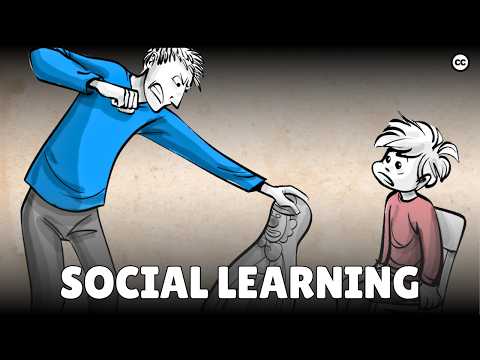
You know that moment when you see a kid copy their parent’s every move? Like, one second they’re playing with toys, and the next, they’re stirring an imaginary pot just like dad does in the kitchen? It’s hilarious, right?
Well, that’s basically the heart of social learning theory. It’s all about how we pick up behaviors from others—like little sponges soaking in everything around us. Seriously! From a young age, we mimic what we see and hear.
Think about your own life for a sec. Ever noticed how you might start using words or phrases after hanging out with certain friends? It’s like magic! There’s something really cool about this way of learning that shapes who we are… and who we become.
So, let’s dive into how this whole idea influences our behavior every day. It’s way more interesting than it sounds, trust me!
Exploring the Impact of Social Learning Theory on Behavioral Science
Social Learning Theory is, like, one of those fascinating ideas that really shapes our understanding of how people behave. It was developed by Albert Bandura in the 1960s, and basically, it says that we learn not just through direct experiences but also by watching others. That means your buddy might pick up a cool trick from a YouTube video and then use it in real life!
Observational Learning is key here. This is where you watch someone else do something and think, “Hey, I can do that too!” For example, if a kid sees their older sibling getting praised for cleaning up their room, they’re more likely to do the same. It’s like seeing a behavior rewarded makes it more appealing to imitate.
Another important concept is Modeling. This is all about having role models. You know how we often look up to celebrities or public figures? Their behaviors can influence us deeply—sometimes even subconsciously. If a famous athlete promotes healthy eating and exercise, you might feel inspired to hit the gym more often or grab that salad instead of fries.
Now let’s talk about Reinforcement. If what you see gets positive reactions from others—like laughter or applause—you’re probably going to want to repeat that behavior yourself. Think about when someone shares a funny story at a party; laughter encourages them to keep sharing similar stories!
There’s also something called Reciprocal Determinism. Sounds fancy, right? What it means is that our environment influences us just as much as we influence our environment. Let’s say you’re in a group of friends who love hiking. Your buddies encourage you to join them outside, and over time, you’ll likely enjoy hiking too! So it’s this back-and-forth thing where behavior, personal factors (like attitude), and the environment all play into each other.
One real-life example of Social Learning Theory can be seen in classrooms. Teachers often use modeling techniques—what they call demos—to show kids how to solve math problems step by step. Kids watch and then try it themselves! And guess what? They learn faster than if they were just reading from a book.
But it’s not just educational settings; think about social media culture today. So many trends spread because people see their friends or influencers engaging in certain activities—like dance challenges on TikTok. People replicate these actions because they’ve seen them being celebrated online.
Still curious? The theory doesn’t stop at individuals; it has broader implications too! It helps explain societal issues such as violence or aggression when kids see these behaviors glamorized on TV shows or video games—they might just mimic what they see without fully understanding the consequences.
In essence, Social Learning Theory shows us that we are shaped not only by our own experiences but also by observing others around us—a constant cycle of learning and adapting through social interactions! So next time you catch yourself picking up habits from friends or family members—or even random internet strangers—you’ll know there’s some serious science behind it!
Exploring Albert Bandura’s Theories on Human Behavior and Their Impact on Behavioral Science
Social learning theory, formulated by Albert Bandura, is pretty cool when you think about it. Basically, it suggests that people can learn new behaviors just by watching others. It’s like when you see a friend do something awesome and you want to try it yourself. No need to go through the whole trial-and-error process.
Bandura’s big experiment with children and the Bobo doll really shows this idea in action. Kids watched adults play aggressively with this inflatable clown doll, and guess what? When they got a chance to play with it themselves, many of them started imitating that aggressive behavior! I mean, that’s a clear sign that learning can happen just through observation.
One of the concepts Bandura introduced is modeling. This means we learn from observing others who act as role models. These role models can be anyone—from parents to celebrities or even characters in movies. You see someone achieving something or handling a situation well, and you think, “Hey, I could do that too!”
Another interesting part of Bandura’s theory is self-efficacy. This refers to our belief in our ability to succeed in specific situations or accomplish a task. If you believe you can skate like your favorite pro skater because you’ve seen them do their tricks over and over again, you’re more likely to get up and try it yourself—maybe even fall down a few times but keep going because you believe in yourself!
Here are some key takeaways about Bandura’s influence on human behavior:
- Learning by Observation: We pick up behaviors from watching others rather than just through direct experience.
- The Role of Reward: When we see someone getting rewarded for their actions (like praise or attention), we tend to imitate those behaviors too.
- Social Context Matters: Different environments can affect how likely we are to adopt certain behaviors.
- Reciprocal Determinism: It’s not just about outside influences; our own thoughts and feelings also impact our behavior in social settings.
The impact of Bandura’s theories on behavioral science is huge! They’ve laid the groundwork for understanding everything from childhood development to educational practices. For example, educators incorporate modeling techniques into classrooms every day—think teachers showing students how to solve problems step-by-step.
I remember one time while watching kids at a playground; they were all trying this tricky climbing structure. And guess what? The ones who had older siblings there were leading the pack! They watched how their siblings tackled it first—and then followed along with confidence.
So yeah, Albert Bandura’s work has shaped not only psychology but also parenting styles and educational methods around the world today! Whether you’re thinking about raising kids or teaching students, his ideas remind us how much we all learn from one another—even without saying a word!
Exploring Social Learning Theory: Its Impact on Human Behavior in Contemporary Science
So, social learning theory is a bit of a big deal when it comes to understanding how humans behave. Basically, it’s all about how we learn from watching others. You know that friend who always seems to pick up new skills just by seeing someone else do it? That’s social learning in action!
Origin of Social Learning Theory
The concept was really popularized by psychologist Albert Bandura in the 1960s. He did some pretty cool experiments, like the famous Bobo doll study. Kids watched an adult interact aggressively with this inflatable doll. Surprise, surprise! The kids who saw that were more likely to imitate that aggression later on. So, it shows us that people can learn not just through direct experience but also by observing what happens to others.
Key Components
Social learning theory has several key components that you might find interesting:
- Attention: To learn something new, you need to pay attention. If you’re busy scrolling through your phone while someone teaches you something, good luck with that!
- Retention: You gotta remember what you observed. This isn’t about cramming for a test; it’s more about recalling information when needed.
- Reproduction: This is where things get hands-on! Once you’ve learned something, you have to be able to reproduce the behavior or skill.
- Motivation: Lastly, there needs to be a reason for you to actually want to do it. Maybe there’s a reward or a personal interest driving you.
These components are kind of like the building blocks of human behavior. They help shape how we interact with our world and each other.
The Role of Environment
Another interesting thing is how your environment plays into this mix. For instance, if you’re surrounded by supportive people who encourage you when trying new things, you’re more likely to take risks and learn more! On the flip side, if your environment is super negative or discouraging? Well, going out on a limb might seem less appealing.
Real-world Applications
You can see social learning theory everywhere – even in small stuff! Take social media influencers; they show followers what products they use or lifestyles they lead. People watch and then often imitate their behaviors—like trying out that new fitness routine or adopting certain fashion trends.
In education too! Teachers use examples from videos or real-life scenarios so students can relate and absorb information better than from just textbook definitions.
The Impact Today
In contemporary science and psychology, understanding social learning helps address issues such as aggression and mental health challenges. By studying how behaviors are modeled and reinforced socially, researchers can develop strategies for everything from improving public health campaigns to tackling bullying in schools.
So yeah! Social learning theory isn’t just some dusty old concept—it actually affects our daily lives and explains so much about why we act the way we do. It’s like holding up a mirror into our interactions with each other—and who knows what else we’ll discover as science continues exploring these ideas?
You know, thinking about social learning theory really gets me reflecting. It’s like, imagine when you were a kid, and you watched your older sibling try to ride a bike. They fell down a bunch of times, but they kept getting back up. Eventually, they were zooming around like it was nothing! Just by seeing that, you probably wanted to try too, right? That’s basically how social learning works—observing others and picking up behaviors without having to go through the trial and error yourself.
So, this whole theory was kicked off by Albert Bandura in the ’60s. He kinda opened our eyes to the idea that we learn not just from what we’re told but from what we see. Like, if you see someone getting rewarded for doing something nice, you’re more likely to do that same thing later on because you want that good feeling or praise too.
But it’s not just about the good stuff; there’s also a darker side. If kids grow up watching violent behavior on TV or in their neighborhoods without any consequences attached to it, they might think that’s acceptable—or cool even! It’s wild how powerful those observations can be.
Thinking back on my own experiences, I once had a friend who always managed to charm teachers and other adults with her wit and humor. I found myself trying out some of her techniques in conversations because I wanted people to like me too. Sometimes it worked; sometimes it didn’t! But that back-and-forth shaped how I interacted with others—and still does.
Now take this idea and zoom out a bit: you can see social learning happening all around us—in schools, workplaces, even on social media. It’s less about direct instruction and more about seeing what’s happening around us every day—how people react and behave shapes our choices.
So yeah, social learning theory has this massive influence on human behavior; it’s almost like we’re all part of one big classroom where everyone is both a teacher and a student at different times. And honestly? That’s kinda beautiful when you think about it! We’re all trying to figure things out together in this messy process called life—learning from each other’s successes and failures along the way.