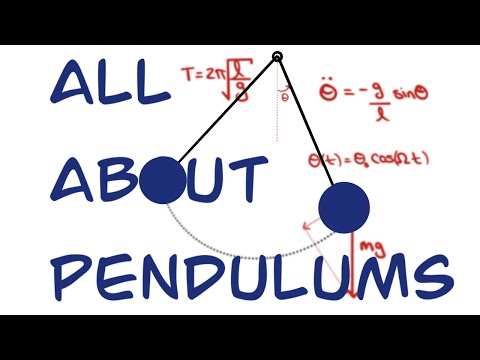
You know that feeling when you’re just hanging out and see a pendulum swinging? It’s like, mesmerizing, right? You stare at it and suddenly your mind starts wandering, thinking about time, gravity, or whatever.
Well, here’s a fun tidbit for you: the word “pendulum” comes from the Latin word “pendere,” which means “to hang.” So yeah, it’s literally something that hangs around!
When you really think about it, there’s this cool dance happening with every swing. Gravity pulling down and then the pendulum fighting back. Kinda poetic if you ask me!
And then there’s that moment when it slows down and comes to a stop. You can almost hear time ticking away. Anyway! Let’s dig into this world of pendulums—there’s a lot more going on than just swinging back and forth. Trust me; you’ll be hooked like I am!
Exploring the Science Behind Pendulums: Mechanics, Physics, and Applications
Okay, let’s talk about pendulums! You know, those things that swing back and forth? They might seem simple at first, but there’s some serious science going on behind them. Basically, a pendulum is just a weight (called a bob) hanging from a fixed point that swings in an arc under the influence of gravity. Sounds easy, right? But there’s so much more to it!
The key to understanding pendulum motion is all about forces. When you pull the bob to one side and let go, gravity pulls it back down, accelerating it. It swings through the lowest point with maximum speed before rising again on the other side until it almost comes to a stop. Think of it like when you’re on a swing at the park—you feel that rush as you move higher and higher before slowing down.
Now here’s where things get interesting: when we measure how long it takes for a pendulum to make one full swing back and forth, we call this its period. The period depends mainly on two things: the length of the pendulum and acceleration due to gravity. So if you wanted to make your pendulum swing slower or faster, you’d either change its length or find somewhere with different gravity—like up in space! But seriously, you’d need an incredibly long pendulum or some way of adjusting gravity since it’s pretty constant on Earth.
If you’re thinking about applications—check this out! Pendulums have been used for all sorts of things like clocks. The classic grandfather clock uses a pendulum for keeping time because its regular swinging makes time measurement super reliable. Imagine living in a world without accurate clocks—total chaos!
But wait, there’s more! Pendulums are not just for telling time; they also show us important physics concepts like energy transfer and conservation. When the bob swings down, gravitational potential energy converts into kinetic energy (that’s just energy of movement). At its lowest point? Maximum kinetic energy! And then as it climbs back up again? The motion transforms back into potential energy.This interplay keeps the whole system going.
If you’re feeling adventurous with physics experiments, try making your own simple pendulum at home! Just grab some string and a weight (a heavy washer works well), hang it from something sturdy, pull it to one side and let go. Count how long it takes for several swings—it’s pretty cool how predictable that motion can be!
Pendulums also have these quirky properties called harmonic motion. This means if you move them gently from their resting position—not too much—they’ll keep swinging in this smooth rhythm forever… well, almost forever if we ignore air resistance and friction!
The science behind pendulums is like uncovering layers in an onion—there’s always something more complex beneath what seems simple at first glance. So next time you’re waiting around and see something swinging back and forth—it might be just a fun little reminder of how fascinating physics can be!
The Famous Pendulum Experiment: Unraveling the Science of Motion and Gravity
The famous pendulum experiment is one of those classic demonstrations that really gets you thinking about motion and gravity. Picture this: a heavy weight hanging from a string, swaying back and forth. It’s simple, but it reveals so much about how the world works.
First off, let’s talk about the science behind it. The pendulum swings because of gravity. When you pull it to one side and let go, gravity pulls it downwards. As it swings through the center, it picks up speed due to the force of gravity acting on it. You follow me? This back-and-forth motion can keep going for a surprisingly long time, depending on factors like air resistance and friction at the pivot point.
Now, there are a few key points to understand:
- The Period: This is the time it takes for the pendulum to complete one full swing—back and forth. The cool thing is that for small angles, this period doesn’t depend on how heavy the weight is! It’s actually determined by the length of the string.
- The Amplitude: This refers to how far you pull it back before letting go. Larger amplitudes mean more potential energy at the start but also result in larger swings.
- Conservation of Energy: The pendulum is a perfect example of conservation of energy. At its highest points, all energy is potential; at its lowest point, all energy converts to kinetic energy (the energy of motion).
- Damping: Over time, every real pendulum loses some energy due to air resistance and friction. You’ll see this as its swings gradually get smaller until it finally comes to rest.
Now let’s bring in something emotional here—imagine watching a pendulum clock swing rhythmically in an old library or museum. It creates this calming atmosphere while illustrating complex physics at play! Many folks have an affinity for these clocks because they reflect both artistry and science.
If you think about famous scientists like Galileo or Huygens, who studied pendulums extensively centuries ago, these experiments contributed significantly to our understanding of physics. Galileo even used swinging objects to measure time intervals way before we had wristwatches!
Oh! And there’s something neat called the Pendulum’s Precession. It’s when a swinging pendulum slowly shifts its plane over time due to Earth’s rotation—a phenomenon that can be seen dramatically in Foucault’s Pendulum.
So remember: whether it’s for keeping perfect time or illustrating fundamental principles of physics, pendulums have played an important role throughout history. They’re not just moving back and forth; they’re telling us stories about gravity and motion we’re still unraveling today!
Exploring the Four Fundamental Laws of Pendulum Motion in Physics
So, pendulums! They’re not just for clocks or playgrounds, you know? There’s actually a lot of cool physics packed into their swinging motion. Let’s break this down into four fundamental laws that help us understand how pendulums work.
First off, we have the Law of Restoring Force. When you pull a pendulum back and let it go, gravity pulls it down. This force tries to bring the pendulum back to its resting position. The more you pull it back, the stronger the force pulling it downward. Imagine holding a rubber band tight; if you let go, it snaps back! That’s kind of what happens with a pendulum.
Next is the Law of Periodicity. This law states that the time it takes for a pendulum to swing to and fro is constant for small angles of displacement. So if you swing a pendulum really gently, it’ll take about the same amount of time—no matter how far you pull it back within certain limits. It’s super cool because this means that even if you swing it harder or softer, if it’s within those small angles, its rhythm stays almost the same. Think of it like your favorite song playing on repeat!
The third law is called Conservation of Energy. When you lift a pendulum up high and let go, all that potential energy from being up high gets converted into kinetic energy as it swings down. When it’s at its lowest point in the swing, it’s moving fastest and has maximum kinetic energy. As it goes back up on the other side, that speed turns back into potential energy until it’s at its peak again. It’s like going up a roller coaster! You feel all that energy building up until you drop down fast.
Finally, we can’t forget about Damping Forces. Over time—like after swinging forever—a pendulum will gradually lose energy due to things like air resistance and friction from where it’s connected to whatever’s holding it. This makes it slow down every time until eventually, it stops swinging altogether. It’s kind of sad but totally normal! Just think about how an old swing at the park gets rusty and doesn’t move as easily anymore.
So there ya have it! Those four laws help explain why when you push a pendulum just right—or even when life swings us around—we can find some pretty fascinating rhythms in motion!
Pendulums, right? They might seem pretty simple, just swinging back and forth, but there’s a lot more happening behind that rhythmic motion. Picture this: you’re in a quiet room, and there’s an old clock ticking away. Each tick is like a heartbeat from some mechanical friend. That pendulum inside is doing its thing, keeping time in a way that connects the science of motion with our everyday lives.
So here’s the deal with pendulum motion. It all boils down to gravity and inertia—two fundamental forces at play. When you pull that pendulum to one side and let go, it swings down because gravity pulls it toward the earth. But then, as it reaches the bottom of its path? Well, inertia kicks in and carries it up on the other side before gravity pulls it back again. It’s this dance between gravity pulling down and inertia pushing up that creates that beautiful, steady swing we see.
How cool is it that something so simple can teach us about complex concepts like energy conservation? Basically, at its highest point on either side of the swing, all the energy is potential—you know, stored up waiting to do something—and then as it swings downwards, that potential energy gets converted into kinetic energy—the energy of movement! And just like that, we’re reminded how interconnected everything is in this universe.
I have this memory from my childhood when I went to a science museum with my family. There was this huge pendulum exhibit that showed how Earth turns underneath while the pendulum keeps swinging in nearly the same direction. Watching the little marble hit those pegs made me feel so small yet part of something grander. It was like witnessing physics in action!
What makes pendulums extra fascinating too—not only do they tell time or provide calming views—they also show us real-world applications in clocks, seismometers for earthquakes, and even swings! It’s just incredible how a simple concept can ripple through various fields.
So next time you see a pendulum swinging or maybe listen to an old clock ticking away in your home or elsewhere—just take a moment to appreciate what’s going on there. There’s beauty not only in its motion but also in what it teaches us about balance—between forces at play in our life too! You follow me?