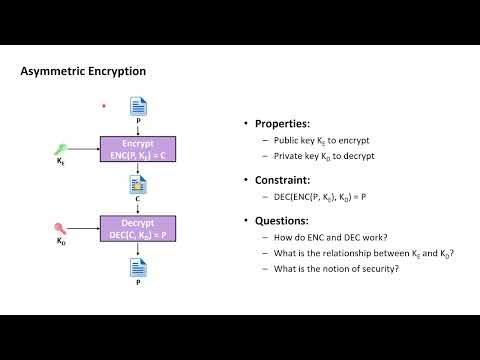
So, here’s a funny thing. You know that moment when you’re trying to send a super secret message to your buddy, but you don’t want eavesdroppers to snoop around? Yeah, that’s where asymmetric encryption struts in like a superhero. Seriously!
Imagine you’ve got this magic lock-and-key situation. Your friend has one special key to unlock your encrypted message, and no one else can touch it. Sounds cool, huh? That’s basically what RSA encryption does.
Now, I know it sounds all techy and complicated, but hang tight. It’s not rocket science! Picture it more like passing notes in class while keeping the nosy teacher off your back. Let’s break this down together and get into the nitty-gritty of how it all works!
Exploring the Challenges and Limitations of Asymmetric Encryption in Modern Science
Asymmetric encryption is a fancy term for a way to secure data using two keys: a public one and a private one. You might’ve heard about it, especially in the context of RSA, which is pretty much a rockstar in the encryption world. But while this technology has its perks, it’s not all sunshine and rainbows. There are some challenges and limitations worth chatting about.
First off, let’s break down what asymmetry means in encryption. Basically, you can share your public key with anyone, and they can use it to send you encrypted messages. Only you have the private key to unlock those messages. Cool, right? But here’s where it gets tricky.
- Computational Resources: Asymmetric encryption like RSA requires way more computational power than symmetric encryption—which only uses one key. So, if you’re dealing with super large datasets or need quick responses, this might slow things down.
- Key Size: To keep things secure, RSA keys need to be really long—typically 2048 bits or more! This is because shorter keys can be cracked relatively easily by modern computers. Longer keys mean more security but also more processing time.
- Vulnerabilities: Even though it’s considered secure, RSA isn’t invincible. Quantum computing is an emerging tech that could break RSA encryption fairly easily if it becomes mainstream. Researchers are already looking for alternatives that could withstand those future threats.
- User Behavior: This one’s surprisingly human! The security of asymmetric encryption relies on users keeping their private keys safe. If someone loses their key or lets it get into the wrong hands, all bets are off! It’s like giving away your house key—total disaster!
- Implementation Issues: Sometimes developers mess up when implementing these algorithms. Bugs or oversights can create serious weaknesses in an otherwise strong system.
Alrighty then! So let me tell you about when I first learned about asymmetric encryption at my college cybersecurity class—seriously, it was like discovering a secret world! We were tasked with trying to crack messages using both symmetric and asymmetric methods (with permission, of course!). The feeling when we cracked a symmetric code was exciting—a true adrenaline rush! But with asymmetric codes? It was like trying to open a vault without the right blueprint!
To wrap up this chat about challenges in asymmetric encryption: The technology itself is powerful yet not without flaws. Balancing security needs while managing computational efficiency is an ongoing puzzle for scientists and developers alike! So whenever you send sensitive data online—remember that while asymmetric encryption plays an essential role in keeping our info safe, it’s always good to stay informed about its limitations too!
Exploring the Future of RSA Encryption: Implications and Innovations in Cryptographic Science
RSA encryption is pretty fascinating, right? It’s like the secret sauce of online security. So, let’s break down what it is and what the future might hold for it.
In its simplest form, RSA stands for Rivest-Shamir-Adleman. These three clever folks came up with a way to keep our digital communications safe from prying eyes. The magic happens through asymmetric encryption, which means you use two different keys: one public and one private. Think of it like your mailbox—anyone can drop a letter in, but only you have the key to open it.
How does RSA work? Well, it relies on the fact that while multiplying two large prime numbers is fairly easy, figuring out those two numbers from their product is super hard. For example, imagine you have 61 and 53; multiply them together and you get 3,233. But good luck trying to guess which primes made that number!
Now, onto the future of RSA encryption. With the rise of quantum computing, things are about to get interesting—and a bit worrisome. Quantum computers can solve certain problems much faster than classical ones. This means they could potentially crack RSA encryption in no time flat! If that happens, we need new ways to protect our info.
What are some innovations in cryptographic science? Here are a few exciting developments:
So, imagine a world where your online banking info or private messages remain safe even if these fancy new computers come along. That’s what innovations in cryptography aim for!
There’s also an emotional side to this whole thing; think about times when your passwords or sensitive data were at risk. It’s not just about numbers and codes; it’s about peace of mind knowing your information is protected.
In summary, while RSA has been a rockstar in securing our digital lives for decades now, its future will likely depend on how well we adapt to challenges like quantum computing and innovate with new algorithms. So we’re really at a crossroads here—exciting but kinda nerve-wracking too!
Exploring RSA: The Pioneering Asymmetric Encryption in Cryptographic Science
RSA, or Rivest-Shamir-Adleman, is like the superhero of asymmetric encryption. You know, the kind of encryption that relies on a pair of keys—public and private—that’s different from the more common symmetric encryption, where you just have one key for both locking and unlocking.
So here’s how it works. With RSA, you get a public key that you can share with anyone. This key lets people encrypt messages that only you—holding the private key—can decrypt. Pretty handy, huh? It’s like sending a locked box to your friend where only they have the key to open it.
Let’s break it down a bit. First off, RSA relies on some heavy math involving prime numbers. Basically, you pick two large prime numbers (let’s call them p and q) and multiply them together to create a number known as n. This number is part of both your public and private keys. The security here comes from how difficult it is to factor n back into those prime components once they’re multiplied.
Now, after getting n, there’s something called the totient, which is like a fancy term for counting how many numbers are coprime to n. You usually find this by calculating (p-1)(q-1). Then, you choose another number, let’s say e, which needs to be coprime with this totient.
This might sound complicated, but hang tight! The coolest part comes when someone wants to send you something. They’ll use your public key (which includes e and n) to encrypt their message using some math we won’t bore ourselves with right now. When it reaches you, only your private key can decrypt that message.
And get this: RSA isn’t just theoretical or academic; it’s what keeps our online communications secure every day! For example, whenever you’re making purchases online or logging in somewhere safe like your email, there’s a good chance RSA is working hard behind the scenes.
But wait—there are some challenges too! Since it involves heavy-duty calculations with large numbers (we’re talking hundreds of digits), it can be slower than symmetric encryption methods like AES when processing data. That’s why most systems usually combine both types for efficiency—a little bit of RSA for exchanging keys followed by fast symmetric encryption for actual data transfer.
So yeah! RSA has its quirks and ups and downs but has paved the way in cryptographic science for keeping our digital lives safe while we explore everything this tech-savvy world throws our way! It’s pretty remarkable how such complex mathematics can blend into our everyday reality without us even noticing!
Alright, so let’s chat about asymmetric encryption with RSA. You might have heard of this kind of tech at some point, especially if you’ve ever wandered into a conversation about online security. It’s all around us, but like most things in life, it can be a bit tricky to wrap your head around.
Imagine you’re sending a message to your best friend, right? You don’t want anyone else snooping on that convo. That’s where encryption comes in. Now, with symmetric encryption, you both use the same key to lock and unlock messages. But here’s the kicker: if someone gets hold of that key, they can read everything! Yikes, right?
So RSA flips that whole idea on its head. It uses two keys: a public one and a private one. The public key—like an open mailbox—is shared with everyone. Anyone can drop a message in there. But the private key? That’s like the secret code that only you have, allowing you to open those messages and read them safely. Super cool!
The first time I really understood how this worked was when I was helping my little niece set up her first email account. She wanted to send secret notes back and forth with her friend across town. As we talked about how we could keep those notes safe from prying eyes, it hit me just how crucial this technology is for privacy these days.
The science behind RSA is fascinating too! It involves prime numbers and some pretty complex math but essentially relies on the fact that while it’s easy to multiply two large primes together, breaking them back down is something even supercomputers struggle with for larger numbers. So it adds a layer of security that keeps our digital lives much safer.
But like anything else in tech, it has its challenges too. Quantum computing is starting to poke holes in traditional encryption methods like RSA. So researchers are scrambling to find new ways to secure our data as we head into this brave new world.
All of this makes you think about trust—trusting that what you’re sending won’t be read by others—and the lengths we go to protect our privacy online from hackers or even just nosy neighbors scrolling through our stuff when we’re not looking!
Anyway, next time you send an email or make an online purchase, just take a moment and appreciate all the brains behind asymmetric encryption like RSA working hard to keep your info safe! It’s pretty incredible when you think about it!