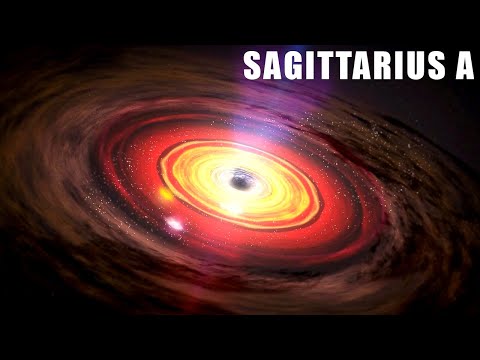
You ever hear that joke about a black hole inviting everyone to a party? Well, turns out they tend to suck everything in instead. Seriously though, our galaxy’s black hole is no laughing matter.
It’s called Sagittarius A*—yup, that’s its name! And it’s hiding at the very center of the Milky Way, over 26,000 light-years away. But don’t worry, it’s not coming for you any time soon.
So why is this big ol’ black hole so interesting? Well, it’s like the universe’s ultimate mystery box. Scientists are still figuring out how it shapes our galaxy and even what happens when stuff gets too close.
Come on a little journey with me. Let’s dig into what makes Sagittarius A* tick and what it means for us here on Earth! You ready?
Unraveling the Mysteries of Black Holes: Insights from Modern Astrophysics
Black holes are like the ultimate cosmic mystery, right? They’re these regions in space where gravity is so strong that nothing—not even light—can escape. Imagine trying to run away from something that’s pulling you back with an invisible rope. That’s a black hole for you!
So, let’s break it down. The Milky Way has a supermassive black hole at its center called Sagittarius A*. This beast weighs about four million times more than our Sun! It’s hidden behind a lot of gas and dust, which makes it tricky to study. But don’t worry, scientists have some cool tricks up their sleeves.
One of the main ways we investigate black holes is by looking at the stars that orbit them. You know how when you’re playing catch, you can tell how far away your friend is based on how fast they throw the ball? Well, by observing stars swirling around Sagittarius A*, astronomers can figure out how massive the black hole is based on their speed.
It’s all about using gravitational influence. When these stars whip around this gigantic void, they reveal clues about what’s hiding in there. In fact, over the past couple of decades, researchers have tracked these stars and gathered some pretty convincing evidence of our black hole’s existence.
Another interesting thing is how we detect black holes indirectly through X-rays. Sometimes when matter falls into a black hole, it gets super heated and emits X-rays just before crossing the event horizon—the point of no return. Picture it as a roller coaster: as you race down and approach the drop, everything gets intense! Those X-rays are like flashing lights signaling something spectacular is happening just near that edge.
But wait, there’s more! Some researchers have also used radio waves to learn more about Sagittarius A*. They’ve spotted radio emissions coming from particles spiraling into the black hole. This kind of research helps us understand not just what goes in but also what might come out—like jets of particles being expelled at mind-blowing speeds.
And there are still so many questions unanswered! Like, what happens to information when it falls into a black hole? Does it really disappear forever? Those are questions keeping physicists awake at night—seriously!
To wrap this up, studying black holes and particularly our own Milky Way’s central monster teaches us loads about physics and the universe itself. With each discovery made through modern astrophysics, we’re peeling back layers of cosmic secrets bit by bit. You follow me? The universe is vast and wild; every new insight reminds us just how much we still have to learn!
Unveiling Sagittarius A*: The Milky Way’s Black Hole and Its Continuous Light Flares
So, let’s talk about Sagittarius A*, the supermassive black hole at the center of our Milky Way galaxy. It’s pretty mind-blowing, to be honest. This black hole is about 4 million times the mass of our Sun. Imagine that amount of mass squished into a tiny point! It’s not visible in the traditional sense because it doesn’t emit light like stars do. Instead, it has this crazy gravitational pull that just swallows everything around it.
You might wonder how we know it’s there if we can’t see it directly. Well, astronomers have gotten super clever with this. By observing the movement of stars orbiting Sagittarius A*, they can actually figure out its presence and mass. These stars whip around this invisible giant at incredible speeds, like they’re on a cosmic merry-go-round!
Now, what’s with these light flares? Good question! These flares of light happen when material near the black hole gets heated up as it’s being pulled in by gravity. Think of it like a cosmic whirlpool: as things get closer to the center, they speed up and heat up. This hot material emits X-ray radiation, which we can detect with powerful telescopes.
- The flares aren’t constant; they come and go unpredictably.
- They can be a million times brighter than usual levels in just a matter of minutes!
- The exact cause of these flares is still being studied, but they offer juicy clues about what happens around black holes.
An interesting thing happened back in 2019 when researchers managed to capture images showing these light fluctuations using advanced observational techniques. For instance, they observed how some gas clouds would brighten intensely before fading back into darkness—like fireworks going off then suddenly disappearing.
Each flare gives scientists valuable information about Sagittarius A* and helps them learn more about how black holes work in general. It’s kind of like piecing together a puzzle where each flare adds another piece to our understanding of cosmic behavior.
To sum it up, Sagittarius A* holds some serious mysteries for us. We’re just starting to scratch the surface regarding understanding its continuous light flares and what they mean for astrophysics as a whole. The whole concept is wild—you’ve got this gigantic entity lurking at the heart of our galaxy sending out bursts of energy! Now that’s something to ponder next time you look up at those twinkling stars.
Exploring the Sweet Universe: The Science Behind Milky Way Chocolate’s Ingredients and Production
I’m glad you want to explore this sweet universe, but let’s clarify something first. When we’re talking about Milky Way chocolate, it’s a completely different topic from the actual Milky Way galaxy and its black hole. But hey, let’s make this fun and tie them together in a way that makes sense!
So, you know about the Milky Way bar, right? It’s that delicious treat filled with nougat and caramel. The ingredients of this chocolate bar are pretty simple but come together to create something pretty special. It’s like a mini science experiment every time you take a bite!
- Cocoa is one of the main ingredients. This comes from cocoa beans, which grow on cacao trees in warm climates. After harvesting them, they undergo fermentation—kind of like how fruit ferments to become wine! Once fermented, the beans are dried and roasted to bring out that rich chocolate flavor.
- Nougat is another critical element here. Made with sugar, corn syrup, and egg whites—think of it as sweet foam! The whisked egg whites give nougat its fluffy texture, making it light yet chewy.
- Caramel, oh my goodness! That gooey stuff adds sweetness and richness. Making caramel involves cooking sugar until it melts and turns golden brown before adding cream or butter for creaminess.
- Last but not least is the milk chocolate coating. This includes cocoa solids, sugar, milk powder, and some emulsifiers to give it that smooth finish. You see? Each ingredient plays its part perfectly!
Now switching gears for a sec—let’s talk about an entirely different kind of Milky Way: our galaxy! At its center lies a supermassive black hole named Sagittarius A*. It has around four million times the mass of our Sun! I mean, can you even imagine something so massive?
Just like how every ingredient in your chocolate bar combines to create something delightful, all the stars and materials in our Milky Way swirl around this black hole due to its intense gravity. Think of it as a cosmic recipe where everything orbits around this central “sweet spot,” if you will.
Speaking of gravity—it’s fascinating how it works both ways! In your candy bar’s production line, gravity helps mix those ingredients together perfectly before they get poured into molds.
So here we have two seemingly unrelated topics—chocolate bars and galaxies—but both are a reminder of how ingredients matter whether you’re making candy or understanding cosmic phenomena. Whether you’re munching on your favorite treat or gazing at the night sky wondering what’s out there behind all those stars, there’s beauty in complexity.
In short—and without getting too technical—it’s all about merging elements into something amazing: cocoa beans with nougat forming your cherished Milky Way treat while celestial bodies gather around gravitational forces at play in our galaxy.
Life’s sweet like that sometimes; don’t you think?
You know those moments when you’re lying on your back, looking up at the stars? It can really hit you—like this urge to understand just what those twinkling lights are all about. I had one of those nights recently, and it got me thinking about our very own cosmic neighborhood: the Milky Way. More specifically, the supermassive black hole chillin’ at its center, called Sagittarius A*.
Seriously, it’s kind of mind-blowing to think about. There’s this massive gravitational monster out there pulling everything towards it. If you could get close enough (which is not a good idea… trust me), you’d feel its tug like an invisible hand gripping everything in the vicinity. Pretty wild imagery, huh?
When scientists first started studying black holes, they thought they were just these weird voids in space where stuff goes missing—like socks in a dryer! But as we’ve peeked deeper into Sagittarius A*, things got really interesting. Imagine a swirling whirlpool where star stuff falls in and gets crushed beyond recognition—this is where science fiction begins to merge with reality.
What blows my mind most is how we know it’s there even though we can’t actually see it. Astronomers are like detectives piecing together clues from light around Sagittarius A*. They look at how stars zip around it; their movement gives away its presence. It’s kind of poetic, don’t you think? The universe speaks in ways we have to decode!
I remember once watching a documentary that showed how they took images of black holes using something called Event Horizon Telescope—a network of radio telescopes pulling an all-nighter across the globe! They captured the shadow of another black hole called M87*, and I just sat there with my jaw dropped. This crazy collaboration yielded such an incredible image! We were peeking into another world entirely.
But back to our own Milky Way’s monster: Sagittarius A* isn’t just a dark spot—it’s influencing its surroundings massively! It changes the life cycles of nearby stars and just might hold secrets about gravity itself or how galaxies evolve over eons.
Sure, there’s still so much we don’t get yet—we’re scratching the surface here! But unraveling these mysteries feels like solving a cosmic puzzle piece by piece. Makes you realize we’re intertwined with this vast universe in ways we can barely comprehend. And man, doesn’t being a tiny part of something so grand feel both humbling and thrilling?
So next time you find yourself gazing into space, remember: that black hole at the center of our galaxy is more than just darkness; it’s a gateway to understanding our universe’s deepest secrets and maybe even ourselves along the way!