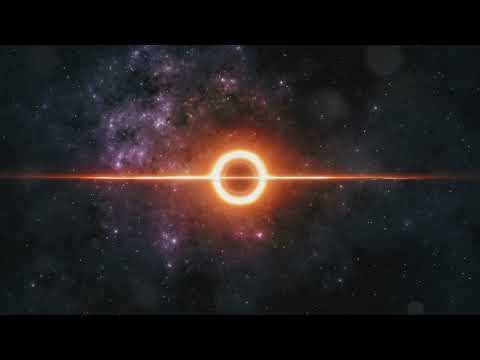
So, picture this: you’re in a space-themed café, sipping on a cappuccino, and the barista mentions something about a giant black hole swallowing stars like they’re popcorn. Yeah, that’s not just the coffee talking!
Black holes are these mind-boggling cosmic beasts. Seriously. They’re like the universe’s ultimate hiding spots for anything that dares get too close. You might be thinking, “What even is a black hole?” or “Can it really eat stars?”
Well, strap in! There’s so much more to these mysterious giants than you’d think. From their wild formation to how they warp space-time – yes, you heard that right – it’s all kind of mind-blowing.
Let’s embark on this cosmic journey and unravel the mysteries of large black holes together!
Unlocking the Secrets of Black Holes: Exploring the Latest Scientific Discoveries
Well, black holes are like the universe’s ultimate hide-and-seek champions, right? They pull everything in but give almost nothing back. But don’t let their mysterious nature scare you! Let’s break it down and explore what scientists have recently discovered about these cosmic enigmas.
First off, a black hole forms when a massive star collapses under its own gravity. This collapse creates an area in space where gravity is so strong that not even light can escape. Crazy, huh? Imagine being sucked into a whirlpool—once you’re in, there’s no getting out!
Scientists usually classify black holes into three main categories:
- Stellar black holes: These are formed by the death of stars and can pack about 3 to several dozen times the mass of our Sun.
- Supermassive black holes: Found at the centers of galaxies, like our Milky Way, they hold millions to billions of solar masses! Just think about how much stuff that is!
- Intermediate black holes: These are the mysterious middle children. Not enough mass to be supermassive but more than stellar. They’re still an ongoing puzzle for astronomers.
One of the latest breakthroughs came from observing **gravitational waves**—ripples in spacetime caused by massive collisions. We can detect these waves when two black holes merge. Imagine two giants grappling with each other, and their movements sending out shockwaves across the universe! This discovery has given us valuable insights into how often these collisions might happen and what they tell us about the distribution of black holes in space.
And then there’s this incredible image we saw back in 2019: the first-ever picture of a black hole’s event horizon taken by the Event Horizon Telescope. It aimed at **M87**, a distant galaxy. The dark center surrounded by glowing gas was like spotting a shadow on a sunny day—it made what feels impossible feel real! It’s almost mind-boggling to think we can capture a glimpse of something that’s such an invisible giant.
But let’s talk emotions for a second. Picture this: you’re sitting outside on a clear night, gazing up at countless stars. Each tiny dot could be hiding something like a black hole! For many folks, just pondering those worlds beyond our reach can stir up feelings of awe and curiosity that connect us all as humans.
Recently, researchers have also been exploring how supermassive black holes affect their host galaxies’ formation and evolution. It seems these monsters aren’t just hanging around doing nothing; they might actually influence star formation rates around them! It’s as if they run some cosmic ‘check and balance’ system for all that surrounds them.
In conclusion (oops!), it’s clear that each new discovery brings us closer to unlocking what makes these celestial bodies tick. Who knows what else lies beyond our reach? But as we keep looking deeper into space—and into ourselves—we find both wonder and possibility swirling in every corner of our vast universe.
Exploring the Enigma: What is the Biggest Mystery Surrounding Black Holes in Modern Scientific Research?
So, black holes, right? They’re like the universe’s great enigmas, and honestly, they have some seriously mind-bending mysteries surrounding them. One of the biggest questions in modern science is: **how do they really form and evolve?** Isn’t that wild?
To understand the core of this mystery, let’s dig into what a black hole actually is. Basically, it’s a region in space where the gravitational pull is so strong that nothing can escape from it—not even light! That’s why they’re called “black” holes; you can’t see them directly. But here’s where it gets all twisty: we have a good grasp on small black holes formed from collapsing stars. It’s like a natural cycle; stars live and die, but when we look at massive black holes, especially those found at the centers of galaxies, things get funky.
- Formation Theories: There are several theories on how these large black holes form. Some scientists believe they could start as really massive stars that collapse under their own gravity. Others think they could grow by consuming gas and dust over time or merging with other black holes.
- Supermassive Black Holes: These are the giants—tipping scales at millions or even billions of times the mass of our own sun! Yet there’s this nagging question: How did they get so enormous? It’s like finding a tiny puppy that suddenly turned into a massive Great Dane overnight!
And here’s another twist: we think supermassive black holes are “everywhere,” lurking at galaxy centers. But how did these colossal entities come to be there? Some researchers suggest it might relate to early universe conditions after the Big Bang—so mind-blowing when you think about time and space!
Another layer to this enigma is related to their **interaction with their surroundings**. Black holes don’t just sit around doing nothing; they affect nearby stars and gas clouds in significant ways. This brings us to one of the coolest concepts known as **Hawking radiation**, proposed by physicist Stephen Hawking. It suggests that black holes can emit radiation due to quantum effects near their event horizon (the point of no return). So essentially, they’re not entirely invincible!
There’s also swirling curiosity around **information paradoxes**, which is basically asking if information that goes into a black hole gets lost forever or if it can somehow escape later on. This question teeters on some serious philosophical edges since if something gets lost in there, does it affect our understanding of reality?
And let’s not forget about technological advancements! New telescopes and imaging techniques like Event Horizon Telescope help us observe these cosmic beasts better than before, providing data for debates around their nature.
So yeah, exploring these mysteries isn’t just about science; it’s about grappling with understanding our universe’s very fabric. We may inch closer to cracking these puzzles through observation and theory crafting—but for now? We’re still left scratching our heads over these fascinating dark wonders!
So, black holes, right? They’re like the ultimate cosmic mystery! Imagine a vacuum cleaner that doesn’t just clean your room but instead pulls everything around it into another dimension. Kinda wild when you think about it. Large black holes, in particular, are just these massive gravitational beasts lurking in the centers of galaxies.
I remember reading about one of the largest known black holes, called TON 618. This thing is about 66 billion times more massive than our Sun! Can you even begin to wrap your head around that? It’s like trying to visualize a giant swimming pool filled with marbles that are all as big as Earth! The thought alone just gets your mind racing.
What really gets me is that despite being these enormous entities, we can’t actually see them. Black holes don’t emit light; they’re basically invisible! The way we “see” them is through their effects on nearby stars and gas clouds. When something gets too close, it starts spiraling in and heats up, glowing brightly before disappearing into the void. It’s like they’re hiding there in plain sight, playing a cosmic game of peek-a-boo!
And then there’s the question of what happens if you fall into one… Well, let’s say there’s no happy ending there. You’d be stretched out like spaghetti as you got sucked in—something scientists call spaghettification. That word alone gives me the chills!
But thinking about black holes isn’t just about what they do; it’s also about what they mean for our universe. They might help us understand how galaxies form and evolve over billions of years. It’s as if these colossal entities are guiding the dance of stars and planets around them.
Sometimes I wonder if there are even larger black holes out there that we haven’t yet discovered. It’s kind of comforting to know there’s always more to learn and explore up there in space—even if it feels daunting at times.
Anyway, while black holes might seem terrifying or confusing—and let’s be honest, they totally are—they’re also a reminder of how incredible and mysterious our universe is. So next time you’re stargazing or scrolling through space pics online, keep an eye out for those dark patches… because who knows what secrets they’re holding?