So, picture this: you’re at a party, right? You’re chatting with your friends about the universe and suddenly someone brings up quantum physics.
Everyone’s eyes glaze over except for that one nerdy friend (you know the type), who starts raving about wave-particle duality like they’re describing a superhero movie or something.
But there’s this cool theory that doesn’t get enough airtime: the De Broglie Bohm theory. It’s like the underdog of quantum mechanics, quietly doing its thing while everyone’s focused on the more popular kids in school.
Seriously, it paints a totally different picture of how particles move and interact, right? Instead of them just being all mysterious and vague, it gives them actual paths to follow. How wild is that?
Anyway, let’s dig into this fascinating world where science meets philosophy! You’re gonna want to stick around for this one.
Exploring Quantum Theory: A Comprehensive PDF on Bohm’s Interpretations and Implications in Modern Science
Alright, so quantum theory, huh? It’s a bit of a wild ride in science. Imagine trying to understand how the tiniest particles in the universe behave—they’re like little rebels, doing their own thing and defying common sense. The thing is, there’s this fascinating theory called the De Broglie-Bohm Theory, or sometimes just Bohm’s interpretation. It tries to make sense of all that chaos.
Now, let me break it down for you. In essence, Bohm’s interpretation proposes that every particle has a definite position and velocity at all times—kind of like they’re on a predetermined path. This contrasts with the classic view of quantum mechanics, which often leaves things up to chance and probabilities. With Bohm’s approach, it feels more like you’re playing checkers instead of roulette.
So what does all that mean? Well, let’s think about some key elements:
- Wave Function: In quantum mechanics, particles are described by something called a wave function. It’s kind of like a cloud that tells us where a particle might be found but doesn’t pin it down exactly. Bohm says this wave function isn’t just an abstract idea; it’s real!
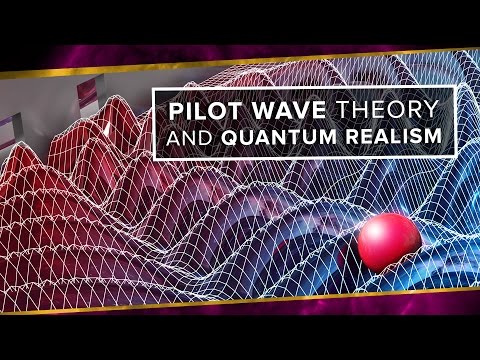
- Pilot Wave: Here comes the cool part! According to Bohm, there’s this “pilot wave” guiding particles along their paths. Imagine surfing—this wave pushes you along as you ride. That means particles aren’t floating aimlessly; they have direction!
- Nonlocality: Here’s another head-scratcher: nonlocality. This means that changes or actions in one place can instantly affect something far away without any physical connection between them—like magic! But don’t worry; it’s not as spooky as it sounds.
You know what got me hooked on this whole idea? A friend told me about how scientists can manipulate photons—not people but tiny packets of light—to test these theories. They set up these intricate experiments revealing connections between seemingly unrelated events with astonishing precision.
Bohm’s theory helps explain some odd results in experiments too, especially those involving entanglement—where two particles become linked in ways we still don’t fully grasp. Keep in mind that while traditional quantum mechanics focuses on probabilities and uncertainties, Bohm brings back some elements of determinism that many folks find comforting or intuitive.
The implications don’t stop at academic debates either; they reach into potential technologies! Think about how understanding these principles could impact fields like quantum computing or even cryptography one day!
If you’re curious about where things stand now with this theory in modern science: well, it’s still debated among physicists! Some swear by Bohm’s ideas for their elegance and coherence while others stick to mainstream interpretations for various reasons.
This lively dance between interpretations makes physics exciting—but also kinda confusing sometimes! So yeah, if you ever find yourself puzzled by the universe’s quirks—or want to impress your friends with your knowledge—you can dive deeper into Bohm and his fascinating contributions!
Exploring Bohm Quantum Theory: A Comprehensive Guide to Its Principles and Implications in Modern Science
Bohm Quantum Theory, also known as the de Broglie-Bohm theory, takes us on a fascinating ride through the world of quantum mechanics. It’s like stepping into a universe where things behave in ways that seem almost magical! So, what’s this all about?
At its core, this theory proposes that particles, like electrons, have definite positions and trajectories. You might be thinking, “Wait, I thought particles were just clouds of probability?” And you’re right! But Bohm’s approach gives them a more classic twist. Instead of being all fuzzy and uncertain, he introduces the idea that there’s a hidden layer behind the quantum veil.
One of the fascinating concepts here is the idea of pilot waves. Picture this: you’re surfing on waves in the ocean. The waves guide your movement, right? Similarly, in Bohm’s theory, these pilot waves guide particles along their paths. It’s not just randomness; there’s an underlying structure!
When it comes to implications, they’re pretty profound. For example:
- This theory offers an alternative way to look at quantum phenomena without diving headfirst into philosophical debates.
- It can potentially solve some puzzles in quantum mechanics like entanglement—where two particles seem connected even when separated by vast distances.
- Bohm’s ideas have even sparked discussions around topics like consciousness and free will in science.
So how does this relate to modern science? Well, think about your smartphone or computer. Quantum mechanics lies at their very heart. Scientists are always trying to understand it better because it opens doors to new technologies—like supercomputers or advanced materials.
An emotional side note: there was a moment when I first learned about Bohm’s ideas—it was like flipping a switch! Suddenly, I saw physics not just as numbers and equations but as stories waiting to be uncovered. It felt exhilarating!
But here’s the catch: while many find Bohm’s theory captivating for its clarity and determinism, others argue about its completeness compared to traditional interpretations of quantum mechanics—like the Copenhagen interpretation which leans heavily on probabilities.
In essence, de Broglie-Bohm theory nudges us toward questioning our classical understanding of reality while still juggling with those wild quantum antics. Isn’t it amazing how much curiosity drives science forward? Remember though—this conversation is ongoing! As we explore deeper into quantum physics’ weirdness and wonder, who knows what we’ll uncover next?
Understanding the De Broglie-Bohm Interpretation: A Comprehensive Guide to Quantum Mechanics
So, let’s talk about the De Broglie-Bohm interpretation of quantum mechanics. Sounds fancy, huh? But really, it’s just a different way to think about how tiny particles behave.
First off, you’ve probably heard of the famous wave-particle duality. Well, Louis de Broglie kicked things off by suggesting that particles like electrons have this wave-like nature. Think of it as if they’re doing a cha-cha dance all around us, not just zipping straight to their destinations.
Now, David Bohm took de Broglie’s ideas and ran with them in the 1950s. He came up with a model where these particles are guided by a wave function. This means that instead of just being random and chaotic at a subatomic level, there’s actually more structure to it all.
In this theory:
- Particles have definite positions all the time, unlike in other interpretations where they exist in multiple states until observed.
- The wave function is more than just a tool for predicting outcomes; it actively influences how particles move.
- This approach avoids some paradoxes found in traditional quantum mechanics by providing clearer trajectories for particles.
Here’s where it gets interesting: imagine tossing a pebble into a pond. The ripples spreading out represent the wave function. Now picture that pebble also having its own little path determined by those ripples as it moves through the water. In De Broglie-Bohm theory, every particle is like that pebble—affected by the waves around it while still having its own unique route.
But why does this matter? Well, many scientists feel that De Broglie-Bohm offers clearer answers to some of those pesky questions we have about quantum measurements and what reality looks like on such a small scale. Picture yourself peering through a foggy window; sometimes it seems chaotic out there. But with this interpretation, you might see outlines and paths clearer—a kind of roadmap for understanding what’s happening.
Now, don’t get me wrong; it’s not all sunshine and rainbows in this theory. Some folks think it’s too complicated or less practical compared to other views like Copenhagen or many-worlds interpretations. But hey, every theory has its pros and cons!
So next time you ponder the universe’s quirks at midnight (we’ve all been there), remember that De Broglie-Bohm gives us a fresh perspective on those tiny particles dancing around us—each one following its unique groove guided by elusive waves that we can only begin to comprehend! Isn’t science exciting?
So, let’s chat about this thing called the De Broglie-Bohm theory. It sounds all fancy and technical, but it’s really just one way to think about how particles behave in quantum physics. You know, that area of science that often makes our brains feel like they’re doing backflips?
Picture this: You’re at a beach, right? You toss a pebble into the water, and you watch those ripples spread out. Quantum particles are kind of like that pebble. They move differently than, say, a baseball rolling down a hill. Instead of being all predictable and straightforward, they can be in multiple places at once until you look at them. That’s where things get trippy!
Now, the De Broglie-Bohm theory steps in with its own perspective. It basically says that every particle has a definite position and velocity all the time—unlike the standard view where particles are more like waves of probability. So imagine if those ripples had tiny little boats riding along them! The theory suggests there’s an actual “guiding wave” leading particles around.
It was developed by Louis de Broglie way back in the 1920s and later expanded by David Bohm in the 1950s. What’s wild is how it offers a sort of “hidden variables” explanation for quantum mechanics; like when you’re playing hide-and-seek at night but have this super strong flashlight to help find everyone hiding under blankets.
Thinking back on it, I once attended this lecture where an enthusiastic professor illustrated quantum mechanics using puppets! Yes, puppets! They danced around representing probabilities and everything felt so chaotic—until we pulled on strings to control them a little bit better; that was essentially what Bohm’s theory aims to do with quantum mechanics.
The De Broglie-Bohm theory isn’t mainstream like its wave function counterpart—it’s kind of like that quirky uncle who shows up at family gatherings with bizarre stories nobody believes but secretly loves hearing him out! Some physicists think it’s an incomplete picture while others find it sheds light on the mysterious behavior of particles.
In essence, this whole topic reflects our struggle to understand reality itself. We’re trying to make sense of things that are just plain weird! But that’s science for ya; it’s all about questioning assumptions, exploring new ideas—even if some can be tough to swallow or seem bizarre at first glance.
So anyway, next time you think about tiny particles behaving all wacky and unpredictable, remember there are different theories out there trying to untangle that cosmic mess. And who knows? Maybe one day we’ll finally figure out what’s really going on behind the scenes!