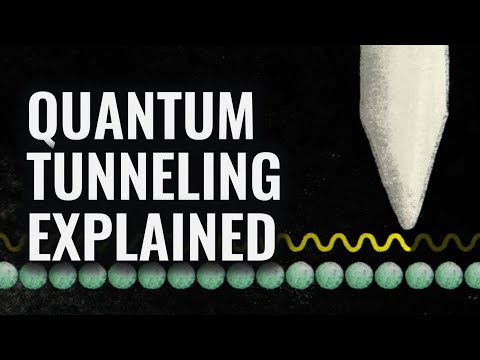
So, picture this: you’re at a party, and someone’s juggling. Suddenly, they drop a ball. But instead of hitting the floor, it just… vanishes! Poof! It’s like the universe said, “Nah, you’re good,” and made it hop over to the other side of the room. Sounds silly, right?
Well, that’s sort of how macroscopic quantum tunneling works. I mean, how weird is it that tiny particles can pull off some serious magic tricks? But when you take a closer look, this little phenomenon isn’t just for show—it’s got some wild implications for our everyday lives.
Imagine all that mind-bending stuff happening without us even noticing! It’s kind of like finding out your favorite movie has an alternate ending you’ve never seen. Curious? Let’s unpack this strange science together!
Exploring the Implications of Quantum Tunneling in Modern Science
Alright, let’s get into this wild ride called quantum tunneling. It sounds like something from a sci-fi movie, right? But it’s actually a super cool concept in quantum mechanics. Basically, it describes how particles can jump through energy barriers instead of bouncing off them. It’s like those weird dreams where you just fly over obstacles instead of climbing over them. Crazy, huh?
Now, you might be thinking: “What does that even mean for us?” Well, quantum tunneling has some major implications in the world of science. Here are some key points to chew on:
- Nuclear Fusion: This is how stars shine! In the core of stars, hydrogen atoms fuse together to form helium. They need to overcome a repulsive force between them due to their positive charges, but thanks to tunneling, they can sneak through that barrier and fuse together.
- Transistors: Remember when I said it’s used in modern tech? Yep! Little transistors in your gadgets are influenced by quantum tunneling effects. They allow your devices to run efficiently by switching on and off at remarkable speeds.
- Chemical Reactions: Tunneling plays a huge role in facilitating reactions at molecular levels. Certain reactions happen faster than expected because particles can tunnel through energy barriers instead of needing extra energy to climb over them.
You know what’s really mind-blowing? This isn’t just about tiny particles! Macroscopic Quantum Tunneling, which sounds all fancy, basically means this effect can potentially occur at larger scales—like we’re talking about objects you can see with your eyes! Imagine an elevator that could sometimes just tunnel through floors instead of stopping at each one. How nuts would that be?
The implications here could stretch far beyond our current understanding of physics. Think about new technologies that might emerge if we harness this behavior on a larger scale! Some researchers are even looking into how this could impact fields like computing, possibly leading us toward super-efficient quantum computers or new materials with unexpected properties.
But let me hit the brakes for a second and share an anecdote: I once heard about a physicist who was so excited about quantum tunneling that he set up an experiment using tiny particles trying to escape from a barrier he built for them. The moment he saw results showing practical evidence of tunneling made him jump up and down like a kid on Christmas morning! That joy in science is contagious; it’s moments like these that remind us how thrilling discoveries can be.
The bottom line is this: while quantum tunneling might sound abstract and philosophical, it has real-world applications and may change our technology landscape as we know it. So next time you hear about those teeny tiny particles taking the leap through barriers, remember—it’s more than just physics; it could very well shape our future!
Breakthrough in Physics: The 2025 Nobel Prize Awarded for Macroscopic Quantum Tunneling Explained
Macroscopic Quantum Tunneling sounds like something out of a sci-fi movie, right? But it’s real, and it’s pretty wild. You might know about quantum tunneling on a tiny scale, like how electrons can jump barriers they shouldn’t be able to cross. Well, imagine that happening with much larger objects. That’s macroscopic quantum tunneling!
So, what exactly is it? Basically, in this phenomenon, larger particles or even small objects manage to “tunnel” through energy barriers instead of going over them. It’s like you’re trying to get over a high fence but somehow find yourself on the other side without climbing. Weird, huh?
Scientists were super surprised when they first thought macroscopic tunneling might be possible. They used to think only tiny particles could do this kind of thing because the laws of physics seem so strict at larger scales—like gravity and friction kick in big-time as size increases. But researchers have shown that under certain conditions, larger entities can also pull off this trick.
The 2025 Nobel Prize in Physics being awarded for discoveries related to macroscopic quantum tunneling is quite ground-breaking! This recognition says a lot about how important this field is getting. You know how sometimes you hear about a new perspective that just changes everything? That’s what they’re saying here.
But let’s break down what this means practically for us:
- Quantum Technologies: Think about supercomputers or super-sensitive sensors that could revolutionize our tech world.
- Energy efficiency: Imagine batteries or engines that can work better thanks to principles from quantum mechanics.
- New Materials: We might create materials with unique properties by manipulating quantum processes; it’s like magic science!
You might be wondering why scientists are so stoked about this whole thing. Well, it opens up opportunities for new technologies we haven’t even dreamed up yet! Just like the way the invention of electricity changed everything from light bulbs to smartphones.
On a personal note—let me tell you—it reminds me of the excitement I felt back in school when we’d learn about groundbreaking theories and discoveries. One time, during an experiment with models of atoms, I was baffled by how strange and counterintuitive these concepts were. And now here we are talking about large objects doing crazy things like tunneling!
So yeah, macroscopic quantum tunneling isn’t just an academic curiosity; it could change everyday technology as we know it! Keep your eyes peeled because there will definitely be more surprises coming our way as scientists dive deeper into this mystery!
Exploring Macroscopic Quantum Effects: Insights into Quantum Physics and Its Impact on Science
So, macroscopic quantum effects, huh? It sounds super fancy, but it really just boils down to how the weird, mind-bending world of quantum physics shows up in our big, everyday world. Most of us think of quantum physics as something that happens at the teeny-tiny level—like with atoms and particles. But what’s totally wild is that these strange behaviors can actually pop up on a larger scale!
One of the coolest examples of this is **macroscopic quantum tunneling**. Imagine you’re climbing a hill; you know you have to get over the top to keep going. But in the quantum world, particles can actually “tunnel” through the hill instead of climbing over it. It’s like *magic*, right? You follow me?
When we talk about **quantum tunneling** on a macroscopic scale, it means we’re focusing on larger systems where this phenomenon can be observed. Like, consider a superconductor—a material that can conduct electricity without resistance when cooled down to extremely low temperatures. These materials rely heavily on quantum effects to function properly.
Now let’s break this down further:
- Superconductivity: In superconductors, electrons form pairs (called Cooper pairs) and move together in such a way that they can tunnel through energy barriers. This leads to zero electrical resistance.
- Quantum Coherence: Think about it; in these systems, particles can exist in multiple states at once! It’s like having your cake and being able to eat it too.
- Applications: The implications are huge! Quantum tunneling is key for things like **quantum computers**, which could revolutionize how we process information.
And here’s where it gets emotional for me: I remember reading about how researchers observed macroscopic quantum tunneling in small magnets or even tiny mechanical systems. They’ve created setups that let them see these effects happening in real time! There’s something mind-blowing about realizing that all those strange theories we learned back in school are not just some abstract ideas—they’re reflected in actual physical phenomena!
The thing is, exploring these effects isn’t only a nerdy pursuit; it’s shaping the future of technology and science. From developing better batteries to improving medical imaging techniques and even understanding fundamental physics better—when we grasp what’s happening at both small and large scales, we’re opening doors for innovation.
Overall, macroscopic quantum effects might sound complex or abstract at first, but they really reflect nature’s quirks showing up when we look closely enough. And who knows? As scientists keep diving deeper into this rabbit hole (*or should I say wormhole*?), who knows what other surprises await us? Isn’t that part of what makes science so incredibly exciting?
Alright, so let’s chat about this mind-bending thing called macroscopic quantum tunneling. Sounds fancy, right? But here’s the deal: it’s like a magic trick that happens at the quantum level—think teeny tiny particles hopping through barriers they shouldn’t logically be able to cross. Picture a ball rolling up a hill. Normally, if it doesn’t have enough energy, it just rolls back down, right? But in the quantum world, there’s this weirdness where sometimes it just appears on the other side of the hill without ever having climbed over. Like, what?!
You might be wondering why we care about this quirky phenomenon. Well, it has some seriously surprising implications for stuff we use every day! For instance, think about how our smartphones work. They rely on these principles at their core—way down in those tiny circuits and semiconductors. So when you’re scrolling through your Insta feed or sending those selfies, you’re actually riding a wave of quantum effects!
I remember once when I was teaching some kids about energy states and how things can be both particles and waves. You could see them light up with curiosity, especially when they grasped that something could be “here” and “there” at the same time! I mean, who wouldn’t geek out over that? It’s like explaining how dreams can feel so real but just vanish into thin air when you wake up.
But here comes another kicker: research suggests that macroscopic quantum tunneling could even play a role in processes like photosynthesis or even our own brains! The idea that our thoughts might have roots in something so bizarre is kind of wild to think about if you ask me. Like there’s this dance of particles happening under the surface while we’re just going about our daily lives.
And hey, while this whole concept might seem abstract or detached from reality at first glance, it really connects us on a fundamental level with everything around us—how we process information and interact with nature. It’s all tied together in this unexpected way.
So yeah, next time you’re holding your phone or enjoying some sunshine outside, just give a moment to acknowledge those quirky little particles doing their thing and remember there’s a whole universe of strange phenomena under our noses! It’s incredible to think how much is happening beneath the surface while we go about living our lives—all thanks to something as odd as quantum tunneling!