You know that moment when you’re binge-watching your favorite show, and you just can’t help but talk back to the screen? Like, “No way that character would do that!” or “Come on, that’s so predictable!” Well, in statistics, we kinda do the same thing when we analyze data. We’re constantly questioning if our models are really making sense or if they’re just throwing surprises at us.
Think about regression. It’s like trying to draw a line through a messy pile of points on a graph. Sometimes those points can be best buddies hanging out together, while other times they look as clueless as a cat at a dog park. That’s where the Durbin-Watson Test comes into play! It’s like your trusty sidekick, helping to figure out if these data points are behaving independently or plotting some sneaky conspiracy behind your back.
So let’s chat about why this test is super handy in keeping our regression analysis from turning into chaos. Seriously, it’s a game changer!
Interpreting the Durbin-Watson Statistic in Regression Analysis: A Comprehensive Guide for Scientific Research
When you’re diving into regression analysis, you come across a lot of different statistics. One of the ones that might make you scratch your head is the Durbin-Watson statistic. This little gem is super useful for checking if the residuals of your regression model are independent. So, what does that mean? Well, let’s break it down!
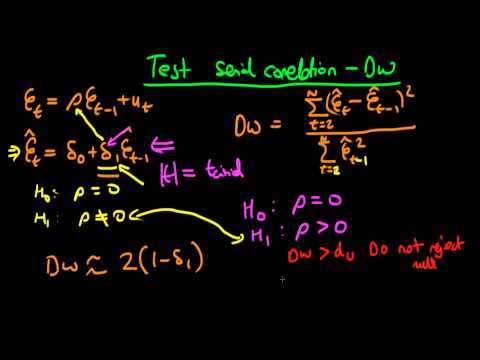
The Durbin-Watson statistic, which we often abbreviate as D-W, ranges from 0 to 4. Ideally, you want a value close to 2. Here’s why:
- D-W = 2: This indicates that there’s no autocorrelation, meaning your residuals aren’t correlated.
- D-W : A value below 2 suggests positive autocorrelation. In simpler terms, it means that if one residual is high, the next one is likely to be high too.
- D-W > 2: Conversely, if it’s above 2, that’s indicative of negative autocorrelation. So here, if a residual is high, the following one might be low.
You might be wondering why all this matters. Let’s say you’re looking at how factors like study hours and sleep affect exam scores (you know, a typical college scenario). If there’s positive autocorrelation in your residuals, it could signal that things are not working independently—maybe students who studied a lot also had similar sleep patterns. This could screw up your results!
Keep in mind though; the D-W test isn’t perfect. It has its limitations. For instance:
- If your sample size is small (like under 30), interpreting D-W can get tricky.
- It doesn’t work well with non-linear models or when you use dummy variables extensively.
Now here’s a little story: I once had a buddy who was doing his thesis on willpower and procrastination’s effect on grades—super relevant stuff! He was analyzing some data and got a D-W score of around 1.5. I mean, he was excited but kind of worried too! Turns out his results indicated positive autocorrelation among his data points. After some adjustments and re-evaluations of how he analyzed his data (and maybe some late-night pizza), he got to understand just how vital independence among those points really was for drawing valid conclusions.
In practice, after calculating the D-W score from your regression output (most software gives this automatically), what do you do next? First off:
- If you’re finding a value around that sweet spot (close to 2), great job! Your model seems solid.
- If it’s straying from 2 significantly (3), it may be time to rethink your model or take corrective actions like adding more variables or reconsidering how you’re measuring things.
To sum it up: understanding the Durbin-Watson statistic can give you insight into how reliable your regression analysis is in terms of independence among errors. Missing out on this could lead you down murky waters when interpreting results—and nobody wants that!
Essential Methods for Testing Independence Assumptions in Regression Analysis within Scientific Research
Well, let’s chat about something that might sound a bit dry at first: regression analysis and, more specifically, testing independence assumptions. You know, it’s one of those crucial bits in scientific research that can really determine whether your results make sense or not.
So, when you’re running a regression analysis, you want to make sure that your data points are independent from one another. If they’re not, you could end up with all sorts of misleading conclusions. That’s where methods like the Durbin-Watson test come in.
Now, the Durbin-Watson test is primarily used to detect autocorrelation in the residuals of a regression model. Autocorrelation occurs when the residuals—that’s just the difference between what your model predicts and what actually happens—are related to each other. It’s like if you went to your favorite coffee shop every morning and found out that the barista knew exactly how much foam you liked on your latte because they remembered your order from yesterday! The test checks for this kind of relationship between errors.
How does it work? Basically, it calculates a statistic ranging from 0 to 4. A value around 2 suggests no autocorrelation—you’re good! A value less than 2 hints at positive autocorrelation (errors are likely following each other), while a value greater than 2 indicates negative autocorrelation (errors are kind of bouncing around). It’s pretty straightforward once you get the hang of it!
But here’s why it matters: if your residuals have autocorrelation, your estimates might not be reliable; predictions could be off too. In practical terms, think about a study aiming to predict housing prices based on certain factors like location and size. If those observations aren’t independent due to some hidden factors affecting multiple houses similarly, you’ll get skewed results.
Here are
to keep in mind regarding testing independence in regression:
So yeah, testing for independence isn’t just an academic exercise; it’s foundational for ensuring that what you find is valid and meaningful. Getting these elements right helps carry forward trustworthy research findings that everyone—from scientists to policy makers—can rely on without second-guessing themselves too much.
Keep these methods close; they’ll save you headaches down the road! Understanding how dependencies mess with data can strengthen your analysis and those meaningful insights you’re striving for. That way, you won’t just crunch numbers—you’ll really get what they’re telling you!
Understanding the Durbin-Watson Test: Assessing Independence of Residuals in Statistical Analysis
Alright, so let’s chat about the Durbin-Watson test. It’s a statistical tool that’s super helpful for checking something pretty important in regression analysis: the independence of residuals. You know, those leftover errors that hang around after we’ve tried to model our data.
First off, what even are residuals? Well, when you make predictions with a regression model, there’s usually a gap between your predicted values and what you actually observe. This gap is called a residual. If your model is doing its job right, these residuals should basically behave randomly. If they don’t? That’s where things can get tricky.
The Durbin-Watson test helps us figure out if there’s some kind of pattern going on in those residuals. So here’s the deal: the test produces a statistic that ranges from 0 to 4.
- If it’s around 2, you’re in good shape! It suggests there’s no correlation between consecutive residuals.
- If it’s less than 2, it may indicate positive autocorrelation—like if one error tends to follow another. Think of it as your errors being buddies!
- If it’s more than 2, this hints at negative autocorrelation—where an error might be followed by something opposite.
Now let me tell ya about my buddy Tom. He was analyzing some sales data to forecast future sales for his café. After running his regression model on past sales figures, he got all excited about making his predictions. But then—boom! He remembered hearing about the Durbin-Watson test and thought he’d better check those pesky residuals.
After crunching some numbers, he found his Durbin-Watson statistic was below 1.5! Yikes! This meant his model had positive autocorrelation happening in the residuals. Basically, he learned that if one week of sales was high or low, chances were the next week’d probably be similar and not random at all.
This finding led him to tweak his model a bit more seriously before using it for any big decisions. The Durbin-Watson test wasn’t just some random number—it helped him avoid making predictions based on flawed assumptions!
The key takeaway? The Durbin-Watson test is super useful when you’re handling regression analysis and want to ensure your models are reliable by examining how independent those leftover errors really are. Always remember this little gem can save you from making misguided choices based on funky patterns in your data!
Alright, so you know when you’re trying to figure out if two things are related? Like, say, how much sleep you get and how cranky you feel the next day? That’s kind of what regression analysis is all about—it’s like this nifty way to see how one thing might predict another. But here’s the twist: sometimes, the data can be a bit sneaky. You might think the relationship is solid… but what if there’s something else going on behind the scenes?
Enter the Durbin-Watson test. This little gem helps us check for independence in regression models. Basically, it looks at whether your residuals—those leftover bits after your model makes its predictions—are hanging out together in a way they shouldn’t be. Imagine throwing a party where every guest is supposed to mingle freely, but instead, they’re all clustered in one corner whispering secrets. Yup, that’s what we’re trying to avoid.
If I’m being honest, I remember sitting through stats class and thinking this stuff was like watching paint dry. And then one day it hit me! It’s not just numbers—it’s about real life. Like that time I did a project on people’s exercise habits during lockdowns (so many Netflix binges!). My initial analysis showed some interesting trends, but as I dove deeper into the data with tools like Durbin-Watson, I realized there were patterns lurking that could totally skew my results.
You start with a hypothesis—or what you think might happen—and then use regression to see if you’re right. But if those residuals are correlated, it could mean you’re cooking up some faulty conclusions. And let me tell you, nobody wants to end up saying that sleeping less makes people happier just because they didn’t double-check their data!
So yeah, while it might seem like just another statistical test at first glance, understanding independence and using tools like the Durbin-Watson test can really sharpen your insights and ensure you’re not chasing shadows in your analysis. It takes practice and patience for sure; sometimes those tests can feel complex and intimidating—but once you get through it? What an eye-opener! You’ll find yourself thinking more critically than ever about the stories those numbers have to tell!