So, picture this: you’re at a party, right? And there’s this super weird couple — they finish each other’s sentences, laugh at jokes no one else gets, and seem totally in sync. You might think they’ve got some telepathic thing going on. Now, imagine if that were happening not just between people but between particles in the universe.
Yeah, I’m talking about quantum entanglement. It’s like a cosmic dance-off where tiny particles are connected in ways that even Einstein thought sounded bonkers. Seriously, he once said it was “spooky action at a distance.” And he wasn’t just being dramatic!
This whole mind-bending concept comes from something called the Einstein-Podolsky-Rosen (EPR) paper. It’s like the ultimate science mystery novel—filled with twists and turns that’ll leave you scratching your head and pondering life itself. So let’s untangle this enigma together. Ready?
Exploring the Einstein-Rosen-Podolsky Paradox: Unraveling the Mysteries of Quantum Entanglement in Science
Alright, let’s chat about the Einstein-Rosen-Podolsky Paradox and, more specifically, the mind-boggling idea of quantum entanglement. Sounds fancy, huh? But don’t worry; I’m here to break it down in a way that makes sense.
So, back in 1935, three brilliant minds—Albert Einstein, Boris Podolsky, and Nathan Rosen—came up with a thought experiment to challenge the accepted understanding of quantum mechanics. They wanted to show that if quantum mechanics was complete (which it seems to be), then it would imply some really strange things about the universe that just didn’t sit well with them. They basically said there must be something missing from our understanding of physics.
At the core of this is **quantum entanglement**. Imagine you have two particles that are somehow connected in a way that the state of one instantly affects the state of the other—no matter how far apart they are. It’s like having twin magic dice: if you roll one and it lands on a six, the other one instantly shows six too—even if it’s light-years away! It’s pretty wild.
Now here’s where it gets tricky. According to quantum mechanics, once these particles are entangled, measuring one immediately gives you information about the other. This leads to what Einstein called “spooky action at a distance.” He wasn’t having any of that! It felt too weird for him. After all, he believed everything in nature should have some reason behind it—a nice little cause-and-effect chain.
To put this into perspective—you know when you’re chatting with someone on the phone and even though they’re miles away, you feel like you’re right there? That’s sort of how entangled particles behave. They share an instant connection regardless of distance. Crazy stuff!
Furthermore, researchers later proved that this phenomenon isn’t just theoretical; it’s been observed in experiments time and again. For example, scientists at various labs have conducted experiments using pairs of photons (particles of light), confirming that when one photon is altered or measured, its partner reacts in tandem immediately—even when separated by vast distances.
Now let’s get back to our trio from 1935: they suggested this paradox might indicate limits in quantum mechanics itself or perhaps something more profound about reality’s fabric—maybe even hints at hidden variables we don’t yet see (like secret codes governing their behavior). But over time and through various experiments like those done by Alain Aspect in the 1980s—the evidence leaned heavily toward accepting entanglement as a core part of quantum mechanics without needing hidden variables.
So why does all this matter? Well, besides leaving your head spinning with awe (which is certainly a bonus!), these concepts have deep implications for technology today! Quantum entanglement forms the backbone for emerging fields like quantum computing and secure communications (think super encrypted messages).
In conclusion—and believe me when I say this is just scratching the surface—the Einstein-Rosen-Podolsky Paradox has opened doors to understanding not only quantum mechanics but also fundamentally questions our view of reality itself. Just goes to show how much there still is left to explore!
And if you’ve ever felt overwhelmed by science? Don’t worry; we’re all on this journey together unraveling these mysteries step by step!
Unraveling the Mystery of Quantum Entanglement: Insights into Quantum Physics and its Implications
Alright, let’s talk about something really cool and, honestly, a bit mind-bending: quantum entanglement. This is one of those topics where you might feel like you’re diving into a sci-fi movie plot, but I promise it’s real science!
So, here’s the deal: quantum entanglement is a phenomenon that occurs when pairs or groups of particles become linked together in such a way that the state of one particle instantly influences the state of another, no matter how far apart they are. Weird, huh? You can think of it as two best buddies who always know what the other is thinking, even if one is on Earth and the other on Mars.
This concept really started making waves back in 1935 when Einstein, Podolsky, and Rosen (yes, that Einstein!) published a paper that raised some eyebrows. They thought **quantum mechanics** was incomplete because of how strange this linked behavior seemed. They called this weirdness “spooky action at a distance.” So basically, they were like: “Hey, if particles are connected like this over distances that make no sense to us humans, then something must be missing from our understanding.”
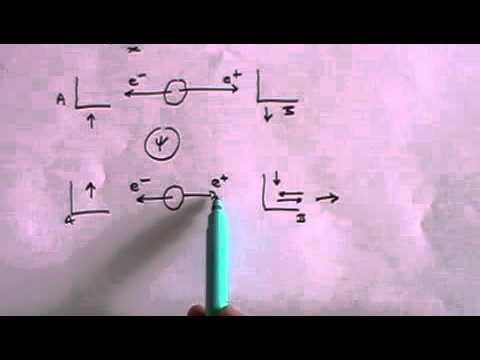
Now let’s break it down a bit. When you have two entangled particles and you measure one of them—let’s say it’s spinning in some direction—you immediately know the spin direction of the other one. Even if that second particle is light-years away! It feels like magic but actually points to some deep truths about reality.
You might be wondering: why does this matter? Great question! Here are a few implications:
- Quantum Computing: Entangled particles can help create super-fast computers by allowing them to process vast amounts of information simultaneously.
- Quantum Cryptography: It could lead to ultra-secure communication channels because any attempt to eavesdrop on the communication would disturb the entangled state and raise red flags.
- Tests of Reality: Entanglement challenges our understanding of reality itself. It raises questions about locality (the idea that objects are only influenced by their immediate surroundings) and how we define information transfer.
There’s even been some real-world testing done! Scientists performed Bell’s theorem experiments that showed entangled particles really do behave as predicted by quantum mechanics. This means Einstein might have been wrong when he thought there was something amiss.
One time I read about researchers using entangled photons for teleportation experiments—yes, teleportation! They weren’t zapping people into space or anything wild like that; instead it was all about transferring information across distances without moving any physical particle from point A to point B.
But let me tell you—it gets even trickier. The thing is, while we observe these particles acting instantaneously—almost as if they’re communicating faster than light—we can’t use it to send messages faster than light or travel through time (sorry!). It’s more about correlation rather than actual transmission.
In short, quantum entanglement flips many assumptions we have about nature and our universe upside down. It blends physics with philosophy in ways that make your head spin. And who knows what else we’ll discover next? All I know is it’s an exciting time to be nibbling at these cosmic mysteries! So keep your curiosity alive—it’s super important!
Exploring the Einstein-Podolsky-Rosen Paradox: A Comprehensive PDF Guide for Physics Enthusiasts
Okay, let’s talk about something that sounds super complicated but is honestly just mind-blowing once you break it down: the Einstein-Podolsky-Rosen (EPR) Paradox. You’ve probably heard of it if you’re even a bit into physics or curious about the weirdness of quantum mechanics.
This whole thing kicks off back in 1935 when Einstein, Podolsky, and Rosen published a paper that basically posed some serious questions about quantum mechanics. They were trying to highlight what they thought were flaws in the theory. So, what’s their deal? They used a concept called quantum entanglement to show that if quantum mechanics was right, then particles could be connected in ways that seemed totally nuts.
Quantum Entanglement: Alright, imagine you have two particles, let’s call them A and B. If these two particles become entangled, whatever happens to particle A instantly affects particle B—even if they’re light years apart! This spooky action at a distance made Einstein go “no way,” and he famously called it “spooky action at a distance.” He believed there should be hidden variables explaining this.
So here’s how EPR played out:
Now, don’t get me wrong; EPR sparked loads of discussions and debates among physicists. There were serious implications here for how we understand our universe. What really hits home is how this weirdness challenges our conventional ideas of reality.
To put this into perspective: think of your favorite pair of shoes—common but comfy. Now imagine those shoes are your reliable old friends who always know how you feel no matter the distance apart from each other! It’s kind of like that: they’re connected somehow in a way we can’t see.
Fast forward to today—scientists have done tons of experiments around EPR and entanglement, showing over and over again that the connections between entangled particles really do seem to defy our classic intuition about space and time! Researchers continue to delve into this paradox because it holds potential clues for future technologies like quantum computing and quantum cryptography. It’s still a huge deal in physics!
So yeah, even if Einstein thought he was proving quantum mechanics wrong with the EPR paper, many would argue he just opened up a whole new box of questions—proving once more that in science, things aren’t always crystal clear!
You know, I was sitting the other day thinking about Einstein and all those wild ideas he threw around. He’s like the poster child for brilliant minds, right? But one of his lesser-known contributions is super interesting: the Einstein-Podolsky-Rosen paper. It’s all about quantum entanglement, which sounds fancy but boils down to some really strange behavior of particles.
So, picture this: you’ve got two particles that are linked in such a way that what happens to one instantly affects the other, no matter how far apart they are. They could be sitting right next to each other or on opposite ends of the universe! It’s like having twin buddies who can finish each other’s sentences even when they’re miles away from each other. Seriously, how does that even work?
Einstein and his pals raised their eyebrows at this concept. They thought it was a bit too “spooky,” as he put it. Like, how can these particles communicate so quickly? It’s almost as if they have a secret handshake or something we just can’t see. In their famous paper from 1935, they were questioning if quantum mechanics really captured the whole picture of reality or if there was more to discover.
I remember once watching a science documentary about entanglement while sipping my coffee—totally lost track of time! They showed this experiment where scientists managed to entangle photons (that’s just light particles). I mean, it blew my mind! You’d do something to one photon here on Earth, and then bam! The other one somewhere far away would react like it had just received a text message. How cool is that?
And get this: even though we can describe what happens when these particles interact and compute probabilities with impressive accuracy, nobody really knows why they do it or how they stay connected across distances like that. It’s a mystery wrapped in an enigma—kind of poetic if you think about it.
In many ways, quantum entanglement challenges our understanding of space and time. It’s like trying to explain love; you can describe behaviors but can’t quite nail down why or how it feels so profound. Makes you wonder what else is out there waiting for us to grasp someday!
The universe has all these hidden connections we’re only starting to scratch the surface of. So yeah, next time you’re staring at the night sky feeling small and insignificant, remember: there might be pairs of entangled particles dancing around out there—just making their cosmic connections without us even knowing it! Pretty wild stuff.