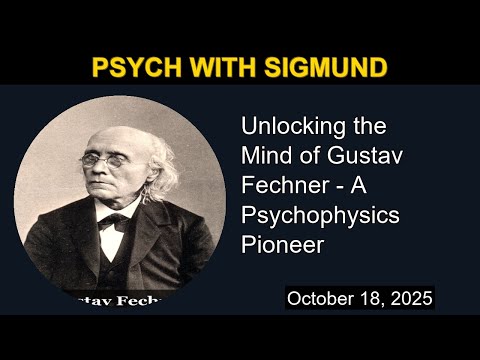
You know that moment when you eat a slice of pizza, and the intense flavor just blows your mind? Well, Gustav Fechner was kind of like that for psychology. Seriously!
Back in the 19th century, he was sitting there thinking about how we perceive the world around us. It’s wild to think how one guy could spark a whole field. You see, before Fechner, psychology wasn’t really taken seriously, and he kinda flipped that script.
Imagine trying to measure feelings and sensations like they’re squishy little marshmallows—how do you even do that? Well, Fechner found a way! He laid down some serious groundwork for what we now call modern psychology.
So let’s dive into his life and work; it’s a journey worth taking!
Exploring the Scientific Contributions of Gustav Fechner: Foundations of Psychophysics and Beyond
Gustav Fechner was one of those mind-bending thinkers who laid down some serious groundwork for psychology. Born in 1801, he started off as a physicist but found himself digging into the mysteries of the human mind. You see, Fechner believed that there was a bridge between the physical world and our mental experiences—the kind of stuff that would eventually lead to what we call **psychophysics**.
Psychophysics is basically about understanding how we perceive different stimuli, like light and sound. To put it simply, Fechner wanted to figure out how physical changes in the environment influence our senses and feelings. He’s like the guy who said, “Hey, let’s measure our feelings!” This was totally new back then!
One of his key contributions was something called the Weber-Fechner Law. This law states that the sensation you experience from a stimulus is proportional to the logarithm of its intensity. Imagine you’re at a concert; if the music’s at a low volume and suddenly gets cranked up a bit, you’ll notice that change more than if it were already blasting your eardrums out! It’s pretty mind-blowing how he quantified this relationship.
Fechner also introduced methods to measure sensation directly. He used techniques like **absolute thresholds** and **difference thresholds** to determine how much stimulus has to change before we notice it. It’s like trying to figure out when your friend changes their cologne—there’s a point where it goes from “I can’t smell anything” to “Whoa, what’s that smell?”
But it’s not just about measuring things. Fechner had this belief in the unity of body and soul, which meant he thought that our mental experiences were linked directly to our physical senses—an idea way ahead of its time! He argued that by studying sensations quantitatively, we could understand consciousness itself.
Another cool thing about Fechner is his pioneering work on experimental psychology. This laid down methods that researchers still use today! Like using controlled experiments where variables are manipulated to see how they affect responses. That’s something crucial in modern psychology—you know?
And then there are his writings! His book *Elemente der Psychophysik* published in 1860 isn’t just some dusty tome; it’s considered one of the foundational texts for psychology and psychophysics! Reading it can feel like diving into an ocean of thoughts; it might be tricky now since language has evolved so much but you’ll catch some really interesting ideas there.
As time passed, Fechner’s ideas didn’t just hang around in dusty old books. They influenced waves of psychologists after him—think figures like Wilhelm Wundt and even Sigmund Freud later on. His work has shown us how much science can connect with philosophy and consciousness—a huge deal even today!
So yeah, Gustav Fechner wasn’t just stirring up trouble with numbers; he was opening doors for understanding what makes us tick as humans. If you think about all those times you experience something—grabbing ice cream or hearing your favorite song—Fechner reminds us there’s more behind those feelings than meets the eye!
Understanding Fechner’s Principle: Foundations and Applications in Science
Fechner’s Principle, you know, is a cornerstone in understanding how we perceive the world around us. It all started with Gustav Fechner, a German psychologist and philosopher who really shook things up back in the 19th century. He’s often referred to as one of the founders of modern psychology.
Fechner’s big idea was about **psychophysics**, which is a fancy term for studying how our minds interpret physical sensations. Basically, he wanted to link the physical world with our mental experiences. So, how do we get from sounds and lights to feelings and perceptions? That’s what he aimed to figure out.
One of his key contributions was what’s known as Fechner’s Law. This law suggests a relationship between the intensity of a stimulus (like light or sound) and our perception of that stimulus. He proposed that our perception does not change linearly as the intensity of the stimulus increases. Instead, it follows a logarithmic scale. What that means is if you double the brightness of a light, you might not perceive it as being twice as bright—more like 10 times brighter instead!
So why does this matter? Well, think about it: ever walked into a dark room and then flicked on the light? At first, it feels super bright! But after a while, your eyes adjust and it doesn’t seem so intense anymore. Fechner helped explain this phenomenon.
Now let’s break down some key points about his principle:
- Perception vs. Reality: It highlights how our sensations can differ from actual stimuli.
- Application in Psychology: His work laid the groundwork for experimental psychology; people began studying sensory experiences systematically.
- Modern Relevance: Today, Fechner’s ideas still influence areas like marketing and product design—think about how companies use lighting in stores.
- Sensory Adaptation: His principles help explain why you no longer notice smells after being in a room for too long.
Fechner didn’t just stop at theory; he also created methods for measurement that are still used today! His research paved the way for others like Wilhelm Wundt—who you might know as the father of experimental psychology—to further explore human consciousness.
Just imagine: picture yourself at an amusement park. You hop onto a ride that’s supposed to be thrilling; right before it starts spinning like crazy, your heart races in anticipation! That’s your mind playing tricks with your senses—a classic example of Fechner’s insights into perception.
So next time you’re dazzled by bright lights or caught off guard by sudden sounds, remember Gustav Fechner! He’s behind much of what we now understand about sensation and perception—and trust me, it’s way cooler than it sounds!
Understanding Gustav Fechner: Key Contributions to AP Psychology and the Science of Perception
Gustav Fechner is one of those names that pops up when you’re studying psychology, especially in AP Psychology. He played a huge role in developing our understanding of perception and the connections between physical stimuli and what we actually perceive. So, let’s break down some of his key contributions that make him such a pivotal figure.
Fechner was born in 1801 in Germany and had this wild mix of interests, from philosophy to physics. But what really set him off on his path was his fascination with how we sense the world around us. You might say he was kind of ahead of his time, thinking about stuff like how light and sound were perceived way before it became mainstream psychology.
One major contribution from Fechner is known as **psychophysics**. Basically, he wanted to study the relationship between physical stimuli (like light or sound) and our psychological experiences (what we perceive). Imagine you’re in a quiet room and someone softly whispers your name. At what point can you actually hear it? That’s psychophysics!
Fechner introduced formulas that help explain this relationship. One of these is called the just noticeable difference (JND). This concept tells us how much something has to change for us to notice that change at all. For example, if you have a light dimmer switch and you turn it slightly, you might not notice until it’s turned down quite a bit. Fechner figured out this kind of stuff could be measured!
In addition to JND, there’s another important concept called the **Weber-Fechner Law**. This connects the JND idea with actual measurement scales, meaning if you want to know how much brighter a light has to be for someone to notice, there’s a predictable ratio involved. It’s sort of like saying if you increase the volume on your music just enough compared to its current level, you’ll definitely hear it better.
Another cool thing about Fechner is his interests weren’t just academic; they were also heavily intertwined with philosophy and spirituality! He believed that consciousness was something that could be measured and understood in scientific terms, which was kind of revolutionary back then.
Fechner also emphasized introspection, where people reflect on their own experiences—kind of like self-reporting your feelings or thoughts about an experience. This method became crucial in psychology later on since it laid groundwork for understanding human experience from within.
In summary, Gustav Fechner wasn’t just messing around; he was laying down big ideas that would shape modern psychology—especially when talking about perception! Through psychophysics, concepts like just noticeable differences, the Weber-Fechner Law, and introspection methods have helped connect dots between science and how we feel or perceive our world today.
So next time someone mentions Gustav Fechner in class or during your studies, remember he’s more than just a name on a test; he helped us figure out how we see and hear things—literally changing the way we understand ourselves!
You know, when you think about the roots of psychology, it’s pretty wild to realize how many of our ideas today can be traced back to people like Gustav Fechner. This guy was operating in the 19th century, and he was like a bridge between philosophy and the hard sciences. Seriously, imagine being in his shoes – trying to figure out not just how the world works, but how our minds perceive it all!
Fechner was really curious about how we experience sensations, and he wanted to put some numbers behind our feelings. It’s almost charming how he went about it—he wasn’t satisfied with just observing; he needed to measure stuff! You could say he was one of the first people trying to quantify experiences that most folks would think were too fuzzy for math. His work laid down some foundational concepts, like the idea that our perception of stimuli doesn’t increase linearly with their intensity. Instead, it follows more of a logarithmic scale, which is really just a fancy way of saying that as things get super intense, our sensitivity doesn’t ramp up at the same rate.
I remember reading an old letter from Fechner where he described this deep sense of connection between the mind and body. You could feel the passion, you know? He totally believed that psychology could be studied scientifically. Back then, this wasn’t exactly a popular opinion; many thought psychology was more about philosophy or speculation than actual research. But Fechner stuck to his guns and helped pave new paths.
What’s also fascinating is how Fechner managed to blend this scientific rigor with a bit of spirituality. Like many thinkers back then, he had this sense of wonder about life and nature—as if understanding ourselves scientifically brings us closer to something greater than ourselves. It reminds me of those conversations you have late at night with friends where you dive into deep questions about existence; Fechner basically formalized those musings into something measurable.
His pioneering spirit is inspiring! He might not be a household name today—let’s be honest; most people probably don’t even know who he is—but without him pushing boundaries back then, modern psychology might look pretty different now. So next time you’re pondering why things feel a certain way or measuring your own experiences through countless apps and surveys today, take a moment to appreciate old Gustav and his quest for understanding what makes us tick—even if some folks thought he was just absolutely nuts at the time!