You know that moment when you’re checking your phone and see a video of a cat trying to fit into a tiny box? It’s hilarious, but also kind of a good analogy for life. Some things just don’t fit neatly into the boxes we want.
So, what if I told you that in science, there are these two cool concepts called mean and standard deviation that help us understand how things really work? For real! They’re like the secret sauce behind all those graphs and data points.
When researchers gather info, they need to figure out what the average is—like, how tall people are at a party—and then how much variation there is from that average. This tells us if everyone’s pretty similar or if we’ve got some serious outliers going on.
Don’t worry; it’s not as complicated as it sounds! Let’s chat about these ideas, and trust me, you’ll be impressing your friends with your newfound knowledge in no time!
Understanding the Role of Mean and Standard Deviation in Scientific Research: Essential Tools for Data Analysis
Understanding the Role of Mean and Standard Deviation in Scientific Research
So, let’s break down these two super important concepts: the mean and standard deviation. Think of them as your trusty sidekicks in the world of data analysis. They help you figure out what’s going on with your data set, which is essential in any scientific research.
First up, the mean. The mean is basically the average of a set of numbers. To find it, you just add up all the values and then divide by how many there are. Say you have five test scores: 80, 85, 90, 95, and 100. You’d add those up to get 450 and then divide by 5. So the mean score would be 90. It gives you a nice snapshot of where most of your data points are hanging out.
But don’t forget about standard deviation! It tells you how spread out those numbers are from the mean. Like, if everyone scored close to that average score of 90, you’d have a small standard deviation. But if some people scored really low and others scored super high, then—boom—the standard deviation gets bigger! This helps you understand consistency in your data.
Here’s how it all plays out in research:
- Mean: If you’re studying plant growth under different light conditions, knowing that one group has an average height of 20 cm helps establish a baseline.
- Standard Deviation: If that same group has a low standard deviation (let’s say 2 cm), it means most plants grew pretty uniformly around that height. High standard deviation? Maybe some plants didn’t thrive at all.
- Comparing Groups: When comparing two different groups—like plants under sunlight vs. fluorescent light—you can use means to see which one grows better but also check the standard deviations to know how consistent those results are.
- Affecting Decisions: In drug trials, understanding both the mean effectiveness and variability can help decide if a new medicine is reliable enough for public use.
Getting into some emotional territory here—imagine working on a big experiment for months or even years only to find out that your results were inconsistent due to high variability! That can be pretty disheartening. So knowing how to calculate these things can save researchers a lot of headaches.
Sometimes researchers even hit roadblocks due to misunderstanding these concepts. For instance, if they focus only on means without considering standard deviations during their analyses, they risk drawing incorrect conclusions about their findings.
In summary, both mean and standard deviation are essential tools for scientists navigating all kinds of data sets—from biology experiments to social sciences studies. With this duo at your side, you’ll be able to present findings clearly while ensuring no important details slip through the cracks! So when you’re sifting through numbers next time—remember these concepts have got your back!
Understanding Standard Deviation: Its Role and Significance in Scientific Research Studies
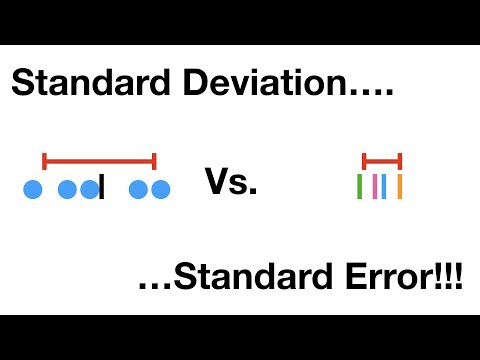
Standard deviation, you know, it’s one of those fancy terms we hear a lot in science and stats. But what does it really mean? Basically, it’s a measure of how spread out your data is from the average, or mean. Think of it as a way to see how much variety exists in a set of numbers.
When you’re studying something—like the height of eighth graders in a school—just knowing their average height doesn’t tell you the whole story. If everyone’s around that average, you’d have a small standard deviation. But if some kids are really tall and others are quite short, that means there’s more variety, resulting in a larger standard deviation. So, it helps you get the bigger picture.
Why is this important? Well, understanding standard deviation is crucial in scientific research for several reasons:
- Data Interpretation: It helps researchers know if their results are consistent or just random flukes.
- Comparing Studies: When you’re looking at different studies with similar subjects, standard deviation allows for better comparison between them.
- Error Margin: A smaller standard deviation usually means results are more reliable; bigger ones can hint at variability that’s worrisome.
Back when I was in school, we did this fun little experiment measuring the time it took to run around the track. We recorded each student’s time and calculated both the mean time and its standard deviation. My buddy John finished way faster than everyone else—and by quite a bit! Our mean time was around 60 seconds, but John’s time had us sitting at an impressive 50 seconds.
After crunching numbers, we found our standard deviation was pretty low because most of us were clustered together near the average. But John’s remarkable speed made our group have this high spread because he was such an outlier. That situation illustrated how vital it is to look at both mean and standard deviation because just focusing on one could lead to misleading conclusions.
In scientific studies especially—like medical trials or psychological research—good ol’ standard deviation becomes essential for creating valid conclusions about populations based on samples. If researchers report results without mentioning variability or uncertainty (which is captured by potential high-standard deviations), then they might be painting way too rosy a picture!
Additionally, when researchers set up hypotheses and predictions based on averages alone without considering variability shown by standard deviations, they can easily be misled about what their findings truly represent. It’s like trying to find your way through foggy weather; if you only look straight ahead without considering how far things might actually be from your position due to varying conditions (like bumps in the road), it’ll make navigating tough.
So yeah! Standard deviation not only enhances data analysis but also enriches our understanding of research context by emphasizing variability within datasets—all so crucial to making informed decisions based on scientific findings.
Mastering Statistical Reporting: Writing Mean and Standard Deviation in Scientific Research Papers
When you’re diving into the world of scientific research, one of the key things you’ll run into is statistical reporting. You know, that stuff that helps make sense of all the data you collect? Two heavy hitters in this field are the **mean** and **standard deviation**. Let’s break them down.
The Mean: This is basically the average of your data set. To find it, just add up all your values and divide by how many you have. So, if you have five test scores: 70, 80, 90, 85, and 75, you’d do it like this:
- Add them up: 70 + 80 + 90 + 85 + 75 = 400
- Divide by the number of scores: 400 ÷ 5 = 80
Your mean score is **80**. Simple enough! But hold on—it’s not always the complete picture.
Standard Deviation: This one’s a little trickier but super important. It tells you how spread out your numbers are from that mean we just calculated. If your data points are really close to the average, you have a low standard deviation; if they’re scattered all over the place, it’s high.
To understand this better let’s say we’ve got two groups with identical means but different spreads:
- Group A: {70, 75, 80, 85, 90} – Here we’ve got numbers very close to each other.
- Group B: {60, 75, 85, 95, 100} – Notice how these numbers are way more spread out?
Even though both groups average out to **80**, Group A has less variability than Group B because its standard deviation would be lower.
Getting comfortable with these concepts is super crucial for writing your research paper. Here’s why:
- Clarity: Using mean and standard deviation clearly shows readers what your data looks like.
- Comparison: When comparing groups or conditions in your study, these stats help explain differences or lack thereof.
- Credibility: Correctly reporting these figures lends authority to your work.
So when you’re writing a paper and need to report these statistics:
1. **Be Clear:** Make sure you define what mean and standard deviation refer to in your context.
2. **Report Them Together:** It helps readers understand both central tendency (mean) and variability (standard deviation). You might write something like: “The test scores had a mean of *80* (SD = *10*)”.
3. **Explain Significance:** If there’s a reason why those numbers matter—like how they relate to previous research—be sure to point it out!
When I first tried my hand at writing up some research findings back in college—oh boy! I remember fumbling around with these concepts big time—I thought throwing in a bunch of numbers would suffice. But without clear definitions or proper context? Total disaster! It was only after some solid feedback that I learned how crucial clarity was.
So remember: getting comfy with mean and standard deviation makes all the difference when crafting clear scientific communication!
Alright, let’s chat about mean and standard deviation. I promise it’s not as boring as it sounds! So, picture this: you’re trying to figure out how much time your friends take to finish a game of Mario Kart. You gather everyone’s times, and now you want to say something meaningful about them.
The mean, or average, is like the sum of all those times divided by the number of players. If you have, let’s say, five friends with times of 30, 35, 40, 55, and 60 seconds—just add those up (which is 220 seconds) and then divide by five. So yeah, that gives you a mean time of 44 seconds. Not too tough so far!
Now, here comes the fun part—standard deviation. It sounds fancy but really just tells you how spread out those times are from the average. Are everyone’s times pretty close to that mean? Or are they all over the place?
To picture this better: if everyone finished between like 43 and 45 seconds—pretty close to each other—the standard deviation would be small. But if some took ages like me (I’m not great at Mario Kart!) while others zoomed through in record time? Well then the standard deviation would be large since there’s more variation.
The emotional side? I remember in school when we did a project analyzing test scores for our class. Some people were acing it while others struggled big time. When we looked at the mean score it seemed like things weren’t too bad—like an average score around 75%. But then when we checked the standard deviation? It wasn’t pretty; some were floundering while others soared high! That really sparked conversations about support for struggling students.
In research, scientists use these two stats to summarize data quickly and communicate findings effectively. So next time someone throws around terms like “mean” or “standard deviation,” know that they’re just trying to paint a clearer picture—not so scary after all! Just remember: it’s all about understanding what those numbers tell us about our world—and doesn’t that make all this math feel a little more real?