Ever tried to figure out if your friends are more into pizza or tacos? You might end up with a bunch of numbers that tell you nothing. Like, one week you ask everyone, and it’s pizza; the next week, it’s tacos. So confusing, right?
Well, this is where mean deviation struts in like a superhero. It’s a nifty little concept in stats that helps you understand how wild those numbers really are—how much they deviate from the average.
Imagine trying to understand if your friends’ tastes are all over the place or kinda consistent. That’s basically what mean deviation does! It breaks it down and gives you a clearer picture. You’ll see just how much those preferences can swing, instead of just looking at the average.
Stick with me here! We’re gonna unpack this together—it’s gonna be fun!
Understanding Mean Deviation in Statistics: Its Purpose and Applications in Scientific Research
So, you’ve probably heard about the mean, right? It’s like the average you calculate in school. But when it comes to statistics, there’s more that we can dig into. One of those things is something called **mean deviation**. You might be wondering, what on earth is that?
Well, let’s break it down: **Mean deviation** is a way to measure how much the numbers in a data set tend to deviate from that average (the mean). It’s all about understanding the spread of your data. So, if you have a bunch of test scores from your friends, mean deviation will tell you whether most scores are close to the average or all over the place.
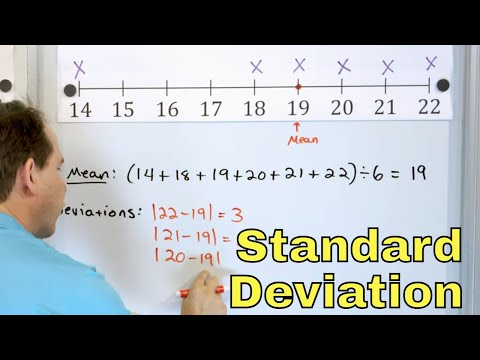
Here’s how it works: basically, you take each number in your data set and see how far it is from the mean. Then, instead of just adding those distances up (which can get confusing because some are positive and some are negative), you take the absolute value of those distances. This means you treat them all as positive values. Then, to find the mean deviation, you divide that total by how many numbers you started with.
Why does this matter? Well, understanding variability in your data sets is super important. For scientists and researchers—that’s anyone studying stuff—you really need to know if results are consistent or varied. Imagine you’re testing a new drug; if everyone responds similarly (low mean deviation), that’s great! If responses vary widely (high mean deviation), then uh-oh—maybe there’s something else going on.
Now let me hit you with some applications:
- Data Analysis: Mean deviation helps identify outliers or unusual data points.
- Quality Control: In manufacturing processes, businesses look at mean deviations to ensure products meet quality standards.
- Finance: Investors use it as part of risk assessment when deciding on investments.
You know what’s interesting? Let me share a quick story! When I was in college taking statistics classes, I had this one professor who loved throwing weird datasets at us—like daily temperatures recorded around campus for an entire year. At first glance, everything seemed fine until we calculated both the mean and the mean deviation. Some days were way colder than others—and that high mean deviation made us realize we couldn’t just rely on averages alone when discussing climate changes over time!
So yeah! Mean deviation plays a vital role in showing us not just what our average looks like but also how much wiggle room we have around that average! It keeps things real by showing us whether numbers dance closely together or throw themselves around freely. Understanding this concept can significantly enhance our approach to interpreting data across various fields from sciences to social studies.
In short: keep an eye on that **mean deviation**! It’s a powerful little metric tucked away in your statistical toolbox—you never know when it might come in handy!
Understanding Mean Absolute Deviation (MAD): Applications in Statistical Analysis and Scientific Research
If you’ve ever looked at a bunch of numbers and thought, “What does this even mean?” you’re not alone! That’s where things like the Mean Absolute Deviation (MAD) come into play. It’s like a friend who helps you understand just how spread out your data really is.
Understanding MAD starts with the basics of what it measures. Simply put, MAD calculates the average distance between each data point and the mean of the dataset. Think of it as a way to see how far off your numbers are from the average, without getting bogged down by positive or negative signs. This makes it super handy when you’re just trying to figure out consistency!
Here’s how you can find MAD:
- First, calculate the mean, which is basically adding up all your numbers and then dividing by how many there are.
- Next, take each number in your dataset and find its absolute difference from that mean. This means no negatives—just pure distances.
- Add up all those differences.
- Finally, divide that total by the number of values you started with. And voilà! You’ve got your MAD!
You might be wondering why you’d even care about this statistic. Well, let me tell you a little story! Once, in a high school science project about plant growth, students measured how tall their plants grew over a month. Some plants shot up like weeds while others, well… not so much! When they calculated MAD for those heights, they realized which set of plants was super consistent (or not). This helped them decide which type of fertilizer worked best!
MAD has lots of real-world applications beyond just science projects. For instance:
- In finance: Investors use MAD to assess risk by looking at historical stock price movements.
- In education: Educators analyze test scores to identify whether students performed consistently across different subjects.
- In meteorology: Weather experts can gauge how variable temperatures are year after year using MAD.
The beauty of using MAD is its simplicity and clarity. Unlike other statistical measures like variance or standard deviation—which can feel like you’re doing math gymnastics—MAD keeps things straightforward. You’re just looking at raw distances! But hey, don’t get too comfortable; remember that while it’s an awesome measure for some datasets, it might not always be the best choice for others where outliers could skew data too much.
You follow me? When it comes down to analyzing data—whether it’s plants growing or stock prices fluctuating—understanding Mean Absolute Deviation gives you valuable insights into consistency and reliability within your datasets! So next time you’re dealing with numbers and want to gauge how spread out they are from that cozy average, think about giving MAD a whirl!
Understanding Mean Deviation: Absolute vs. Relative Measures in Scientific Analysis
Alright, so let’s talk about mean deviation. It’s one of those terms that can sound a bit fancy, but it’s really not that complicated. Basically, mean deviation is a way of measuring how spread out numbers are in a dataset. You get it by looking at the average distance of each number from the average (mean) of the dataset.
Now, there are two types of measures we often compare here: absolute and relative. They might sound like betta fish names or something, but they’re actually super useful in scientific analysis.
Absolute Mean Deviation is the straightforward one. You calculate it by:
- Finding the mean of your data set.
- Calculating the absolute differences between each data point and that mean.
- Averaging those absolute differences.
This gives you a sense of how much variation there is overall. If you had a small class test with scores like 85, 90, and 95, you’d find that they’re all pretty close to each other when you calculate the absolute mean deviation, right? Simple enough!
On to Relative Mean Deviation, which adds another layer to this whole thing. This one takes into account the size of your data set! To get it:
- You still find that mean and calculate absolute deviations.
- This time though, you divide those absolute deviations by the mean itself.
This gives you a percentage or proportion instead of just an average distance. It’s super handy when you want to compare datasets with different scales or units! For instance, if we were comparing test scores to income levels across different neighborhoods—it would help us see which has more variability relatively speaking.
The key difference? Well, absolute mean deviation tells you how far your numbers deviate in specific units (like points on a test), while relative mean deviation provides perspective relative to their size (so like comparing differences based on percentages). It’s kind of like comparing apples and oranges but in numerical form!
A practical example could be this: Imagine two students scored an A on different tests—one got a score of 90/100 and another scored 80/120. Absolute measures would just look at how far they are from their respective means without giving context about test difficulty. Relative measures? They show which student performed better considering their tests’ weightage!
The thing is using these deviations helps scientists and researchers make sense out things when dealing with data—like figuring out if results are consistent across studies or just random flukes! That little number can tell us quite a story about our data.
In essence, whether you’re going for absolute or relative means boils down to what you’re trying to achieve with your analysis. The world needs both tools—you know? It’s kind of like having both salt and pepper in your kitchen; each one has its own flavor!
So, mean deviation, huh? It might sound super technical, but honestly, it’s just a way to get a grip on how spread out your data really is. Think of it like this: if you ever tried to figure out how close or far off your friends are from showing up on time at a party, you’d basically be dealing with mean deviation.
Let’s say you invite five friends over for a game night. If they each show up at different times—like some trickle in an hour late and others are right on the dot—you kind of start to wonder just how punctual they really are. Mean deviation helps you see that! In a more official sense, it looks at the average distance between each data point and the mean. It’s like saying, “Okay, on average, how far away are these numbers from my average?”
I remember one time in school when we had this project involving test scores. We were all anxious about grades because some folks nailed it with 90s while others barely scraped by with 60s. So we calculated the mean and then looked at the mean deviation to see who was really struggling versus who was doing okay. The stats showed us that even though one person got an A and another flunked, there were many who fell somewhere in between—like those slightly above or below average performers.
And while standard deviation often gets more love in classrooms because it sounds cooler (and has its own little Greek symbol), mean deviation is totally useful in its own right! It’s straightforward and can give you insights without getting too caught up in fancy equations. You know what I mean?
So yeah, whether you’re using it for school projects or just trying to figure out why your friend can’t stick to party times, recognizing patterns through mean deviation can make making sense of life just a bit easier!