You know that feeling when you see a chart or a bunch of numbers, and your brain just goes blank? Seriously, it can be so overwhelming! But imagine if you had this cool tool that could make sense of all that chaos. That’s where weighted standard deviation comes in.
Picture this: You’re hosting a backyard barbecue. Everyone brings their favorite dish, but some friends bring massive platters while others show up with little snack bags. If you’re trying to figure out who brought the best food, counting everyone equally wouldn’t really cut it, right? It’s the same with data!
So, why not give extra credit to those big platters? The weighted standard deviation does just that. It helps you weigh the importance of different values in data analysis. And let’s face it—making sense of numbers is way more fun when you get to play around with them!
Understanding Standard Deviation: Key Insights for Data Analysis in Scientific Research
Alright, let’s chat about standard deviation. You might have heard of it in school or seen it pop up in scientific research. But what is it, really? And why should you care?
So, standard deviation is all about understanding how spread out your data is. Imagine you have a group of friends, and they all took a test together. If everyone scored around the same number, we’d say the scores are pretty consistent. But if one person bombed it and someone else totally aced it, that spread between the scores is what standard deviation helps us measure.
Now, here’s where things get interesting with **weighted standard deviation**. You see, sometimes not all data points are created equal. For example, let’s say you’re studying test scores but some tests count more than others toward your final grade. In that case, you’d want to give those bigger tests more “weight” in your calculations.
Why does weighting matter? When you adjust for weight, you’re factoring in how much impact each data point has on the overall picture. This gives you a clearer view of what’s going on.
Just to break it down:
- Standard Deviation: Measures how much scores (or any data) vary from the average.
- Weighted Standard Deviation: Adjusts for different levels of importance among your data points.
- Greater Control: Helps in research where certain values need to weigh heavier based on their significance.
Let me tell you a quick story here. I once worked on a project where we analyzed the effectiveness of different teaching methods through students’ test scores from various classrooms. Some classrooms had way more students than others! If we just calculated a regular standard deviation without considering class sizes, we could get super skewed results—like saying one method wasn’t effective when it actually was for most kids.
By using weighted standard deviation there, we could account for those larger classes and get an honest evaluation of each teaching method’s success.
A couple more key points:
- The mathematical formula gets a little different when you weight your data.
- The main goal remains: getting an accurate measure of variability.
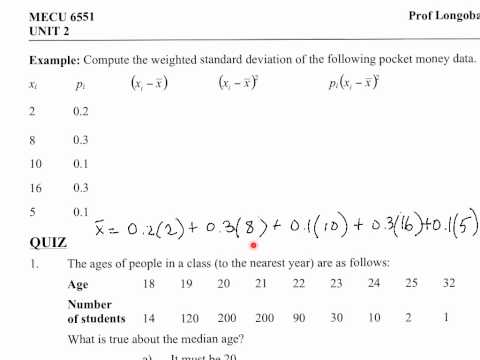
You take each score’s deviation from the mean, multiply that by how much “weight” or importance that score has compared to others, and then you do some averaging magic to arrive at your weighted standard deviation.
So there you have it! Standard deviation gives us insights into variability while weighted standard deviation allows us to give appropriate emphasis based on context and significance. It’s pretty powerful stuff when analyzing data in scientific research! Keep this in mind next time you’re looking at numbers—it can change how you interpret everything!
Understanding the Weighted Mean: A Key Statistical Tool in Scientific Research
When you’re dealing with data, sometimes those numbers can feel like they’re just flying at you, right? Well, that’s where the concept of the weighted mean comes in. It’s a super handy statistical tool that helps make sense of all that information.
So, what’s the deal with a weighted mean? Basically, it’s a way of averaging values while taking into account how important each value is. Picture this: you’re in school and you’ve got different types of assignments—homework, tests, and projects. Let’s say your homework counts for 20% of your grade but tests count for 50%. If you just averaged them out equally, you’d miss that each assignment type has a different weight in your overall performance.
To calculate a weighted mean, you multiply each value by its corresponding weight and then divide the total by the sum of all weights. It sounds complex but hang on—it’s not too tricky once you get the hang of it!
- Step 1: Multiply each number by its weight.
- Step 2: Add those results together.
- Step 3: Divide that total by the sum of the weights.
Let’s break this down with an example. Imagine you scored 80 on homework (weight: 0.2), 90 on tests (weight: 0.5), and 70 on projects (weight: 0.3). Your weighted mean would look like this:
(80 * 0.2 + 90 * 0.5 + 70 * 0.3) / (0.2 + 0.5 + 0.3) = (16 + 45 + 21) / 1 = **82**.
See how that works? The weighted mean gives more importance to tests since they contribute more to your overall grade.
Now, onto weighted standard deviation. This is similar but tracks how spread out those scores are while also considering their weights! So if you’ve got some numbers that are all over the place—maybe most people did great on tests but not as well on projects—the weighted standard deviation will help highlight that disparity.
Why does this matter? Well, when researchers analyze data—like how effective a new drug is—they often deal with multiple groups or measurements that come from various sources or conditions. Using a simple average could mask significant differences in responses depending on how much each group contributes to the overall picture.
In short, both weighted mean and weighted standard deviation are essential tools in scientific research because they allow for more accurate representations of data by factoring in varying levels of importance across different sets of information.
So next time you’re faced with data analysis, think about using these concepts! They can really sharpen your insights—and who knows? You might just uncover something profound hiding within those numbers!
Calculating Weighted Standard Deviation in Excel: A Comprehensive Guide for Scientific Analysis
So, you’re diving into the world of statistics with something called *Weighted Standard Deviation*, huh? That’s pretty cool! It’s a handy tool for analyzing data that doesn’t treat everything equally. Let’s break it down like we’re chatting over coffee.
Calculating the weighted standard deviation involves a few steps, but first, just to keep it simple, the **weighted standard deviation** gives more importance to some values based on their “weight.” It’s super useful when you have data points where some contribute more to the average than others—you know what I mean?
To begin with, you’ll need your dataset ready. Imagine you’re working on student scores from different quizzes and you want to emphasize scores from harder quizzes more than easier ones. You’d have something like this:
- Quiz 1: Score = 85, Weight = 1
- Quiz 2: Score = 90, Weight = 2
- Quiz 3: Score = 78, Weight = 1
In Excel, the formula for weighted standard deviation is kinda long but don’t stress! Here’s how it goes:
1. **Calculate the Weighted Mean**:
You sum up all scores multiplied by their weights and then divide by the total weight.
For our example:
(85 * 1 + 90 * 2 + 78 * 1) / (1 + 2 + 1) = (85 + 180 + 78) / 4 = 86.25
2. **Calculate Variance**:
For each score, subtract the weighted mean and square that result. Then multiply by each score’s weight.
Keep in mind that variance is essentially how spread out your numbers are.
3. **Put Everything Together**:
The formula for weighted variance looks like this:
Variance_w = (Σ(w_i*(x_i – mean)^2)) / Σw_i
Here’s what it means:
– (w_i) is each weight,
– (x_i) is each data point,
– mean is that weighted average we calculated earlier.
4. **Finally**:
Take the square root of your variance to get your weighted standard deviation!
Now that you’ve got this down in theory, using Excel makes life easier! Instead of crunching numbers manually forever:
– Use functions like `SUMPRODUCT` for multiplying weights by values.
– `SUM` can help add things up quickly.
Your final formula might look somewhat like this in Excel:
=SQRT(SUMPRODUCT(weights,(scores-weighted_mean)^2)/SUM(weights))
And there you go! You’ve calculated a weighted standard deviation in Excel! Just remember that using weights helps reflect which data matters more instead of treating every point equally—kind of like how a teacher might grade an exam differently based on its difficulty.
So next time you’re analyzing your data or reports, think about whether those weights matter and use this handy formula to get insights from your numbers!
So, let’s chat about something that might sound a bit math-y but is really just super practical: weighted standard deviation. You know, it’s like when you’re trying to make sense of those numbers that just seem to swirl around in your head. So, what’s the deal with this concept?
Imagine you’re in school and you took a bunch of tests. Some were worth a lot more than others in terms of your overall grade, right? Like that final exam probably counts for more than a little quiz from two weeks ago. That’s where the idea of weighting comes into play! It’s not just about getting an average score; it’s about giving more importance to the things that matter most.
Now picture this: you’re trying to analyze customer satisfaction at a coffee shop. Maybe you have feedback from regulars who visit every day and tourists who drop by just once. The opinions of those regulars might weigh heavier because they know the place inside out! If you treat their feedback equally to someone who’s just passing through, you could misinterpret how happy your customers really are.
When we talk about weighted standard deviation, we’re essentially adding that layer of complexity and depth to our data analysis. It allows us to not only consider how spread out our data points are but also how much each point really counts in the big picture.
I remember sitting with a friend who was studying for her statistics class. She was all stressed about her project where she had to analyze survey results. I told her about using weighted averages and deviations, and I saw her light up—with that little twinkle in her eye that said, “Oh wait! This makes sense!” It’s seriously heartwarming when concepts click like that.
So yeah, applying weighted standard deviation gives us a clearer view of our data’s reliability and variations. It helps filter out the noise from those outlier scores or opinions that don’t carry as much weight—just like sorting through all those random thoughts cluttering your mind on a busy day! Just remember: while numbers can be tricky sometimes, tools like these help us see beyond them and guide us toward better decisions based on reality rather than guesswork.
In short, next time you’re crunching some numbers or looking at survey results, think about how weight can change the whole perspective on what you’re analyzing! It’s pretty neat stuff!