You know that feeling when you’re at a party, and you just can’t seem to figure out how many chips are left in the bowl? It’s like, is it just me, or do chips vanish into thin air? Seriously!
Well, that got me thinking about something called the Poisson distribution. Sounds fancy, right? But here’s the deal: it’s actually kind of cool and surprisingly useful.
Imagine if you could predict how often those pesky chips disappear. Or even better, calculate how many friends will show up for movie night. That’s what this distribution does—it helps us figure out probabilities when events happen randomly.
So, stick around as we break down this nifty tool and see how it can help you make sense of the chaos in your life—or at least your snack bowl!
Understanding Poisson Distribution: A Guide to Calculating Probabilities in Scientific Research
Sure! Let’s talk about the Poisson distribution, which might sound complex, but I promise it’s not as scary as it seems. Imagine you’re sitting at your favorite cafe, and you’re counting how many customers walk in every hour. Some hours are busy, while others are super quiet. That’s where this cool statistical tool comes in handy!
The Poisson distribution helps you model the number of times an event happens in a fixed interval of time or space. You know how sometimes things just seem to happen randomly? Well, the Poisson distribution is like a magic formula for predicting those random events—kind of like guessing how many times your buddy is going to drop their phone this week!
So, what we’re really looking at is a process that can provide you with probabilities for counts of events—like, maybe you’d like to know how often more than five customers show up in an hour.
One big thing to remember about this distribution is that it applies when:
- The events are independent. So if a customer walks in, it doesn’t change the chance of another one walking in right after.
- The average rate (let’s say 2 customers per hour) stays constant over time.
- Two events can’t occur at exactly the same instant.
Now here comes the fun part: calculating probabilities! To find out how likely it is that a certain number of events occur during your hour watch party, we use a formula:
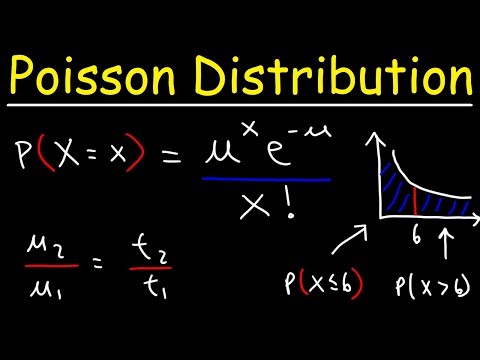
P(X = k) = (λ^k * e^-λ) / k!
What does that mean? Let’s break it down:
– **k** is the actual number of occurrences you’re interested in—maybe that’s 3 customers.
– **λ (lambda)** is what scientists call the average rate—the predicted number—for instance, 2 customers per hour.
– And **e** is Euler’s number (about 2.71828). Don’t sweat trying to remember it; it’s just part of the math scene.
Let’s say on average you expect 2 people to walk into your cafe per hour (your λ). What’s the chance exactly three people walk in during one specific hour? Well, plug those numbers into our formula:
P(X=3) = (2^3 * e^-2) / 3!
After some calculations (you might want a calculator for this!), you’ll find out that there’s about a 23% chance that three customers will come through those doors in any given hour.
It gets cooler when you look at something called the Poisson Distribution Table. This table collects probabilities for different values of k based on various lambdas. So instead of crunching numbers every time someone asks about “what are my odds?”, you can just look them up! It really speeds things up when you’re stuck doing research or making predictions.
This kind of probability analysis helps scientists and researchers make informed decisions based on real data—in fields ranging from biology to engineering and even finance. Imagine predicting how often certain bacteria might multiply or accidents might happen in different intervals—you get where I’m going with this?
So next time you hear someone bring up Poisson distribution—and trust me, they will—it’ll be like having a secret weapon for analyzing those random patterns we see all around us every day!
Mastering Probability: A Comprehensive Guide to Analyzing Probability Distribution Tables in Science
Understanding probability can feel a bit like trying to untangle a ball of yarn. You know, there’s a lot going on, and it can get pretty messy. But once you get the hang of it, everything starts to make sense. Let’s chat about probability distribution tables, especially the Poisson distribution, which is super handy in scientific analysis.
So, what’s the deal with probability distributions? Basically, they help us understand how likely different outcomes are in a random process. For example, let’s say you’re counting how many cars pass by your house in an hour. The Poisson distribution is perfect for modeling that since we’re dealing with rare events over time or space.
Now, onto the Poisson distribution table. This table gives you probabilities associated with different numbers of events occurring in a fixed interval. Imagine if you’ve got a bunch of friends who throw darts at a board. If they throw darts randomly over time and you’re curious about how many times they hit the bullseye in an hour, you’d want to look at this kind of table.
Here’s how it works:
- The formula: The Poisson distribution is represented by the formula P(X=k) = (λ^k * e^(-λ)) / k!, where λ (lambda) is the average number of occurrences in your interval and k is the number of occurrences you’re looking for.
- The parameter λ: This is crucial! It represents your average rate. If you normally see 3 cars pass by every hour, then λ would be 3.
- Calculating probabilities: Say you want to know the probability that exactly 4 cars will pass by in an hour when λ = 3. Plugging those values into the formula gives you P(X=4), which tells you how often that might happen.
- The shape of the distribution: As λ increases, you’ll notice that this distribution starts looking more like a bell curve (think normal distribution). Pretty cool, huh? Initially, though, it’s more skewed towards lower counts.
But let me tell ya—a little anecdote here because I think it adds flavor! Once when I was helping my younger sibling with their math homework, we used some real-life examples involving Poisson distributions to figure out things like how often our dog barks at mailmen (seriously frequent!). We used λ based on our observations and created our own little table together! It made understanding so much easier and fun.
Also worth mentioning: this isn’t just for counting cars or barking dogs; scientists use Poisson distributions for everything from radioactive decay rates to analyzing traffic accidents over time. Isn’t that wild?
As you dive deeper into this world of probability tables and distributions, remember one key takeaway: they’re tools. Just like any other tool in science or math—like calculators or microscopes—they help us analyze patterns and make informed decisions based on randomness.
So next time you think about probability—whether it’s predicting darts hitting targets or counting something random—give that Poisson distribution a thought! It’s like having a trusty sidekick ready to help make sense of those unpredictable moments. Keep exploring these ideas; there’s so much out there waiting for your curiosity!
Exploring 5 Real-Life Applications of Poisson Distribution in Scientific Research
Alright, let’s chat about the **Poisson distribution**. It might sound a bit fancy, but it’s actually pretty straightforward and incredibly useful in all sorts of scientific research. Basically, this distribution helps us understand how often an event happens in a fixed interval of time or space. And yeah, there are some real-life applications that are super interesting!
- Traffic Flow: Imagine you’re at a busy intersection. Researchers use the Poisson distribution to predict how many cars will pass through in, say, 10 minutes. By analyzing historical data, they can estimate traffic patterns during rush hours or even plan for road improvements.
- Biology and Medicine: In the world of biology, this distribution comes into play when studying rare events like mutations or infections. For example, if scientists want to know how often a specific mutation occurs in a population of viruses, they can use the Poisson distribution to model that frequency based on sample data.
- Call Centers: Here’s something relatable: ever waited on hold? Call centers analyze incoming calls using the Poisson distribution to manage staffing levels. By predicting call volumes at different times of day, they make sure enough agents are available to handle customers without long wait times.
- Epidemiology: Public health officials often use the Poisson distribution to study disease outbreaks. When there’s an uptick in cases of something like influenza in a particular region, they can model how many new cases might pop up over time based on past trends and current data.
- Natural Disasters: Think about earthquakes or hurricanes; scientists have used this distribution to model their occurrences over time and space. By studying historical data on earthquake frequency in certain regions, researchers can assess risks and better prepare communities for potential disasters.
So what’s cool here is that each application takes advantage of the same underlying principle: predicting what happens based on what has happened before! The **Poisson distribution table** acts as a handy reference point for researchers when calculating probabilities related to these events.
It’s kinda wild if you think about it — this math tool helps people manage traffic better, prepare for disease outbreaks, and make sense of nature’s unpredictable chaos! You know what I mean?
You know, when you think about probability, it can get pretty abstract sometimes. Like, how do we make sense of all those random events around us? That’s where the Poisson distribution comes in, and honestly, it’s kind of a neat concept.
So, imagine you’re waiting for your favorite pizza delivery on a Friday night. You know the restaurant is always busy around that time. You might wonder: how many deliveries will they make in an hour? That’s exactly the kind of situation where a Poisson distribution table shines! It helps you estimate the likelihood of these kinds of occurrences based on an average rate.
Let me tell you a quick story. A while ago, I was at this little café, sitting outside with a friend. We were just chit-chatting when suddenly—bam!—a pigeon swoops down and snags some crumbs right near our feet. I remember laughing and thinking how unpredictable that was! But if I had known the average number of pigeons swooping by every minute (like let’s say two), I could use a Poisson distribution table to figure out the probability of seeing one or two pigeons in ten minutes or more.
That’s the beauty of this statistical tool! It tells us what to expect in certain situations where things happen randomly but at an average rate—you know? The table gives you probabilities for different outcomes based on that rate. So if you find yourself asking questions about rare events—like how many times will it rain this month or how often cars pass through your street during rush hour—you can turn to this handy table for guidance.
Of course, it’s not perfect; it assumes that these events happen independently and at a constant average rate. Life’s messy, right? So there are times when things don’t quite fit into those neat little boxes, but it’s still super helpful for analyzing data and making predictions!
In short, exploring probability with tools like the Poisson distribution just makes everything feel a bit more manageable—like taking away some of the chaos from life’s unpredictability. It adds structure to randomness! And who doesn’t want a little more clarity in their day-to-day shenanigans?