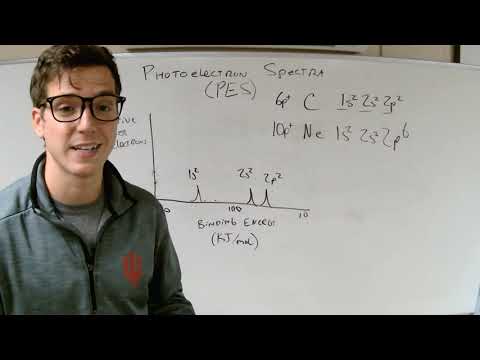
You know how sometimes you get a picture and it just captures your vibe? Well, photoelectron spectra do something kinda similar, but with atoms and molecules. Imagine taking a snapshot of what’s going on at the tiniest level. It’s wild!
So here’s the scoop: when light hits an electron in an atom, it can kick that bad boy out. The cool part? The energy from that light helps scientists figure out where those electrons hang out and what they’re up to. Kinda like eavesdropping on a secret conversation, if you ask me!
In modern chemistry, these spectra are like magic crystal balls. They give chemists clues about molecular structures and reactions that are super hard to see otherwise. It’s all about understanding the little things to make sense of the big picture—and that’s pretty much what this whole thing is about. Ready to geek out over electrons?
Exploring Photoelectron Spectra: Insights and Applications in Modern Chemistry
Photoelectron spectroscopy, or PES for short, is a powerful tool in modern chemistry. It helps scientists understand the electronic structure of molecules. Basically, it tells you how electrons are arranged in an atom or a molecule. You see, when light hits a sample, it can knock electrons out. By measuring the energy of these emitted electrons, researchers can gather valuable info about the material.
So how does this work? Well, first off, we shine light—often ultraviolet or X-rays—on our sample. The energy from the light causes electrons to be ejected. The photoelectron spectrum that we get from this process shows peaks at different energies. Each peak corresponds to a specific electron binding energy within the molecule. This can reveal details about the chemical environment of those electrons.
But wait, there’s more! PES can tell us not just where electrons are but also how they behave during chemical reactions. For example, imagine you’re watching two people dance at a party. If one person changes their style mid-dance, you’d notice it right away! Similarly, by monitoring electron behavior during reactions, chemists can gain insights into reaction mechanisms.
One fascinating application of PES is in understanding catalysts—substances that speed up reactions without being consumed in the process. Understanding how catalysts interact with reactants at the electronic level is crucial for making them more efficient. You might think of it as fine-tuning an engine; getting just the right balance leads to better performance!
Another area where PES shines is in studying surfaces and materials science. For instance, when researching new materials for batteries or solar cells, knowing how electrons behave can help tweak those materials for better efficiency and longevity.
Of course, there are challenges too! Some materials might not emit enough electrons to get a clear spectrum or could have complex interactions that make interpretation tricky. But advances in technology continue to improve our ability to analyze these spectra accurately.
In summary:
- PES gives insights into electron arrangements and behaviors.
- This technique involves shining light on samples and measuring emitted electron energies.
- It’s vital for understanding chemical reactions and optimizing catalysts.
- PES plays a key role in materials science.
- Despite challenges like low emission rates or complex data patterns, technology is advancing rapidly!
All things considered, photoelectron spectroscopy is like having a magnifying glass into the world of molecules! It opens doors for innovations across different fields—a true gem in modern chemistry’s toolbox!
Exploring Photoelectron Spectra: Essential Insights for Modern Chemistry Laboratories
So, you’re curious about photoelectron spectra? That’s awesome! These spectra are like the DNA of materials—unlocking their secrets in ways that are both fascinating and kind of essential for modern chemistry labs.
Basically, photoelectron spectroscopy (or PES for short) is a technique that involves bombarding a material with light, usually ultraviolet or X-ray light. This burst of energy kicks electrons out of their orbits, and then we can measure these escaping electrons. It’s like giving the material a little nudge to see who gets ejected first!
When these electrons fly away, they carry information about the energy levels and states they were in before being freed. This is where things get interesting because each element has its own unique “fingerprint.” So with PES, you can find out what elements are present in your sample and even learn about their chemical states.
Here’s how it works:
- The light hits the sample and excites the electrons.
- Electrons absorb that energy and get knocked out.
- We collect these emitted electrons and analyze their energies.
You can think of it as a game of musical chairs where only certain players (electrons) find a seat (get detected) based on the tunes (light energy) playing at that moment.
A practical example? Imagine you’re studying a new catalyst for speeding up chemical reactions. Through PES, you could investigate how different reaction conditions alter the electron states of your catalyst. Maybe you’ll see peaks shift or even new peaks appear in your spectrum! Each peak corresponds to electrons from specific orbitals, giving you significant insights about how your catalyst interacts with other molecules.
And here’s another thing—you don’t just get qualitative data but also quantitative insights! You can measure how many electrons come from each element based on the intensity of those peaks. More intense peaks? That means more electrons are involved!
Using this powerful tool helps chemists understand materials at an atomic level. Whether it’s examining new battery materials or understanding environmental samples, PES is key in figuring out composition and electronic structure.
In labs today, there’s some seriously cool stuff happening thanks to photoelectron spectra. It’s not just about knowing what elements are around; it’s also about understanding bonding situations and electron distributions within molecules. Such knowledge shapes everything from drug design to nanotechnology.
So yeah, without photoelectron spectroscopy, many modern chemistry experiments would feel like trying to solve a puzzle without half the pieces. It gives researchers not just clues but clear paths toward unraveling complex chemical mysteries!
Exploring Photoelectron Spectra: Insights and Applications in Modern Chemistry
Alright, let’s chat about photoelectron spectra, shall we? This little gem of a topic sits at the intersection of chemistry and physics, allowing scientists to peek into the electronic structure of atoms and molecules. I mean, who wouldn’t want to know what makes stuff tick on such a fundamental level?
So what’s the deal with photoelectrons? Well, when you shine light—usually in the form of photons—onto a material, you can knock electrons out from their orbitals. The energy from those photons gives the electrons enough kick to escape. What we’re left with is something called a photoelectron spectrum, which is essentially a readout of those ejected electrons and their energies.
You might be wondering why this matters. The thing is, these spectra are like fingerprints for different elements and compounds. When you analyze them, you can figure out details about the electronic states present in whatever you’re studying. Here’s how it breaks down:
- Element identification: Each element has its unique signature based on how its electrons behave when hit by light.
- Molecular structure insights: By examining shifts in binding energy, chemists can infer information about molecular geometry and bonding.
- Dynamics of reactions: Watching how electrons move during chemical processes helps us understand reaction mechanisms better.
Let me throw an example your way. Imagine studying water (H2O) using photoelectron spectroscopy. You’d see distinct peaks corresponding to oxygen and hydrogen’s electron bindings. Those peaks reveal how tightly those electrons are held and can tell you lots about the bonds in water—like why it’s such a good solvent!
The application of this knowledge is vast! In modern chemistry, researchers use photoelectron spectra for everything from designing new materials to understanding biological systems at a molecular level. It even plays a role in developing better catalysts that speed up chemical reactions.
The beauty of it all? Photoelectron spectroscopy isn’t just confined to basic science; it also touches on practical applications like environmental science or pharmacology. For example, analyzing pollutants or drug interactions could significantly benefit from this technique.
If you think about it, diving into photoelectron spectra helps bridge gaps between theoretical ideas and real-world applications. It feels pretty satisfying knowing that by exploring these tiny electron adventures, scientists can make informed decisions that impact technology and health.
Naturally, there are challenges too—like dealing with complex mixtures or interpreting crowded spectra where many peaks overlap. But that’s where innovation kicks in! New methods are being developed constantly to refine this technique so we can dig even deeper into our understanding of matter.
This whole idea brings us closer to grasping what our universe is made of at an atomic level—all through the lens—or more accurately, the light—of photoelectron spectroscopy!
So, let’s chat about photoelectron spectra. You might be wondering, what the heck is that? Well, it’s a fancy way of saying we’re gonna look at how materials interact with light—specifically, how they give off electrons when they get hit by photons (which are basically light particles).
Imagine you’re at a concert, and the crowd’s going wild every time the band plays. Now think of those band members as photons and the crowd as electrons. When the right song hits, boom! The crowd jumps up and starts dancing around. That’s kind of what happens in photoelectron spectroscopy! The energy from the light makes those electrons pop out of their cozy spots in atoms.
I remember this one time during my first chemistry class. We were trying to understand why some metals shine under specific lights while others just look dull. Our professor started waving around a flashlight and pointed out how light interacts with different metals in different ways—some got excited and shone brightly, while others just didn’t react much at all. It clicked for me then how vital these interactions are for understanding materials.
So why does all this matter? Well, photoelectron spectroscopy can tell chemists what elements are in a material and even give hints about their structure or state. It’s like peeking inside a locked box without having to open it! By studying the emitted electrons, scientists can figure out things like how strong chemical bonds are or what kinds of reactions might occur.
The cool part is that it’s not just used for basic chemistry stuff; it has applications everywhere—from developing new materials for batteries to understanding biological processes at the molecular level. Seriously! It’s like when you find out your favorite band influences tons of other artists—you start to see connections you never thought about before.
But there’s still so much more to learn! Each time chemists dive into this world with their photoelectron spectrometers (which sounds super high-tech), they uncover little secrets hidden in materials that could lead to innovations we haven’t even dreamed up yet.
So yeah, photoelectron spectra may sound complicated at first glance, but they play a key role in paving pathways for modern chemistry—like opening up doors we didn’t even know were there! And who knows what cool discoveries await just around the corner?