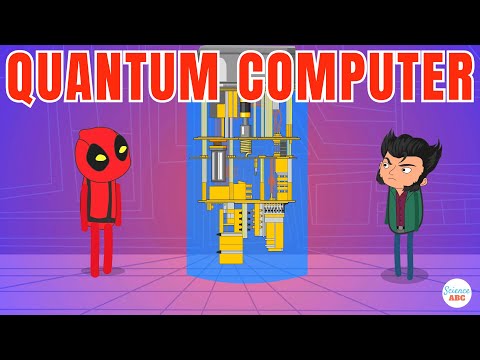
So, imagine you’re at a party, right? Everyone’s chatting about their boring day jobs. And then there’s that one dude in the corner who starts talking about quantum computing. You wonder if he’s just finished reading a sci-fi novel or if he really knows what he’s on about.
Well, hold on to your drink because quantum computing is like the Wild West of tech right now. Seriously, it’s wild! We’re talking about computers that can solve problems faster than you can say, “Wait, how does that work?”
The thing is, this isn’t just geeky chit-chat. The advancements in this field could change everything from medicine to cryptography. Imagine diagnosing diseases before they even show symptoms or cracking codes that could keep our data safe.
I mean, it sounds almost too good to be true, huh? But trust me; it’s all based on some real mind-bending science. Let’s break it down together; dig into what these quantum wonders can really do!
Exploring the Future: Will Quantum Technology Surpass AI in Scientific Advancement?
Well, let’s chat about **quantum technology** and how it stacks up against **artificial intelligence (AI)** when we think about the future of science. It’s like a sci-fi movie coming to life, but this stuff is real!
Quantum computing is all about harnessing the quirky behaviors of tiny particles. You know how in human computers, bits are like little on-off switches? They represent 1s and 0s, right? In quantum computing, you’ve got **qubits** instead. These bad boys can be both 1 and 0 at the same time thanks to something called **superposition**. This allows quantum computers to process information at lightning speed! Imagine trying to solve a gigantic maze, where regular computers stumble around while a quantum computer zips through all the paths simultaneously. Wild, huh?
Now let’s pivot to AI for a sec. AI has been revolutionizing so many fields by learning from tons of data. Think about your phone recognizing your voice or those algorithms that suggest what show you should binge next; it’s really smart stuff! But here’s the thing: current AI depends on traditional computing power to analyze that data. It’s impressive but has limits.
So, this raises an interesting question: could **quantum technology** outdo AI? Here are some points that could help frame this discussion:
- Speed: Quantum computers could solve complex problems way faster than traditional computers ever could, which might boost AI development.
- Data processing: With their ability to handle massive amounts of possibilities at once, quantum tech could enable new kinds of AI learning algorithms.
- Applications: Imagine using quantum computing for drug discovery or materials science. This would massively impact not just AI but multiple scientific fields!
But let’s not forget—this doesn’t mean one will just “win” over the other! Quantum tech is still in its early days; it’s like watching a baby learn how to walk—it has great potential, but there’s a long road ahead. For now, they both have unique strengths that can complement each other.
Take my friend Marco; he works in neuroscience and once told me how using supercomputers helped him simulate brain activity patterns for studying diseases like Alzheimer’s. If we had quantum technology back then… well, who knows what breakthroughs they might have made!
So yeah, it seems likely that as both fields grow, they’ll end up collaborating more often than competing head-to-head. Picture a future where quantum algorithms help train smarter AIs or where breakthroughs in machine learning push forward quantum research. That’d be pretty epic!
It’s hard to predict exactly what will happen next; that’s part of the excitement! Whether one surpasses the other remains up for debate—but no matter what happens down the line, both techs have massive potential for transforming our world in ways we’re only starting to scratch the surface of today.
Exploring the Impacts of Quantum Computing on Scientific Research: Potential Benefits and Innovations
Quantum computing is like the cool cousin of traditional computing. It works on the principles of quantum mechanics, which is pretty much the science of tiny things, like atoms and particles. So, you can imagine how this technology can shake things up in scientific research.
First off, let’s talk speed. Quantum computers use qubits instead of regular bits. While a regular bit is like a light switch that can be either off or on (0 or 1), a qubit can be both at the same time thanks to something called superposition. This means that quantum computers can process vast amounts of information way faster than classical computers. You follow me?
Now, because they are so fast, they could tackle complex simulations that would take traditional computers ages to solve. Think about how weather forecasting works. Classical models use tons of data but can’t always give accurate long-term predictions due to limited processing power. With quantum computing, models could become super precise in predicting weather patterns and climate change impacts.
They also shine in optimization problems. These occur in various fields—like logistics or pharmaceuticals—where you need to find the best solution among many possibilities. For instance, if you’re trying to figure out how to distribute medicine across hospitals efficiently, traditional methods might take forever. But quantum algorithms could help find that perfect distribution in no time.
Then there’s machine learning. We all know AI’s potential, but when you pair it with quantum computing? Magic happens! Quantum machine learning could improve pattern recognitions and data analysis capabilities significantly. Imagine training an AI to identify diseases from medical images faster and more accurately!
But wait, there’s more! Quantum computing also dives into areas like cryptography, which is vital for keeping our data secure. Traditional encryption methods could become vulnerable as quantum computers advance because they’re good at cracking codes that would take classical computers a gazillion years to break. So researchers are scrambling now to develop new encryption methods that’ll hold up against these powerful machines.
Of course, we’re still in the early days of this tech revolution. Building practical quantum computers isn’t easy; they require super cool environments—literally! I mean cryogenic temperatures—just for them to function properly without errors.
What does this mean for scientists today? It’s like having an incredibly powerful tool just waiting as it gets sharpened over time. The potential benefits and innovations brought by quantum computing are exciting but also daunting; we’re still figuring out how best to integrate this tech responsibly into our scientific endeavors.
So there you have it: from speeding up simulations and solving optimization puzzles to groundbreaking advancements in machine learning and securing data through cryptography—the future looks bright with quantum computing on the horizon!
Exploring Five Key Advancements in Quantum Computing and Their Impact on Scientific Innovation
Quantum computing is one of those topics that may sound like it’s straight out of a sci-fi movie, but it’s becoming super real and kinda exciting. So let’s break down five key advancements in this field and how they could shake things up for scientific innovation.
1. Qubits: The Game Changers
Traditional computers use bits as the smallest unit of data, which are like tiny switches that can be either on (1) or off (0). But quantum computers use qubits, which can be both on and off at the same time thanks to something called superposition. Imagine flipping a coin; while it’s in the air, it’s both heads and tails until you catch it. This means quantum computers can process a ton more information all at once! Crazy, right?
2. Entanglement: Spooky Action
Now, here’s where it gets even weirder: entanglement. This is when two qubits become linked, such that the state of one instantly influences the other, no matter how far apart they are. Think about twins who can finish each other’s sentences even when they’re miles apart. Because of entangled qubits, quantum computers can perform calculations much faster than traditional ones by sharing information instantly.
3. Quantum Algorithms: Speeding Things Up
With advancements in quantum algorithms like Shor’s algorithm, we’re looking at potentially breaking down complex problems in seconds that would take conventional computers thousands of years! For instance, this algorithm could factor large numbers efficiently, which has huge implications for encryption and cybersecurity. If you’ve ever struggled with long math problems, you know how exciting this sounds!
4. Quantum Supremacy: A Milestone Achievement
In 2019, Google claimed to have achieved quantum supremacy, meaning their quantum computer solved a problem faster than any classical computer could have done. They completed a complex task in 200 seconds—something they said would take even supercomputers around 10,000 years! This breakthrough wasn’t just about showing off; it marked a significant step forward for research and development in this field.
5. Real-World Applications: From Medicine to AI
The potential applications for quantum computing are endless! Think about drug discovery—quantum computers could simulate molecular interactions at speeds we can’t even fathom today. Or AI optimization problems—quantum algorithms can help create smarter algorithms more efficiently than ever before. Imagine being able to solve climate models or optimize logistics for delivery services almost on a whim!
So yeah, the way things are shaping up with quantum computing is wild! Each advancement brings us closer to innovations that could literally transform fields we rely on every day—from medicine to finance to environmental science. And honestly? It feels like we’re just scratching the surface here; who knows what else is coming our way?
Quantum computing is one of those topics that can make your head spin, but it’s super exciting too. I mean, we’re talking about a kind of computing that could change everything we know about technology. Imagine having a computer that can process vast amounts of information in the blink of an eye, way faster than our current supercomputers. You know how in movies they show computers solving complex problems in seconds? Well, quantum computers could actually do that for real.
So, let’s break it down. Traditional computers use bits as the smallest unit of data, which are like tiny switches that can either be off (0) or on (1). But quantum computers use qubits. These little guys are like magical switches because they can be both 0 and 1 at the same time thanks to something called superposition. It’s like flipping a coin and it being both heads and tails until you take a good look at it. Crazy, right?
The potential here is huge! For instance, think about drug discovery. It usually takes ages to figure out how different molecules interact with each other. Quantum computers could simulate these interactions quickly and accurately, leading to new medicines much faster than we currently do. That reminds me of when my grandma had to wait for what felt like forever just to get her treatments sorted out; if quantum computing had been around, maybe things would’ve been different.
And then there’s cryptography—the art of keeping information secret. Current encryption methods might become obsolete as quantum computers get better at cracking codes in no time flat! This means we’d need new ways to secure our data because what’s the point of all this tech if we can’t keep our secrets safe?
Of course, there are challenges ahead too. Building stable qubits is tough; they’re finicky little things easily disturbed by their environment—like trying to keep a house of cards standing in a windstorm! Researchers are working on this every day though, pushing boundaries.
So yeah, while we’re still figuring out how to make these quantum wonders work reliably, the excitement around them is palpable. It’s like standing on the edge of something massive—something that could redefine what computing means for us all… just thinking about it makes you feel like anything is possible!