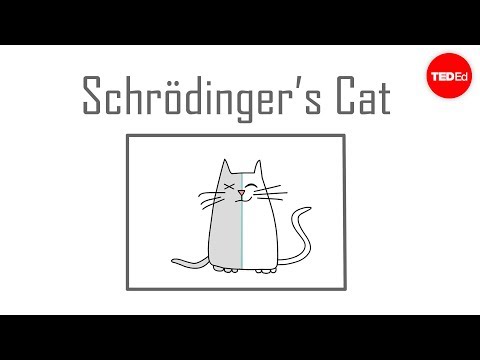
You know that feeling when you accidentally walk into a room and forget why you went in there? It’s a bit like Schrödinger’s cat. Stick with me here!
This quirky thought experiment from the famous physicist has people scratching their heads for decades. Picture this: a cat in a box, both alive and dead at the same time until you peek inside. Sounds bizarre, right?
But that’s just the tip of the iceberg in the wild world of quantum physics. There are some seriously cool and puzzling ideas lurking around, waiting to mess with your mind.
So let’s take a stroll through Schrödinger’s quirky universe together, shall we? You might just find yourself giggling and gasping at the same time!
Exploring Schrödinger’s Quantum Theory: A Comprehensive Guide to Its Principles and Implications in Modern Science
Alright, so Schrödinger’s Quantum Theory is one of those topics that sounds super complicated but is really kinda fun once you break it down. Imagine you’re sitting with a friend, and you both just scratch your heads over the weirdness of the quantum world. That’s where we’ll go!
To start off, quantum theory is basically a set of principles that explains how tiny particles, like electrons and photons, behave. This behavior can be totally different from what we see in our everyday life. You might remember your science class where they taught you about big things—like trees or cars? Well, at the quantum level, everything gets a bit wacky.
So, now let’s talk about Schrödinger himself. He was this brilliant Austrian physicist who came up with some ideas in the 1920s that still boggle minds today! One of his most famous ideas is known as **Schrödinger’s Cat**—and it’s just as bizarre as it sounds.
Imagine you have a cat in a sealed box along with a random radioactive atom and some poison. If the atom decays, it triggers a mechanism that kills the cat; if not, the cat lives. Until someone opens the box to check, the cat is both alive and dead at the same time! Sounds nuts, right? This thought experiment shows how superposition works in quantum mechanics: particles can exist in multiple states until measured.
In simpler terms:
- Superposition: A particle can be in more than one state at once.
- Entanglement: Two particles can become linked so that changes to one affect the other instantly!
- Wave-Particle Duality: Particles can show characteristics of both waves and particles depending on how we observe them.
Now here’s where it gets really interesting. These principles lead to real-world applications like quantum computing. Imagine computers that could solve complex problems way faster than today’s machines because they harness superposition! That could revolutionize tech as we know it.
But there’s also this philosophical side to Schrödinger’s work. It raises questions about reality itself and observation—like do things only exist when we look at them? It’s almost poetic!
On a personal note, I remember reading about Schrödinger’s Cat while hanging out with friends during college. We were all sipping coffee and laughing nervously about what it would mean if we had an alive-dead cat chilling in our living room! That moment made science feel alive—like there was no boundary between serious theory and just having fun with wild ideas.
So yeah, Schrödinger’s Quantum Theory opens up a rabbit hole filled with curious paradoxes and challenges our understanding of reality itself. It mixes science with philosophy in such an exciting way—it doesn’t matter if you’re into physics or not; it’s hard not to be captivated by what lies behind closed boxes full of mystery!
Einstein’s Insights on Schrödinger: Exploring the Intersection of Quantum Mechanics and Relativity
Einstein and Schrödinger: A Cosmic Tango
Okay, so let’s jump into this cool connection between two of the biggest brains in physics: Albert Einstein and Erwin Schrödinger. They were both pivotal figures in understanding the universe, but they danced around some major ideas in different ways.
Einstein is famous for his theory of relativity, which changed how we think about space and time. He saw the universe as a kind of grand clockwork, all predictable and orderly. Imagine you’re at a park watching a perfectly timed fountain show. Everything has its place, you know? That was Einstein’s vision.
Now, enter Schrödinger with his quantum mechanics. This guy took a wild left turn by saying that at tiny scales—like atoms—things don’t behave like we expect them to. It’s like being in a funhouse where everything looks distorted and nothing is what it seems. With his famous thought experiment involving a cat that’s both alive and dead until you see it, he showed us that particles exist in states of probability rather than certainty.
The Clash of Ideas
But here’s where it gets interesting: Einstein didn’t buy into this whole “probability” thing very easily. He famously said, “God does not play dice with the universe.” So while Schrödinger was embracing this strange new world where particles could be in multiple states at once, Einstein wanted to stick to the idea that everything should have a definite state.
You can see their differing philosophies reflected in their work too.
- Determinism vs Indeterminism: Einstein’s theories rely heavily on determinism—everything can be predicted if you know enough about it.
- Quantum Superposition: Schrödinger’s work opened doors to concepts like superposition, where particles can exist in multiple states until observed.
Imagine two friends debating over how to play a game: one wants strict rules while the other says it’s all about spontaneity! That was Einstein and Schrödinger.
The Legacy of Their Insights
Their debates helped shape our understanding of quantum mechanics today. Even though they had their differences (which sometimes got pretty heated), both contributed massively to physics as we know it now!
There’s something kind of beautiful about how these two minds clashed yet complemented each other. You might think it’s just theoretical stuff—but these ideas impact technology2 right now! Ever used your smartphone? Yep, quantum mechanics plays a role there too!
So next time someone mentions Schrödinger’s cat or talks about relativity, think back to these two brilliant minds and their cosmic tango through the fascinating realms of science!
Exploring Schrödinger’s Famous Quote: Insights into Quantum Mechanics and Its Impact on Science
So, let’s talk about Schrödinger’s famous quote, especially the one that goes something like this: “I don’t like it, and I’m sorry I ever had anything to do with it.” This quote stems from his discomfort with quantum mechanics. The whole concept can feel a bit mind-bending, right? Well, it all ties into something called quantum superposition, which is at the heart of Schrödinger’s famous cat thought experiment.
Now, imagine putting a cat in a box with a radioactive atom. If the atom decays, it releases poison and the cat dies; if not, the cat lives. According to quantum mechanics, until you open that box and check, the cat is both alive and dead at the same time. Sounds nuts? Well yeah! This is superposition, where things exist in multiple states until observed.
Schrödinger used this idea to illustrate how strange and counterintuitive quantum mechanics can be. The thing is that in classical physics—like when you’re tossing a ball—we are used to neat outcomes. With quantum particles? Not so much! They can exist in several places at once or even go through two paths simultaneously until you’re looking at them.
- Observation Matters: One of the wild things about quantum mechanics is that simply observing something changes its state. It’s as if particles are shy! They go into hiding until you peek inside.
- The Uncertainty Principle: On top of that, there’s Heisenberg’s uncertainty principle which tells us you can’t know both the position and momentum of a particle precisely at the same time. It’s like trying to catch smoke with your bare hands—frustrating!
- Quantum Entanglement: Then we have entanglement—a weird connection between particles where one instantly influences another no matter how far apart they are. Imagine having a twin who always knows what you’re feeling—whether they’re next door or halfway around the world!
This stuff isn’t just theoretical either; it has actual implications for modern technology! Think about how we use things like lasers or semiconductors—those gadgets rely on principles of quantum mechanics every day. Plus, breakthroughs in fields like quantum computing could totally change our tech landscape.
The beauty—and frustration—of quantum mechanics lies in its paradoxes. It challenges our traditional understanding of reality and makes us question what we think we know. You could say Schrödinger himself was grappling with these concepts when he expressed his regrets about his involvement in all this crazy science!
You might not walk away understanding everything about Schrödinger’s thoughts on this stuff—but hey, isn’t that what makes science so captivating? It keeps us curious and constantly searching for answers—a bit like opening that infamous box.
Alright, let’s chat about Schrödinger’s quantum world, which is, like, one of the most mind-boggling areas of physics. You’ve probably heard of Schrödinger’s cat—it’s that odd thought experiment where you have a cat in a box that’s both alive and dead until you open it up. Crazy stuff, right?
So here’s the deal: quantum mechanics challenges everything we think we know about reality. Imagine being at a party where the music suddenly stops and you realize everyone is frozen in their spot. That’s sort of like how particles behave at the quantum level—they can exist in multiple states at once until someone, or something, observes them. It’s like reality changes based on whether we’re looking or not!
This whole idea sends shivers down my spine sometimes. I mean, just think about it! I remember chatting with my buddy Sam about this when we were in college—he got so frustrated trying to wrap his head around it that he dramatically threw his coffee cup across the room (sorry to the janitor!). But honestly? That frustration kind of speaks volumes about how weird and complex this stuff really is.
Then there are those quantum entanglements—two particles connected in such a way that if you mess with one, the other reacts instantly no matter how far apart they are. It feels like something out of a sci-fi movie! And yet here we are talking about actual science. What does that say about our reality? Does distance even matter if these particles can be so intertwined?
But let me tell you—this isn’t just some abstract mumbo-jumbo for scientists wearing lab coats. It has real-life implications; think quantum computing or advances in medical technology. The more we learn about this bizarre realm, the more doors open for innovation.
So yeah, when you dive into Schrödinger’s world, you’re not just peeking into a scientific oddity; you’re stepping into a universe full of paradoxes that challenge your everyday expectations. And who knows? Maybe one day we’ll figure it all out—or maybe we’ll just find more questions to ask. That thought alone is pretty exciting!