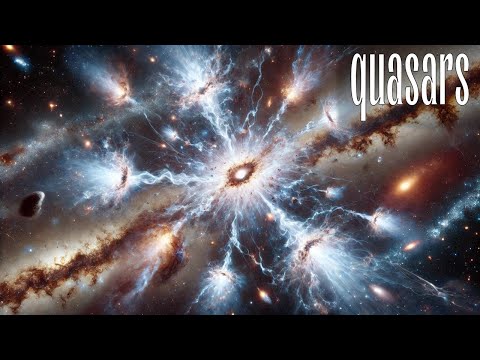
You know what’s wild? There are these things in space that shine brighter than a billion suns. Seriously! They’re called quasars, and they’re about as mysterious as your favorite magician’s tricks.
Once, I was hanging out with a friend, and we were stargazing. We were trying to spot the Big Dipper when out of nowhere, they asked me about quasars. I had to admit: I didn’t know much. But hey, a little research led me down a cosmic rabbit hole that left me jaw-dropped!
Just imagine a giant black hole munching on gas and dust like it’s the last slice of pizza at a party. That’s pretty much what a quasar is—an energetic powerhouse at the center of distant galaxies.
So let’s take a stroll through the universe and unravel this cosmic enigma together! Buckle up; it’s gonna be a stellar ride!
Exploring the Mysteries of the Galaxy: Insights from Astronomy and Science
When you look up at the night sky, it’s kind of mesmerizing, right? I mean, just thinking about all those stars and galaxies out there can make your mind go wild! But one of the real rock stars in the cosmos is something called a quasar. These things are like cosmic beacons shining brightly from billions of light-years away, and they’ve got some pretty interesting stories to tell.
So what exactly is a quasar? Picture this: a supermassive black hole at the center of a galaxy. That black hole is surrounded by a swirling disk of gas and dust, all getting pulled in due to its intense gravity. Now, as this material spirals in, it heats up and emits an incredible amount of energy—like an enormous lighthouse shining across the universe! This emission makes quasars some of the most luminous objects we know about.
But why should you care about these faraway wonders? Well, quasars aren’t just pretty lights; they provide us with insights into the early universe. When we observe them, we’re looking back in time—sometimes up to 13 billion years! This means that by studying quasars, we get to peek into our universe’s past and learn how galaxies formed and evolved.
- Distance Indicator: Quasars help astronomers gauge how far away galaxies are. The light from these objects travels vast distances before reaching us—and based on that journey, scientists can determine how fast the universe is expanding.
- Cosmic Evolution: They give clues about galaxy formation. By examining different kinds of quasars at various stages of their life cycle, researchers can piece together how galaxies developed over billions of years.
- Chemical Composition: Quasars allow us to study the chemical makeup of their surroundings. As light travels through gas clouds between us and the quasar, it interacts with elements like hydrogen and helium. This interaction helps scientists identify what materials were present when those galaxies formed!
A little anecdote for you: There was once a team doing research on quasars when they stumbled upon one that was glowing brighter than any other known quasar. They quickly realized that this wasn’t just any run-of-the-mill quasar; it was like discovering your favorite band had released an album after years! It sparked excitement throughout the scientific community because it challenged existing ideas about how black holes grow.
In essence, studying quasars not only fuels our curiosity but also enhances our understanding of physics and cosmic history. Like little snapshots frozen in time from billions of years ago, these enigmatic forces beckon us to unravel more mysteries hiding in plain sight within our vast universe.
The quest continues! As technology improves—like super fancy telescopes getting launched—we’ll keep uncovering secrets hidden among these distant lights. Who knows what else we might find staring back at us from beyond? Isn’t that just wild?
Exploring the Top 10 Most Powerful Forces in the Universe: Insights from Modern Science
Exploring the universe is like peeling back layers of an onion. Each layer reveals something more incredible than the last. When we talk about the most powerful forces in the cosmos, we’re diving into a vast realm where physics meets pure mind-boggling phenomena.
First up, we have gravity. Yeah, it’s what keeps your feet on the ground, but it’s so much more. It shapes planets, stars, galaxies, and even light! Think about black holes: these invisible monsters have gravity so strong that not even light can escape their clutches. The drama of their formation is wild—collapsing stars shrink under their own weight until they reach this point of no return.
Next on our list is electromagnetism. This force is why you can see and feel things around you. It’s responsible for everything from lightning bolts to auroras in the sky. It governs how atoms bond together to form molecules, creating all kinds of matter. Imagine two magnets snapping together; that’s similar to how charged particles interact!
Then we have strong nuclear force. Let’s be real—it sounds complicated, but it’s basically the glue holding protons and neutrons together in an atomic nucleus. Without it, matter wouldn’t exist as we know it. If you’re into explosive stuff (who isn’t?), this force is also at play in nuclear reactions!
After that comes weak nuclear force, which plays a role in radioactive decay. This one’s sneaky! It’s responsible for particles changing from one type to another; think about how certain uranium isotopes decay into lead over time—it sounds like something out of a sci-fi movie.
Now let’s talk about dark energy. Even though we can’t see it directly (how frustrating!), scientists believe it makes up a whopping 68% of our universe! It seems to be driving galaxies apart and accelerating their flight away from each other—like an unseen hand pushing them away faster every moment.
On top of that, there are those cosmic rays flying through space with insane energy levels! These charged particles zoom across the universe at nearly light speed and can originate from places like supernovae or active galactic nuclei (AGN). They’re basically nature’s way of sending us postcards from outer space!
Speaking of AGNs, they lead us right into our next powerful force: quasars. These are some of the brightest objects in the universe! Picture this: supermassive black holes surrounded by swirling gas that heats up so much as it spirals inward that it emits enormous amounts of radiation—seriously blinding stuff! They help us understand cosmic distances and how galaxies evolved over time.
Then there’s the expansion of the universe. Galaxies are moving away from each other because space itself is expanding. Sometimes I imagine space as a loaf of bread baking; as it rises, everything inside moves apart from one another—a fascinating thought!
Let’s not forget about time dilation, which comes straight outta Einstein’s theory of relativity! In simple terms, gravity can warp time—it actually runs slower near massive objects compared to areas with less mass! This phenomenon means that if you were hanging out near a black hole (not advisable!), you’d age slower than someone chilling on Earth.
Finally, there’s entropy, which tends to say everything moves toward disorder over time—or as my grandfather used to say when my room was messy: “You know kids these days!” Entropy dictates how energy transitions and influences processes across space—from heat death theories to star formation.
So there you go—ten powerful forces shaping our universe! Each one tells a story filled with mysteries yet to unravel. The more we learn about these forces—especially those involving quasars—the more we realize how little we know about this incredible cosmos we call home! Cool stuff, huh?
Quasars vs. Black Holes: Unraveling the Mysteries of the Universe’s Most Powerful Objects
Quasars and black holes are two of the most captivating objects in the universe. They’re like cosmic giants, each with their own bizarre characteristics. So, let’s break this down a bit.
First off, **what’s a quasar?** Imagine the brightest lighthouse you’ve ever seen, but way brighter—like trillions of times brighter than our sun! Quasars are powered by supermassive black holes at the centers of distant galaxies. When matter falls into these black holes, it heats up and emits incredible amounts of energy, often outshining entire galaxies. Pretty cool, huh?
On the other hand, **a black hole** is a region in space where gravity is so strong that nothing can escape from it—not even light! That’s why they’re called “black.” They form when massive stars run out of fuel and collapse under their own gravity. But don’t let that freak you out too much; they’re not just floating around like vacuum cleaners waiting to suck everything up. They’re pretty far away from us!
Now let’s compare these two fascinating entities:
- Energy Output: Quasars release immense energy due to accretion processes around their black holes.
- Visibility: Quasars can be observed billions of light-years away, while black holes themselves are invisible unless interacting with nearby matter.
- Size: Black holes can range from a few times to billions of times the mass of our sun; quasars typically indicate the presence of even larger supermassive black holes.
- Scale: While both are vast, quasars represent an active phase in a galaxy’s life cycle with significant energy output compared to the more dormant state of many black holes.
Let’s dig a little deeper into how they relate to each other. Quasars are basically indicators that there’s something big going on in their host galaxies—a supermassive black hole gobbling up material like it’s at an all-you-can-eat buffet. This process creates powerful jets and beams that shoot outwards at nearly the speed of light—imagine cosmic fireworks!
You know what’s mind-boggling? Some scientists believe that learning about quasars helps us understand how galaxies evolve over time because they’re often found in young galaxies during periods when star formation is ramping up.
I remember reading about one quasar called **3C 273**, which was discovered back in 1963. It blew people away with its brightness and distance—it opened a whole new chapter in astronomy! It showed us there were things out there we’d never even considered before.
So yeah, both quasars and black holes play crucial roles in our understanding of the universe. They remind us how dynamic and varied space can be! Whether you look at them as cosmic forces or mere curiosities, there’s no denying their importance in unraveling our cosmic mysteries.
Quasars are like the rock stars of the universe—seriously! They’re all about that high-energy life, and they shine with a brilliance we can’t help but be curious about. Imagine this: billions of light-years away, there’s a supermassive black hole surrounded by swirling gas and dust, all heating up and creating this incredible glow. That’s what a quasar is! It’s basically black holes having a wild party, and we’re lucky enough to catch a glimpse.
I remember sitting in my old astronomy class, staring at the images of these distant quasars projected on the screen. My professor animatedly described them as “the beacons of the early universe.” I could see how excited he got; it was contagious! He painted this picture of ancient light traveling through time and space just to reach us—wow! Thinking about it still gives me chills.
But let’s break down what makes quasars so special. When we peek into space with powerful telescopes, we’re not just looking at pretty pictures. We’re also seeing the evolution of galaxies and learning about their growth over billions of years. Quasars are like cosmic lighthouses helping us understand where everything fits in the grand scheme.
Now, here’s something intriguing: they aren’t just pretty lights. They give us clues about dark matter and how galaxies merge. The energy these guys put out can outshine entire galaxies! It’s mind-boggling to think that these dimmer spots in our night sky could actually be portals into understanding fundamental concepts like gravity and expansion.
And here’s a fun fact for you: though they’re hard to spot without fancy equipment, there are tons of them scattered throughout the universe. Each quasar tells a story—a love letter from the cosmos written across eons—of how our universe has evolved.
So yeah, exploring these bright celestial objects is more than just gazing at cool lights in the sky; it’s about connecting with our cosmic past and contemplating where we fit into this vast universe. And honestly? Doesn’t that ignite a spark inside you too?