You know that feeling when you’re trying to make sense of a mountain of data? It’s like trying to find a needle in a haystack, right? I mean, come on—where do you even start?
Well, let me tell you about this thing called sufficient statistics. It sounds fancy, but it’s actually super handy. Imagine you’ve got a whole buffet of data in front of you. Sufficient statistics help you grab just the right amount of info without piling your plate too high.
So, picture this: You’re at a party, and everyone’s talking over each other. You can’t make heads or tails of what they’re saying! But then someone distills all those conversations into just a few key points—that’s what these statistics do for your data.
It’s all about simplifying things so you can see the big picture without losing your mind in the details. Pretty cool, huh? Let’s get into why they matter so much in data analysis!
Understanding the Role of Sufficient Statistics in Scientific Research and Data Analysis
So, let’s talk about sufficient statistics. It’s a pretty cool concept in statistical theory. You might be thinking, “What is that even?” Well, let me break it down for you.
First off, imagine you have a big jar of jellybeans. You want to know the average weight of jellybeans in that jar, right? So, you take a sample and weigh a few of them. Now, the magic happens with sufficient statistics. They’re basically a way to summarize all the data you’ve collected in a way that still gives you the most important information about the population.
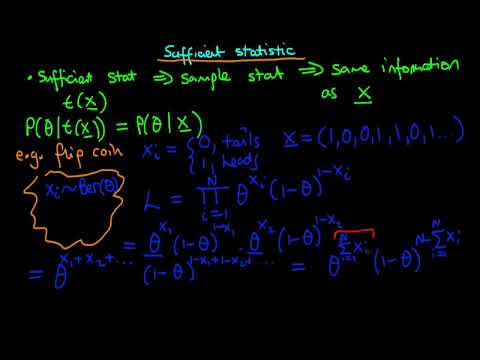
Here’s a simpler example: If you’re tossing a coin and want to know how biased it is, counting heads or tails gives you the answer without needing every single toss recorded. In this case, the total number of heads or tails is your sufficient statistic.
Now think about data analysis in scientific research. When analyzing a dataset, researchers often need to extract relevant information while ignoring excess details that don’t really help with their conclusions. This is where sufficient statistics come into play.
- Efficiency: It saves time and computational resources by reducing the amount of data needed for analysis.
- Minimality: They carry all necessary information about parameters while being as compact as possible.
A classic example is when estimating the mean of normally distributed data. If you have random samples from this distribution, just knowing the sample mean and variance gives you all you need to estimate population parameters accurately!
Additionally, sufficient statistics often help when dealing with complex models. For instance, in Bayesian statistics, these statistics can simplify calculations and lead to more straightforward inference.
But hey! The cool part is that not every statistic is sufficient for every parameter. Think of it like fitting puzzle pieces together; some pieces work well for certain pictures but not others. Researchers need to carefully choose which statistics are sufficient depending on what they’re trying to estimate.
Another fun thing? Sufficient statistics are connected deeply with likelihood functions. The likelihood function measures how likely your observed data would be under various parameter values. If your statistic captures all relevant info about your data, then it leads directly back to these likelihoods—pretty neat!
So remember: in scientific research and data analysis, using sufficient statistics is like having an efficient toolbox that helps streamline your findings without losing essential insights. It’s all about working smarter with data rather than harder!
In summary, understanding sufficient statistics isn’t just for mathematicians or statisticians; it’s vital for anyone looking to make sense of data without getting lost in unnecessary details or computations!
Understanding the Sufficiency Principle in Statistics: Its Importance and Applications in Scientific Research
Understanding the Sufficiency Principle in Statistics is like peeling an onion, layer by layer. You see, in the realm of statistics, sufficiency helps us capture all the important information from our data while keeping things simple. It’s a big deal for anyone diving into data analysis and scientific research.
Now, let’s break it down! The **Sufficiency Principle** states that if you have a set of data and a statistical model, there could be a smaller representation of that data that still contains all the necessary information about the parameter you’re interested in. Basically, if you can summarize your data without losing essential info, you should do it.
Imagine you’re trying to figure out how tall your friends are. You gather everyone’s heights – say 5’6″, 5’8″, and 5’10”. Instead of remembering each height separately, you could just use their average height, right? That average height is sufficient for understanding their general height; it compresses all those heights into one number.
In statistics jargon, we talk about **sufficient statistics** to represent our data effectively. A statistic is considered sufficient for a parameter if knowing that statistic gives you all the information in your data regarding that parameter. So when you’re analyzing something like test scores or survey results, you want to isolate what’s really crucial.
Why does this matter? Well, using sufficient statistics can make computations easier and models simpler. That means when scientists analyze complex datasets—like those from clinical trials or environmental studies—they can focus on what’s truly relevant without getting lost in unnecessary details.
But there’s more! This principle also helps avoid redundancy in statistical inference. In research scenarios, repeating info doesn’t help make better predictions or conclusions; instead, it complicates things! When scientists use efficient summaries of their data through sufficient statistics, they boost their analyses’ clarity and efficiency.
So let’s highlight why understanding this principle is vital:
- Clarity: It reduces complexity in analyzing datasets.
- Efficiency: Saves time by minimizing unnecessary calculations.
- Focus: Keeps attention on critical information needed for analysis.
- Better Inference: Allows researchers to draw clearer conclusions from their work.
In real-world research projects—say studying how different diets affect health—you could collect tons of dietary info. But if just a few key numbers (like calories consumed per day) provide what you need to understand health outcomes related to those diets? Fantastic!
The Sufficiency Principle isn’t just some theoretical idea tucked away in math textbooks; it’s at the core of solid scientific practices! It helps bridge complex statistical theories with practical applications every time researchers analyze large amounts of diverse data.
So next time you hear someone mention sufficiency in statistics during a study presentation or while reading about some cool research findings? You’ll know these ideas aren’t just academic fluff—they’re crucial tools that help scientists make sense of our world out there!
Understanding Minimal Sufficient Statistics: Key Concepts and Applications in Scientific Research
Alright, let’s talk about something that sounds super fancy but is, at its core, pretty neat: **minimal sufficient statistics**. These are like the secret sauce in data analysis, helping you to get just the right amount of info from your data without all the clutter. You know how sometimes you just want the highlights and not the whole story? That’s basically what minimal sufficient statistics do.
First off, let’s break down what we mean by sufficient statistics. A statistic is considered sufficient if it captures all the information needed about a parameter in a statistical model. Imagine you’re making a smoothie. If you have enough bananas and berries (the sufficiency), you don’t need to know how many ice cubes are in there to guess how sweet it’ll be. You follow me?
Now, minimal sufficient statistics are those that achieve this sufficiency with as little data as possible. It’s like having just the right amount of fruit without overwhelming your blender! In technical terms, if you have a set of statistics that summarizes your data completely and no other smaller statistic can do that job, then you’ve got a minimal sufficient statistic.
But why should you care? Well, think about scientific research or any kind of data analysis where you’re trying to interpret results. You want to make decisions based on the essentials and not get bogged down by unnecessary details or noise in your data.
- Simplicity: Minimal sufficient statistics strip away the fluff. They help researchers focus on what really matters.
- Efficiency: They often make calculations easier and faster because you’re dealing with less information while still retaining all necessary insights.
- Identifiability: In parameters estimation, having minimal sufficient statistics can help identify parameter values more easily.
A classic example involves estimating the mean of a normally distributed dataset. If you’re given a bunch of numbers (let’s say heights of students), instead of keeping every single height measurement (which can get unwieldy), you just need the sample mean and sample size to summarize everything about these heights effectively! Pretty cool, right?
You might wonder if minimal sufficient statistics are always easy to find—it’s sometimes a bit tricky! For certain distributions like normal or exponential distributions, they are relatively straightforward to pin down. But for more complex models? It can feel like searching for lost keys in your couch cushions—frustrating!
The beauty here is that once you know how to find these minimal sufficient statistics for various models, it opens up doors for better data analysis practices in fields ranging from biology to economics. Researchers can use them confidently knowing they have captured all required information without excess baggage influencing their insights.
If you’re diving into statistical methods or maybe even writing up an experiment’s results, keep this concept in mind. Recognizing when you’ve got those minimal sufficients gives clarity in research results—like turning on a lamp in a dark room. So next time you sift through piles of data trying to make sense of it all remember: sometimes less really is more!
You know, when you first start digging into the world of data analysis, it can feel overwhelming. There’s just so much information swirling around. I remember when I was trying to wrap my head around all the different methods and concepts, hoping to make sense of the chaos. That’s when I stumbled upon something called sufficient statistics. It was like finding a beacon in a dense fog.
Basically, sufficient statistics condense all the critical information from a dataset into a smaller set without losing any of the valuable details needed for analysis. It’s like looking at a massive pile of puzzle pieces and realizing that only a few key pieces can actually show you the complete picture. If you’ve ever felt lost in numbers and wanted to get straight to what matters, that’s where sufficient statistics come in.
This concept is super useful in areas like machine learning and hypothesis testing. Think about it—when you’re dealing with tons of data, having those key figures lets you work more effectively without getting bogged down in unnecessary details. It’s almost like having a secret weapon in your back pocket! Well, sort of.
So here’s the thing: using sufficient statistics isn’t just about simplifying things; it’s also about clarity. When you extract only what you need from your dataset, you keep your focus on what really counts. Less clutter means better decision-making. Like when you’re trying to pick a movie on Netflix: instead of scrolling endlessly through options, wouldn’t it be great if someone could just highlight the ones you’ll love? That’s how sufficient statistics work—they highlight what matters most.
There are some trade-offs too, though. Sometimes those key metrics might not tell the complete story or leave out nuances that could change your understanding of the data—like missing out on an emotional subplot in your favorite book because you only skimmed through! So it’s crucial to keep an open mind and remember that while this method provides powerful insights, it’s not always foolproof.
Reflecting on it all now makes me realize how important balance is in data analysis; knowing when to dive deep into details or when to simplify things with sufficient statistics will really enhance understanding and decision making. It’s fascinating how concepts like these can shape our approach towards data—a reminder that even amidst complexity, there are ways to find clarity!