You know that moment when you’re trying to find your way through a maze? It’s like, one wrong turn and you’re back at square one, right? Well, graph traversal is kinda like that, but with numbers and lines instead of walls.
So, there’s this super smart dude named Robert Tarjan who came up with a slick way to navigate these complex networks. His algorithm helps you find stuff quickly—like a GPS for graphs! Seriously, it’s efficient and elegant.
Imagine having the power to untangle all those connections without breaking a sweat. That’s what we’re diving into today! Get ready to geek out over Tarjan’s Algorithm and see how it can change the game in graph theory.
Understanding Kosaraju’s Algorithm: A Comprehensive Guide to Strongly Connected Components in Graph Theory
So, let’s chat about **Kosaraju’s Algorithm** and its cool role in finding **strongly connected components (SCCs)** in directed graphs. Sounds complex, but hang tight! I’ll break it down for you.
First off, what’s a strongly connected component? Imagine a group of friends where everyone can reach each other directly or through other friends. That’s an SCC! In graph terms, it means that for any two vertices (or nodes), there’s a path leading from one to the other in both directions.
Now, why should you care about this? Well, SCCs help in various applications like analyzing social networks or optimizing web page rankings. A lot of tech stuff runs on these concepts, you know?
**Kosaraju’s Algorithm** is like your trusty guide through the maze of directed graphs. It works in two main steps, which is pretty neat because it makes the whole process efficient, running in linear time—O(V + E), where V is vertices and E is edges.
Step 1: Perform a DFS and record finish times.
You start with a depth-first search (DFS) on the original graph. As you explore each node and finish with it (i.e., backtrack), you note down its finishing time. Think of this as marking when friends leave a party: the last ones out are the ones who stayed longest!
Step 2: Transpose the graph and perform DFS again.
Next up, you create what we call a “transpose” of that graph. This just means flipping all the edges around; if A points to B, now B points to A. Then you take that transposed graph and do another DFS! This time, though, you start from nodes based on their finishing times from step one (from last finished to first).
Why does this work? It’s all about how SCCs relate to each other through paths. When you do the DFS on the transposed graph based on finish times from the first pass, nodes that are reachable from each other will cluster together.
To get specific here:
- The first pass identifies “exit” points.
- The second pass collects nodes that can reach these exit points.
- This way, each finished cluster represents one strongly connected component!
And you’re done! You basically have all your strongly connected components identified.
A quick personal story here: I once tried explaining this algorithm to my little cousin using Lego blocks. We built towers where each block could only connect to certain blocks above or below it… By reshuffling them after coloring them based on how they connected? Total light bulb moment for both of us! It made grasping those connections way easier.
In summary, Kosaraju’s algorithm might sound tricky at first but with its clever method of traversing graphs twice—once in normal order then once more in reverse—it’s truly powerful for finding those elusive clusters of connectivity within graphs.
Hope this clears things up! If you’ve got any questions or just wanna chat more about algorithms or anything else nerdy, hit me up!
Analyzing Tarjan’s Algorithm for Identifying Bridges in Graph Theory: A Comprehensive Study
Alright, let’s have a chat about Tarjan’s Algorithm and how it helps us find bridges in graph theory. You might be wondering, what exactly is a bridge in this context? Well, it’s simply an edge that, when removed, increases the number of connected components in a graph. It’s like cutting a vital rope in a network; if you do that, some parts will be isolated.
Now, Tarjan’s Algorithm is an efficient way to discover these bridges. Developed by Robert Tarjan in the 1970s, it uses a depth-first search (DFS) method. So basically, it starts at one vertex and explores as far as possible along each branch before backtracking.
The magic happens with two key concepts: **discovery time** and **low values**. The discovery time is just when you first visit a vertex during the DFS. The low value tells you the earliest visited vertex you can reach from that vertex or any of its descendants.
Here’s how it works:
- You begin with a DFS traversal from any vertex.
- For each vertex visited, assign it a discovery time and initialize its low value to its discovery time.
- If you encounter an adjacent vertex that hasn’t been visited yet, recursively apply DFS on it.
- After returning from the recursive call, check if the low value of the adjacent vertex is greater than your current vertex’s discovery time—if so, you’ve found a bridge!
Sounds simple enough, right? But hang on—there’s more! When dealing with undirected graphs (which don’t have direction), it’s crucial to avoid treating back edges as bridges. A back edge connects to an ancestor in the DFS tree but doesn’t disconnect components.
Now here’s something interesting: let’s say you’re analyzing a social network graph where people are represented as vertices and friendships as edges. You might want to know which friendships are essential for maintaining connectivity among groups of friends. Those connections are your bridges!
So why do we care about this stuff? Bridges can help identify weak spots in networks or systems—like finding critical routes in transportation networks or understanding relationships in social dynamics.
In terms of efficiency, Tarjan’s algorithm runs in linear time: O(V + E), where V is vertices and E is edges. This efficiency means it can handle large graphs pretty well without breaking a sweat.
Wrapping up: understanding Tarjan’s Algorithm isn’t just about coding; it’s about visualizing connections and seeing how things fit together or fall apart when critical links go missing! Just imagine being able to map out essential friendships or transportation routes—you’d see who truly holds everything together!
Visualizing the Tarjan Algorithm: Enhancing Understanding of Graph Theory in Scientific Research
Alright, let’s chat about something cool in the world of graph theory: Tarjan’s Algorithm. It’s all about efficiently traversing graphs, which are basically just a bunch of points (or vertices) connected by lines (or edges). Think of it like a map where cities are points and roads are edges connecting them.
The thing is, when you’re dealing with big graphs, like those found in social networks or computer networks, you wanna be quick and efficient. That’s where Tarjan comes in. This algorithm helps you find certain aspects of a graph without having to check every single connection one by one. Sounds neat, right?
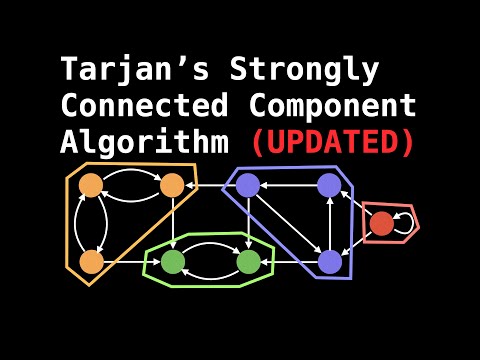
But wait, what exactly does this algorithm do? Well, it primarily helps find strongly connected components. In simpler terms, that means it finds clusters of nodes in a directed graph where any node can reach any other node within that cluster. Imagine group texts—everyone can message everyone else in the group.
Now let’s visualize this! Picture you have a graph representing various friends and their relationships. If some friends frequently talk to each other (like your buddy groups), Tarjan’s Algorithm can quickly show you those close-knit clusters without taking forever sifting through every conversation.
- How does it work? Basically, it uses Depth First Search (DFS), which is a way to explore the graph deeply before moving on.
- It keeps track of each node it visits and assigns them an index so that it knows the order they were discovered.
- If it hits a back edge, meaning it finds an already visited node that isn’t its immediate parent during DFS—it realizes these nodes form part of a strongly connected component.
This whole process is pretty efficient since it runs in linear time—meaning if your graph has ‘n’ nodes and ‘m’ edges, it’ll take O(n + m) time to complete!
An emotional hit here? Well, think about how interconnections reflect real life. Relationships build communities; understanding them improves everything from social policies to software development. Seeing clusters within large datasets makes complex things feel more manageable.
If you’re into programming or data analysis and looking at graphs regularly, using Tarjan’s Algorithm can help make sense of all those connections quicker and easier than ever before!
You know what? This kind of insight shows how math isn’t just numbers—it literally connects us all! And understanding these principles can totally change how we handle data today.
Alright, so let’s chat about something a bit technical but super interesting—Tarjan’s Algorithm. It’s all about traversing graphs efficiently, which is kind of like finding your way through a maze but with some serious math behind it.
Imagine you’re in a big city, and you need to visit a bunch of places. You could just wander around aimlessly, or you could use a map to find the quickest route without backtracking too much. That’s what this algorithm helps with when dealing with graphs!
Now, before we dive too deep into the nuts and bolts, I wanna share a little story. A while back, I was trying to organize a community event, and we had all these different activities and spots laid out in this park. It was chaotic! Everyone was wandering around in every direction—some folks visiting the snack stand for the third time while others were confused about where the games were. It was like a messy graph! If only I had Tarjan’s method to sort it all out and find those connections quickly.
The cool part? Tarjan’s Algorithm focuses on what’s known as “strongly connected components” in directed graphs. So basically, it’s about figuring out which groups of nodes (or points) are linked together tightly enough that you can reach one from another without leaving the group. If you think of friendships, it’s like identifying friend circles—you know who can reach whom without having to scroll through Facebook for ages!
What makes it efficient? Well, it uses depth-first search along with some clever bookkeeping—kind of like keeping track of where you’ve been so you don’t end up going around in circles. By doing this only once for each node instead of multiple times (like some other algorithms), it saves time! And let me tell ya, that can make a huge difference when working with large datasets.
Now here’s where things get really fascinating: the whole idea behind efficient graph traversal isn’t just limited to theory or computer science nerds locked away coding all day. Think about how it applies to real life! From social networks connecting friends to Google Maps plotting your journey home based on traffic patterns—it’s everywhere!
So yeah, next time you’re scrolling through your favorite app or planning an outing with friends (without getting lost in that park), maybe give Tarjan’s Algorithm a little nod for helping make those connections clearer and more efficient. It really shows how math can sprinkle some magic on everyday problems!