You know that feeling when you’re staring up at the stars, and it hits you just how tiny we really are? It’s kinda mind-blowing, right? I remember my buddy once tried to impress everyone by using a toy telescope he found at a garage sale. Let’s just say, he ended up looking at the neighbor’s cat instead of Jupiter.
But seriously, telescopes are way cooler than they seem at first glance. They come in all shapes and sizes, each serving its own purpose, like superheroes with different powers. Some help us find distant galaxies, while others show us the nearby planets in stunning detail.
So, if you’re curious about these two main types of telescopes and what makes them tick—stick around! You might just find yourself wanting to gaze into the cosmos for hours on end.
Exploring the Two Types of Telescopes: A Comprehensive Guide to Astronomical Science
So, let’s talk telescopes! You know, those amazing tools that let us peek into the vastness of space? They come in two main flavors: **refractors** and **reflectors**. Each has its own unique way of letting us gaze at the stars.
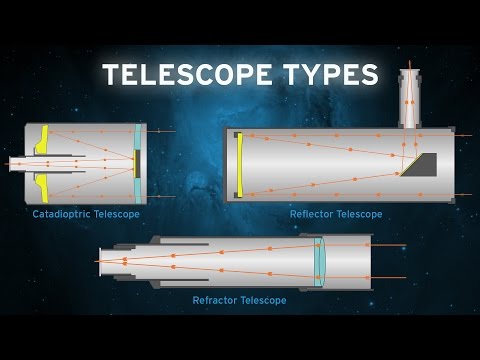
First up, refracting telescopes. These are like the classic ones you picture. They use lenses to gather light and focus it to make things look clearer. Imagine looking through a really cool glass bottle; the way the light bends can change what you see! These telescopes generally have long tubes and are pretty straightforward.
Now, there’s something special about a refractor’s design. Because they use lenses, they can produce sharp images with great color detail. That’s why they’re often used for viewing planets and stars close up! But yeah, they can get kinda heavy and pricey when you want a big one.
Then we have reflecting telescopes. Instead of using lenses, these bad boys rely on mirrors to collect light. A curved mirror reflects light to a focus point where it forms an image. It’s like how you might see your reflection in a shiny car hood but way more complex—and cooler!
The neat part about reflectors is that they can be built larger without breaking the bank as much as refractors do. So for those massive scopes you hear about, especially in research institutions, they’re usually reflectors! Just think about the Hubble Space Telescope—it’s a reflector too!
Both types have their perks and quirks:
- Refractors: Great for planetary views; typically simpler optics.
- Reflectors: Easier to build bigger; good for deep space objects.
However, there’s this trade-off with reflectors: they need regular maintenance since mirrors can get dusty or misaligned over time; it’s kind of a hassle if you’re not into DIY stuff.
In my mind, both types have this magic in their own right; it reminds me of that night I spent stargazing on my roof with friends. We could see Saturn’s rings through my buddy’s refractor—it felt like we were astronauts on our little journey across space!
So whatever your choice is when looking at the cosmos—whether it’s through a refractor or reflector—you’re tapping into centuries of exploration that connect us all to those twinkling lights high above. Isn’t that just mind-blowing?
Exploring the Universe: The Two Main Telescopes Revolutionizing Astronomy
So, let’s chat about telescopes! These magical tools have seriously changed how we see the universe. Two main types of telescopes have really shaken things up in astronomy: the optical telescopes and radio telescopes. They each have their own cool jobs, and they help us understand space in completely different ways.
Optical Telescopes are like the classic ones you picture when you think about stargazing. They catch visible light— you know, the kind of light our eyes can actually see. So, these instruments are great for spotting planets, stars, and galaxies. The famous Hubble Space Telescope is probably one of the best-known optical telescopes. Launched way back in 1990, it has given us some jaw-dropping pictures of deep space that make even skeptics go “wow!”
Now you might be wondering how they work. Basically, optical telescopes use mirrors or lenses to focus light onto a detector—like a camera sensor—that captures all that cosmic beauty. You can find them on Earth (like at big observatories) or even flying high up in space! Being above the atmosphere is helpful because it blocks a lot of light pollution and bad weather.
Then we have Radio Telescopes. These guys operate on a totally different wavelength… literally! Instead of trying to capture visible light, they listen for radio waves emitted by objects in space. It’s like tuning into your favorite radio station but for cosmic signals. One super famous example is the Very Large Array (VLA) in New Mexico—it looks pretty wild with its giant dishes all over the place.
So what makes these radio telescopes so cool? Well, they can pick up signals from really distant objects and phenomena like pulsars or quasars—things we can’t really see with optical telescopes because they’re too faint or far away. And get this: they work during the day and night without worrying about clouds! Imagine doing an all-nighter observing your favorite band while chilling at home; that’s how these telescopes roll!
Each type has its own **unique functions** that complement one another perfectly:
- Optical Telescopes: Great for observing fine details in visible light.
- Radio Telescopes: Perfect for picking up faint signals from deep space.
- Spectrum Analysis: Optical ones help analyze chemical compositions through spectra; radio ones show dynamics within galaxies.
- Catching Varied Phenomena: Some events only show up better in one type than another!
You might think it’s all just numbers and data crunching, but there’s something deeply emotional about staring into the vastness of space through these lenses or dishes. Like when scientists first saw those beautiful images from Hubble capturing distant galaxies—it just makes everything feel connected.
In short, both types of telescopes are distinct yet interconnected threads in our quest to unravel cosmic mysteries. They provide insights that stretch our imagination and deepen our understanding of everything from tiny comets zooming by to massive galactic clusters far beyond what we ever thought possible.
Understanding the Two Main Functions of Telescopes in Astronomy and Scientific Exploration
Alright, let’s talk telescopes! They’re pretty amazing tools for astronomers, and they serve two main functions that totally shape how we see the universe. You know, just peeking into the vastness of space and figuring stuff out like it’s no big deal. So, here’s a breakdown.
The first function of a telescope is to collect light. Think of it like this: the more light you gather from an object in space, the clearer and more detailed that object becomes in your view. It’s kind of like taking a photo with your phone. If you take a picture in low light, everything looks fuzzy and dark. But add some good lighting, and suddenly it all pops!
Telescope designs vary based on how they collect this light. There are mainly two types:
- Reflecting telescopes: These use mirrors to focus light. Big ones are often found in observatories. For example, the famous Hubble Space Telescope is a reflecting telescope! It captures awesome images of distant galaxies.
- Refracting telescopes: These use lenses to bend and focus light. They were the go-to way back when; think Galileo with his lens! These telescopes can show beautiful details of planets like Jupiter or Saturn.
The second main function? Magnifying objects. This is where things get really exciting! Magnification helps us see objects that are super far away as though they’re much closer. With magnification, you can spot craters on the moon or even distant stars twinkling in different colors! How cool is that?
If you’ve ever looked through a big telescope at an observatory or even through binoculars, you’ve experienced this firsthand—it’s like being transported into another world!
The level of magnification can change based on the telescope’s design and its specific eyepiece (that’s what you look through). But here’s the kicker: while magnifying an object makes it bigger, there’s a limit to how much detail you’ll actually be able to see before things start getting blurry again because you’re stretching things too far.
A neat trick: astronomers usually find that less powerful telescopes can give clearer views than high-magnification ones since they gather more light effectively without losing too much detail!
So basically, whether it’s collecting light or magnifying distant worlds (or both), telescopes are vital for our quest to understand what lies beyond our planet. And honestly? Next time you see one pointed at the stars, take a moment to appreciate just how far human curiosity has taken us.
You know, telescopes are like the magic windows to our universe. It’s amazing to think about how they’ve opened our eyes to the stars, planets, and countless galaxies out there. But not all telescopes are created equal. There are basically two big types: refractors and reflectors, each with their own cool quirks.
So, let’s chat about refractor telescopes first. These babies use lenses to bend light and bring objects into focus. Picture a giant magnifying glass—kinda neat, right? I remember when my uncle bought one when I was a kid. He set it up in the backyard one summer night, pointing it at Jupiter. I will never forget seeing that beautiful planet with its stripes and moons! It felt like I was peeking into another world.
On the flip side, we have reflector telescopes that use mirrors instead of lenses. They gather light and bounce it around until it creates an image you can actually see. This design can be more compact than refractors since mirrors are lighter than glass lenses, which means bigger apertures are easier to handle. Reflectors can get super big for serious astronomy without breaking the bank—so more bang for your buck!
Both types have special places in amateur astronomy as well as professional research. Refractors are often favored for planetary observation because they produce crisp images without much distortion. That’s why when you look at the Moon through one of these bad boys, it’s so detailed! Meanwhile, reflectors shine (pun totally intended) when it comes to viewing faint deep-sky objects like galaxies and nebulae because they capture more light.
And here’s a fun tidbit—you might think reflectors came out first since they’re kinda simpler in concept, but actually refractors were the original star-gazers! Ain’t that a twist?
These two telescope types both have their strengths depending on what you’re in the mood for: gazing at our own solar system or getting lost among distant galaxies? Each telescope opens up new ways of seeing—and for all of us fascinated by space—it’s all about exploring what lies beyond our little corner of existence.