You know that moment when you’re staring at a beer can, and it kinda hits you? Like, how in the world did all these tiny little particles come together to make, well, this? Seriously.
Atoms are like the ultimate building blocks of everything. They’re the reason your favorite snack exists and what makes up your best friend’s weird sense of humor. But here’s the kicker: we barely think about them!
Okay, so let’s break it down. Atoms are super small, but they pack a punch in terms of importance. Understanding atomic structure helps us figure out why things behave the way they do. It’s wild!
So grab your favorite snack and settle in. We’re diving into the fascinating world of atoms — where science isn’t just theory; it’s the stuff that makes life…well, life!
Exploring the Fundamentals of Atomic Structure in Modern Science
Atomic structure is pretty cool, right? I mean, when you think about it, everything around us is made up of tiny particles called atoms. They’re like the building blocks of life, and understanding them helps us grasp so much about the universe.
First off, let’s break down what an atom actually is. An atom consists of three main parts: protons, neutrons, and electrons. Protons and neutrons hang out in the center—it’s called the nucleus—while electrons zoom around the outside in various orbitals. Think of it like a solar system where the nucleus is the sun and electrons are planets zipping around.
Now, each element on the periodic table has a unique number of protons. That number is known as the atomic number. For example, hydrogen has one proton and oxygen has eight. This atomic number essentially tells you what kind of element you’re dealing with. It’s kind of mind-blowing to realize that just a few protons can create something as complex as a living organism while others create gases we breathe!
You ever notice how some atoms are stable while others are not? That’s where isotopes come into play! They have the same number of protons but different numbers of neutrons. These differences can make some elements radioactive—they want to break down into something more stable over time.
Moving on to electrons, these little guys are super important because they determine how an atom interacts with others. The way they arrange themselves in energy levels around the nucleus influences chemical bonding. If you have two atoms trying to bond together but their outermost electron shells aren’t filled—well, they’re gonna be a bit clingy! They’ll want to share or transfer electrons to stabilize themselves.
And here’s another thing that gets really interesting: ions! Atoms can gain or lose electrons and become charged particles called ions. You can picture this like making a new friend who brings snacks—more positive or negative energy changes how atoms behave in reactions!
Why does all this matter? Understanding atomic structure is foundational for fields like chemistry and physics. For instance, chemists need this info for creating new materials or drugs because it helps explain how substances will react with one another.
So yeah, whether it’s powering your phone or explaining why cooking with salt matters (thanks to ionic bonds), we see atomic structure influencing our daily lives everywhere! Every single thing around us—from air to water—is a dance of atoms following a structured rhythm.
In essence, atomic structure isn’t just dry science; it’s deeply connected to everything we experience in life! It’s kind of exciting when you realize that all these tiny particles work together in ways that shape our world!
The Significance of Atomic Structure in Scientific Understanding and Innovation
Atomic structure is one of those topics that sounds super technical, but it’s really about the building blocks of everything around us. You know, when you get down to it, everything—your morning coffee, the air we breathe, and even your favorite snack—is made up of atoms. So grasping the significance of atomic structure is like understanding the alphabet before learning to read!
Atoms are made up of three main particles: protons, neutrons, and electrons. Protons live in the nucleus at the center, with neutrons hanging out next to them. Electrons zoom around outside, kind of like little planets around a sun. It’s wild how these tiny particles dictate so much about what substances are like.
First off, let’s talk about elements. Each element on the periodic table is defined by its number of protons. For example, hydrogen has just one proton, while gold has 79! This atomic identity shapes how elements react with each other. When you know an element’s atomic structure, you can predict its behavior in chemical reactions. Like when sodium (with 11 protons) meets chlorine (with 17 protons)—boom! You get table salt.
Understanding atomic structure also plays a huge role in innovation. Take semiconductors used in electronics; they’re all about manipulating atomic properties for better performance. By examining how electrons behave in different materials at the atomic level, scientists can create better devices—think smartphones and computers that are smaller and faster.
And here’s something cool: quantum mechanics comes into play when we talk about atoms. Quantum physics explains how electrons act strangely compared to larger objects—they don’t always travel like good little balls but exist in probabilities until observed! This leads to amazing tech developments like lasers and MRI machines that help save lives.
Also worth mentioning is how studying atomic structure helps us tackle big challenges like sustainable energy. By understanding how atoms interact in materials used for solar panels or batteries, researchers can develop more efficient ways to harness energy. Like working on making electric cars last longer between charges?
Let’s not forget about medicine either! Atoms play a key role in medical imaging techniques and targeted drug delivery systems too. With a solid grasp on atomic interactions, doctors can devise treatments tailored specifically to combat diseases at a cellular level.
So really, the significance of atomic structure isn’t just nerdy science stuff—it connects to our everyday lives in ways most people don’t even realize! It fuels scientific understanding and drives innovation that keeps pushing society forward into new frontiers.
In summary:
- Atomic identity: Elements defined by protons shape chemical reactions.
- Innovation: Understanding electron behavior leads to better technology.
- Quantum mechanics: Influences cutting-edge medical technologies.
- Sustainable energy: Assists research for cleaner energy sources.
- Medicine: Enhances imaging techniques & targeted therapies.
The world around us is alive with atoms doing their thing; knowing their secrets helps us make smarter choices today and invent for tomorrow!
Exploring the Fundamentals of Atomic Theory: Key Concepts in Chemistry and Physics
Okay, let’s chat about atomic theory—seriously, it’s like the backbone of chemistry and physics! At its core, atomic theory tries to explain what everything is made of. So, picture this: everything around you—from that delicious pizza to the air you breathe—is made up of tiny particles called atoms.
Now, atoms are like the building blocks of matter. They’re super small, way too tiny to see with your eyes. Imagine a speck of dust—that’s a million times bigger than an atom! And here’s a fun twist: each atom has different parts, which we’re gonna break down.
- Nucleus: Right in the center, there’s the nucleus. It’s packed with protons and neutrons. Protons are positively charged, while neutrons have no charge at all. The nucleus is like the heart of the atom!
- Electrons: Floating around this nucleus are electrons. These little guys have a negative charge and zip around in areas called electron shells or orbitals. Think of them as planets orbiting a sun—kinda cool!
The number of protons determines what element it is. Like, if an atom has one proton, it’s hydrogen; if it has six protons, it’s carbon! Neat how something so small can define everything about an element?
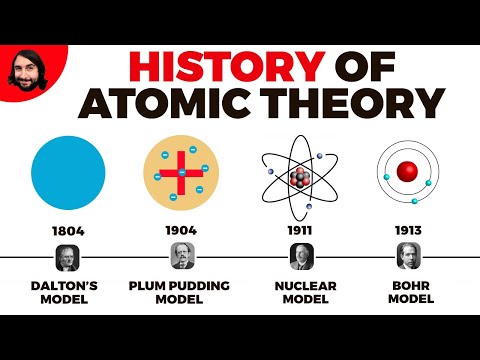
A long time ago—think back to the early 1800s—a scientist named John Dalton came up with this whole idea that atoms are indivisible spheres. He thought that different elements were made up of different kinds of atoms. But then along came J.J. Thomson in 1897 who discovered electrons! He found out that atoms weren’t just solid spheres; they had these tiny particles zipping around.
This theory evolved even more over time through figures like Ernest Rutherford and Niels Bohr. Rutherford figured out that most of an atom is empty space except for that dense nucleus we talked about earlier. Bohr added on by suggesting that electrons exist in fixed orbits around the nucleus.
Now here’s where it gets really wild: quantum mechanics. This is where things get a bit fuzzy because atoms don’t always follow simple rules like we expect them to! Electrons can act like both particles and waves at times—it’s kind of mind-blowing!
The significance? Well, understanding atomic theory helps us grasp how substances interact with each other—like how elements combine to form compounds or why some materials conduct electricity while others don’t.
- Chemical Reactions: Every time there’s a chemical reaction—like when baking soda meets vinegar—you’re seeing atoms rearranging themselves into new combinations!
- Nuclear Energy: Atoms play a central role in nuclear reactions too; energy from splitting these nuclei can power homes or fuel bombs.
The thing is, atomic theory isn’t just some old science lesson—it lays down the tools for multiple fields from medicine (hello MRI machines!) to environmental science (understanding pollutants). Such a big deal for something so tiny!
The next time you munch on your favorite snack or look at your phone screen remember: it all comes down to those little invisible atoms working together in fancy ways! Amazing how much they affect our everyday lives.
Alright, let’s talk about atomic structure. You know, when I was a kid, I remember staring at this giant poster of an atom in my science classroom. It had swirls of electrons around a small nucleus made up of protons and neutrons, and to be honest, it looked kinda like a little solar system. Ever pondered what goes on inside that tiny little world? Well, the thing is, everything around us—like the air we breathe to the chair you’re sitting on—is made up of atoms.
So, what’s the big deal with atoms? Imagine breaking down every single thing into its smallest pieces. That’s what atoms are—super tiny building blocks. Each atom consists of a nucleus that packs protons (which are positively charged) and neutrons (which are neutral). Then there are those speedy little electrons buzzing around the outside. They’re like your hyperactive friend who can’t sit still for more than five seconds!
But why should you care? Well, understanding atomic structure helps us grasp so many other topics in science: chemistry and physics jump to mind right away. For instance, think about how elements combine to form compounds. Water—H2O—is just two hydrogen atoms attached to one oxygen atom! It’s wild to think that such an essential part of life is just a simple arrangement of tiny particles.
Plus, considering atomic interactions can lead us to some groundbreaking discoveries in technology and medicine. Like nuclear energy—it all comes down to manipulating these tiny guys for big results! And don’t forget about how understanding atoms helps with things like nanotechnology or even developing new materials that could revolutionize industries.
In short, digging into atomic structure isn’t just for science junkies or lab geeks; it connects everything from how your phone works to why certain medicines help you feel better when you’re sick. It’s kind of poetic when you think about it—all these invisible little bits working together create our whole world. So next time you see something—anything at all—just remember: it’s all atoms doing their thing!