So, picture this: It’s a Saturday, and you’re in the mood to binge-watch your favorite series. You pop some popcorn and settle in. You grab your remote, but wait! The remote is lost in the couch cushions somewhere. Why is it always hiding like that? Isn’t it just a remote for Pete’s sake?
Now, imagine if that remote had its own special spot every time you needed it. Wouldn’t that save you a ton of time and headaches? That’s kinda how binary search trees work.
These nifty little structures help you organize data efficiently, making it super easy to find what you’re looking for—just like that pesky remote. You won’t be digging through endless junk anymore!
In the next bit, we’ll unravel this whole binary search tree thing and see how they make our digital lives smoother. Get comfy; let’s figure this out together!
Understanding the Binary Search Tree: Optimizing Data Structures for Efficient Searching in Computer Science
Understanding a Binary Search Tree (BST) is like knowing the secret to fast searching in computer science. So, let’s break it down together.
A **binary search tree** is a special type of data structure that stores information in a way that makes searching for data really quick. Here’s how it works: each node in a BST has at most two children, called the left and right child. The key thing is how the nodes are organized:
- The left child always holds a value less than its parent node.
- The right child always holds a value greater than its parent node.
Imagine you have some books on a shelf organized by titles. If you want to find one book, it’s much easier if you know that all the titles starting with “A” are on the left side and those starting with “Z” are on the right. This organization allows you to get to your book without checking every single title!
Now, when you’re searching for something in a BST, you start at the root node. You then compare your target value with the current node:
– If it’s less, you go left.
– If it’s more, you go right.
Keep going until you find what you’re looking for or hit a dead end. This technique can make searching super fast—like finding Waldo in a field of people when he’s standing out clearly!
Let’s dive into an example. Say we want to insert these numbers into our BST: 8, 3, 10, 1, 6, 14.
1. Start with **8**; that becomes our root.
2. Next comes **3**; since it’s less than 8, it goes to the left.
3. Now **10** goes to the right because it’s greater than 8.
4. Then we add **1**, which goes left of **3**.
5. The **6** goes right of **3**, and finally,
6. The **14** goes right of **10**.
So now our tree looks like this:
“`
8
/
3 10
/
1 6 14
“`
In this tree structure, if you were looking for **6**, you’d start at **8**, head left to **3**, and then right again — pretty neat and efficient!
You might be thinking about balancing too—because sometimes trees can get lopsided if we keep adding numbers in order (like just adding them from smallest to largest). A lopsided tree becomes kind of slow since we’d have to navigate through multiple nodes instead of cutting down our search space quickly.
To fix this problem, there are balanced versions like AVL trees or Red-Black trees which automatically keep things sorted as they’re added or removed! By doing so, they maintain quick search times even as data grows.
So remember: binary search trees optimize data organization by allowing efficient searching based on their structured layout. It’s like having an organized closet rather than dumping everything into one pile! You wouldn’t want to hunt for your favorite sweater in all that mess—same with data!
Understanding Optimal Binary Search Trees: Enhancing Efficiency in Data Structures
So, let’s chat about binary search trees (BSTs). You might be thinking, “What’s so special about them?” Well, they’re super useful for organizing data efficiently! Basically, a binary search tree is a way to store data that lets you find items quickly. Imagine trying to find your favorite book in a huge library. If the books are just piled up randomly, good luck. But if they’re organized by titles, you can zero in on what you want without sifting through every single one.
Alright, here’s the deal: in a BST, each node has at most two children. The left child is always less than the parent node and the right child is always greater. This makes searching pretty quick because you can skip entire branches of the tree if you know where to look.
Now, when we talk about optimal binary search trees, we’re focusing on maximizing efficiency. You see, not all trees are created equal. Some arrangements make lookups faster than others. Think of it like this: if your friends are standing in line based on how long it’ll take to ask them something—those who know answers quicker are upfront—your average wait time shrinks dramatically!
Here’s where it gets interesting. An optimal BST minimizes the overall search cost based on how often each element is accessed. So if your best pal checks their social media ten times a day but another friend only once a week, you’d want that social media addict closer to the top of your tree.
So how do we actually build these optimal structures?
- Frequency of Access: This is where we consider how often each item is accessed.
- Dynamic Programming: We use algorithms that calculate costs efficiently and help determine the best arrangement.
- Tree Height: A shorter tree typically means faster searches; keeping it balanced helps!
Let’s say we’ve got four items: A, B, C, D with access frequencies 15 for A, 10 for B, 30 for C and 5 for D. An optimal arrangement would place C as the root since it gets accessed most often; next would be A and B as children—and finally D at the bottom because it gets used way less.
Oh! And here’s something cool: balancing trees isn’t just about sticking things neatly together; it also involves ensuring that no leaf (a node with no children) is too far from another leaf. Think of it like making sure everyone can get served at a buffet without waiting ages while someone takes forever deciding what to put on their plate.
Incorporating strategies like Avoiding Degeneration helps too! If all nodes skew one way (like a chain), searching becomes slow because you have to dig through many nodes linearly instead of taking advantage of that whole left/right split.
So basically—the whole point behind designing an optimal binary search tree boils down to improving efficiency when managing data structures. It’s kind of like being strategic with your time instead of willy-nilly throwing everything together and hoping for the best!
With nuanced approaches and clever arrangements under our belts—or rather in our coding toolkits—we can make those searches lightning fast! Isn’t that rad?
Optimizing Binary Search: Exploring the Most Efficient Data Structures in Computer Science
When you think about finding stuff in a giant pile of data, what pops into your head? For many folks in computer science, a big player in that game is the **binary search**. It’s like having a super-powerful flashlight in a dark room full of books. Instead of flipping through every single page, you can skip right to the section you’re interested in. Let’s unpack this whole binary search thing and check out some data structures that make it all possible.
So, binary search works on sorted arrays or lists, right? The idea is pretty simple: you pick the middle element and see if it’s the one you’re looking for. If it is, great! If not, you’ll figure out if your target is bigger or smaller than the middle value and then narrow your search to just half of the list. You keep doing this until you either find your item or exhaust all possibilities. The magic here is that this approach only takes **O(log n)** time, which means it gets really fast with larger datasets.
Now, while arrays are great for binary searching, they do have their limits. That’s where **binary search trees (BSTs)** come into play. Imagine a tree where each node has at most two children: one on the left (for smaller values) and one on the right (for larger values). This structure allows for really efficient searching because you’re breaking down your search space incrementally—kind of like having smaller and smaller rooms to look through rather than one giant hall.
Another thing, BSTs aren’t just cool for searching; they’re also pretty neat for inserting or deleting items as well. The average case for these operations is still around **O(log n)** if balanced properly! But there’s a twist—if a BST isn’t balanced well (like all nodes getting stuck on one side), its performance can drop to **O(n)** in the worst-case scenario.
That brings us to balancing techniques like **AVL trees** and **Red-Black trees**. They help keep our binary search trees all nice and tidy so that we don’t lose efficiency over time with skewed structures. Here’s why that’s important: imagine trying to find a book in an unorganized library versus one where everything’s categorized perfectly. Makes a huge difference!
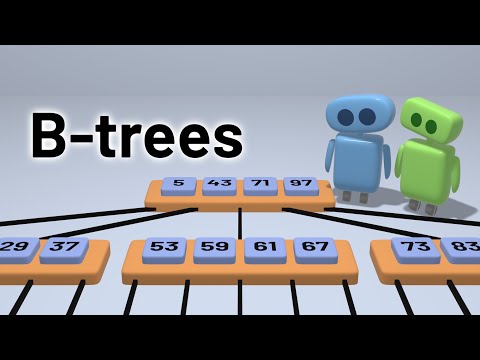
While we’re chatting about efficiency, let’s not forget about another structure called the **B-tree**. This one’s often used in databases and filesystems because it can handle lots more information at once compared to regular BSTs. B-trees are designed to maintain balance through paddling with multiple children per node—think of them as big branches holding several leaves instead of just two kids fighting over which way is up.
In summary:
- Binary Search focuses on quickly finding elements in sorted lists.
- Binary Search Trees (BST) arrange data hierarchically for efficient searching.
- Balancing Techniques, like AVL trees and Red-Black trees help maintain efficiency.
- B-trees allow handling of large datasets effectively—super handy for databases!
Each structure has its pros and cons depending on what you’re trying to achieve or how much data you’ve got going on! So whether you’re optimizing some code or designing complex data systems, understanding these fundamentals gives you tools that can really shine when navigating through heaps of info!
So, let’s chat about binary search trees. They’re kind of a cool concept in computer science and, believe it or not, they can really help keep data organized efficiently. Imagine you have a huge pile of books all over your room—like seriously chaotic. You can’t find anything! Now, picture if you had a neat bookshelf with everything arranged in order. That’s what binary search trees do for data!
The way these trees work is pretty neat. Every piece of data is stored within a node, and each node has two branches: one for smaller values and another for larger ones. It’s like having smaller books on the left side of the shelf and larger ones on the right side. If you want to find something, instead of riffling through every single book like you might’ve done before, you can skip whole sections just by knowing if your book is bigger or smaller than the one you’re currently looking at.
I remember trying to sort through my old comic book collection when I was a kid. I had them stacked everywhere—under my bed, in the closet, along with random action figures! It drove me nuts trying to find that one issue of Spider-Man I loved so much. But then my older brother helped me organize them by series and issue number, kind of like creating my own binary search tree! Suddenly, I could find what I wanted super easily—no more digging around or feeling frustrated.
One cool thing about binary search trees is their efficiency. Searching through them usually only takes about O(log n) time on average if balanced well. Which means as your data grows larger, it won’t take forever to search through it—unlike that time-consuming mess I had before!
But here’s the catch: if they’re not balanced properly (imagine stacking all your comic books on one side), they can end up being more like a linked list than an efficient tree, which can slow things down big time when you need to search.
There’s something satisfying about knowing there are structured ways to deal with heaps of information without losing control. Life’s already chaotic enough; it helps to have some neat tricks up our sleeves to keep things organized when dealing with computers or even just life in general! So next time you hear someone mention binary search trees at a party or something (hey, happens all the time!), you’ll know just how helpful they really are for keeping everything sorted out smoothly!