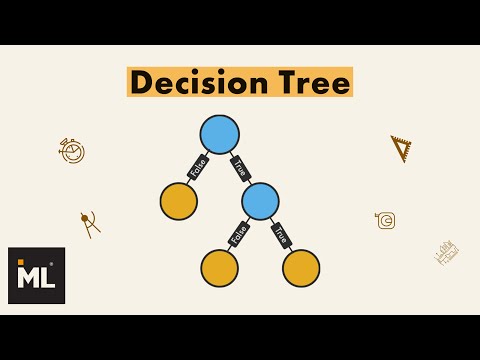
You know that moment when you’re trying to decide what to have for dinner? You run through all the options: pizza, tacos, maybe some sushi? Then you start breaking it down. Pizza has cheese, but tacos have that spicy kick! That’s basically how decision trees work, but with data!
Imagine a big ol’ tree diagram sprouting out from one question. Each branch leads you to another question, helping you narrow things down until—bam—you’ve got your answer. It’s like the “20 Questions” game but for scientific data. Yeah, it sounds a bit nerdy, but trust me, it’s way cooler than it sounds.
Decision trees help scientists tackle complex questions. They transform messy data into clear paths of insight. And isn’t that what we all want? A clear route through the chaos of information? So come on, let’s explore this together and see how these funky trees can make sense of our scientific world!
Leveraging Decision Trees for Advanced Scientific Data Analysis in Python
Decision trees are like the Swiss Army knife of data analysis in Python. They’re super handy when you want to make sense of complex data sets and draw insights without getting lost in the numbers. So, let’s break down how these trees work and why they’re so useful for scientific data.
What exactly is a decision tree? Imagine you’re playing 20 Questions. Each question narrows down options until you find the answer. That’s basically how a decision tree operates. It starts with a root node, which contains the whole dataset, and then it branches out based on different features or questions within that data. Each split is like asking another question that helps us decide which direction to go next.
You might be wondering why this matters in science, huh? Well, scientists deal with massive amounts of data—think experiments with thousands of variables. Decision trees help simplify this chaos by breaking it down into more manageable pieces. They allow researchers to visualize their findings easily.
Here’s where Python comes in as your trusty sidekick. With libraries like scikit-learn and pandas, building decision trees becomes a breeze! You can load your datasets and use just a few lines of code to create and analyze models.
- Preprocessing your data: Before diving into decision trees, clean up your dataset. Remove duplicates, handle missing values, and normalize if needed.
- Fitting the model: Use scikit-learn’s `DecisionTreeClassifier` or `DecisionTreeRegressor` to fit your model on training data.
- Visualizing: Visualize the tree using `plot_tree` from scikit-learn for easy interpretation of how decisions are made.
Let’s take an example: say you’re studying plant growth under different light conditions. You can use a decision tree to predict whether a plant will thrive based on hours of sunlight versus soil moisture levels! As you gather more results, the tree adapts—making it easier to see how factors interact with each other.
But here’s a little twist—decision trees aren’t perfect! They can easily overfit if they get too complex or deep (kinda like telling too many details in a story). Luckily, you can tune parameters—like setting a maximum depth—to keep your tree just right.
So what’s the takeaway? Decision trees provide intuitive visualizations and straightforward interpretations of scientific data analysis in Python. By leveraging them effectively, you can cut through complexity and discover patterns that might have gone unnoticed otherwise!
Optimizing Scientific Data Analysis: Implementing Decision Trees with GitHub Resources
When it comes to analyzing scientific data, **decision trees** are like the friendly guides that help you find your way through a complex forest of numbers. They can simplify decisions and make predictions based on your data. So, let’s chat about how you can optimize this process using decision trees along with resources from **GitHub**.
- What is a Decision Tree? Basically, it’s a flowchart-like structure that helps in decision-making by splitting data into branches based on certain criteria. Each branch represents a choice or outcome. It’s super visual and easy to understand.
- Why Use Decision Trees? Well, they’re great because they handle both numerical and categorical data pretty well. Imagine you’re trying to predict whether students will pass or fail based on hours of study, attendance, and their previous grades. A decision tree simplifies this by breaking down the info into clear paths.
- Optimizing Your Analysis To get the most out of your decision tree, you might want to look into techniques like pruning, which is basically cutting away sections of the tree that don’t provide useful information. This helps avoid overfitting—where your model gets too specific and loses its predictive power.
- Using GitHub for Resources GitHub is packed with repositories where you can find code examples and libraries for implementing decision trees in various programming languages like Python or R. Libraries like Scikit-learn for Python offer pre-built functions that streamline the whole process. You just import them into your project and start tweaking!
- Example Projects There are tons of public projects out there where folks have shared their decision tree analyses. You can browse through these repositories for inspiration or even fork one to make it your own! It’s like having a community of researchers helping each other out.
- The Importance of Data Quality Always remember that good input leads to good output! Make sure your dataset is clean and relevant before feeding it into the model. Bad data can lead to misleading conclusions—like trying to predict weather patterns from last decade’s outdated stats!
- Integrating with Other Tools Decision trees can work even better when combined with other tools like ensemble methods (think random forests) which use multiple trees for making decisions. This not only improves accuracy but adds an extra layer of insight.
- Anecdote Moment I once worked on a research project where we tried predicting patient outcomes based on treatment plans using decision trees. It was honestly pretty heartwarming when we figured out a robust model—it felt like we were really making a difference in how doctors could tailor treatments!
So there you have it! Optimizing scientific data analysis using decision trees via GitHub resources is definitely feasible and surprisingly straightforward once you get the hang of it. And remember, science is always evolving—so keep experimenting!
Utilizing Decision Trees for Enhanced Scientific Data Analysis: A Practical Example
So, let’s get into decision trees and how they can rock your scientific data analysis. Imagine you’re trying to figure out what plants might thrive in a garden based on different weather conditions, soil type, and all that jazz. That’s where decision trees come in—like a game of 20 Questions but for data.
Basically, a decision tree is this cool visual tool that helps you make decisions based on data features. It starts with a question at the top of the tree and branches out based on answers leading to further questions. You can think of it as a flowchart where each branch represents a possible outcome, guiding you toward conclusions.
Let’s say you want to study flower growth in various conditions. You could start with “Is the sunlight high or low?” If it’s high, you go one way; if it’s low, another. Then maybe you ask about soil moisture next. This way, even if your data is complicated, the tree simplifies your thinking process.
Now let’s break down why using decision trees can be super helpful in scientific research:
- Clear visualization: They let you see how decisions are made step by step.
- Easy interpretation: Anyone can grasp what’s happening without needing fancy math skills.
- Handles different types of data: Whether it’s numbers or categories, these trees can manage them all.
- No assumptions about distributions: Unlike some statistical methods that assume normal distributions, decision trees don’t care about those rules!
Here’s an example: picture a biologist trying to decide which species of fish to conserve in a certain lake. They take into account factors like water temperature and pollution levels. Starting with “Is the temperature too high?” as the initial question splits off into various outcomes—whether conservation efforts will be more effective for species A or B.
But it ain’t all butterflies and rainbows! Decision trees can sometimes overfit the data—meaning they get too specific and won’t generalize well to new information. Imagine creating a unique pathway for every single case; it can get messy! Regularly pruning the tree is essential (like cutting back leaves) to keep it neat and functional.
Another thing worth mentioning is that decision trees are often combined with other techniques—like random forests—to improve accuracy. Think of this as teaming up multiple decision trees so they work together instead of relying on just one.
So yeah, using decision trees can really amp up your approach when handling scientific data analysis by making complex decisions more manageable and visualizing results clearly. Definitely worth considering if you’re diving into research where understanding patterns is key!
You know, decision trees are kind of like those old Choose Your Own Adventure books we used to read as kids. Remember flipping to a certain page based on your choices? It’s that sense of branching out, making decisions, and seeing where each path leads.
In the world of science, particularly when it comes to analyzing data, decision trees do something similar. They help scientists break down complex datasets into more manageable bits by asking a series of questions. With each answer, they go down a different branch until they reach a conclusion or prediction. It’s pretty neat!
I remember back in college when I worked on a project analyzing environmental data. We had mountains of numbers and various variables—temperature, rainfall, pollution levels—you name it. Honestly, staring at that data was overwhelming! But then we applied decision trees. Suddenly it felt like we had a trusty guide through the chaos. Each split in the tree made things clearer and more understandable; we could visualize how different factors influenced outcomes.
Now, don’t get me wrong; it’s not all smooth sailing with decision trees. They can easily overfit the data if you’re not careful—sorta like making too many assumptions based on your own experience instead of what’s actually there. You really need to strike a balance if you want them to work effectively for predictions.
It’s also important to mention that while they’re straightforward and intuitive, decision trees aren’t always the best tool for every situation—it’s just one method among many in the scientific toolbox. But when they click just right with a particular dataset? Oh boy, it feels like solving a fun puzzle!
So basically, using decision trees in scientific data analysis is like finding your way through an intricate maze armed with only questions and answers as your compass. And isn’t that what science is all about? Making sense of complexities one choice at a time?