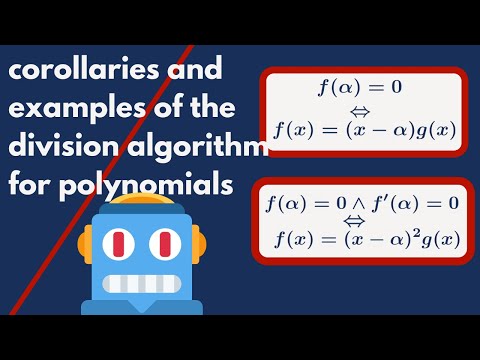
So, picture this: you’re in math class, right? The teacher starts talking about polynomials, and you’re thinking, “What even is that? Sounds like a fancy dessert or something!” But trust me, polynomials are way cooler than they sound.
Now, have you ever tried dividing pizza slices evenly among friends? Yeah, it’s sort of like that but with numbers and letters instead of pepperoni. The polynomial division algorithm helps us break down these mathematical expressions into simpler pieces.
Why does this matter? Well, it turns out that understanding this stuff can shed light on some pretty weighty scientific concepts! It connects to everything from engineering to computer science—seriously! So let’s chat about how this polynomial division thing works and why it’s got some serious street cred in the scientific community. Sound good?
Understanding the Division Algorithm for Polynomials: Its Purpose and Applications in Science
The Division Algorithm for polynomials is a handy tool, kind of like finding your way through a maze. It helps us divide one polynomial by another, which isn’t just some math trick; it has real-world applications too! You know, things like computer science, engineering, and even physics can get really tangled up with polynomials—trust me.
So what’s the deal with this algorithm? Basically, it states that when you divide a polynomial ( f(x) ) by another polynomial ( g(x) ), you can express the result as:
f(x) = g(x) * q(x) + r(x)
Here, ( q(x) ) is the quotient and ( r(x) ) is the remainder. The cool part? The degree of ( r(x) ) is always less than the degree of ( g(x) ). It’s like making sure you don’t exceed a certain height when stacking blocks.
But why should we care? Well, imagine you’re trying to simplify complex equations or factor higher-degree polynomials. Using this algorithm makes life way easier. Instead of getting lost in a web of numbers and letters, you can break things down into simpler components that are manageable.
And trust me; there’s something satisfying about seeing how neatly everything fits together. Think about long division from math class but with letters instead of just numbers! When I first learned this method, it felt like peeling an onion; each layer revealed something new and exciting.
Now let’s look at some applications:
- Computer Science: Algorithms for code optimization often rely on polynomial division to improve efficiency.
- Signal Processing: These divisions help in filtering signals and improving data transmission.
- Physics: Many equations in physics are polynomials that describe motion or wave patterns.
So yeah, next time you encounter a polynomial equation in your math homework or even during coding sessions, remember this division algorithm! It not only simplifies the task at hand but also builds a foundation for understanding higher-level concepts in various fields. And who knows? You might find yourself using it in an unexpected place!
Practical Applications of Polynomial Division in Scientific Research and Real-World Problem Solving
Polynomial division might sound like something you’d tackle in a high school math class, but let me tell you, it’s way more than just numbers and letters on a page. There’s a whole lot of science and real-world problem-solving hiding behind those equations. So, what’s the deal with polynomial division? It’s basically a method for dividing one polynomial by another, kind of like long division but with x’s involved!
One important thing to grasp is the **Polynomial Division Algorithm**. This handy tool helps break down complex polynomials into simpler ones. You see, when researchers are dealing with intricate models—like those in physics or genetics—they often hit walls where simpler expressions just won’t cut it. Here’s where polynomial division comes to the rescue!
Let’s check out some practical applications of this:
- Signal Processing: In telecommunications, polynomial division helps in designing filters that eliminate unwanted noise from signals. Think about trying to hear your favorite song at a concert while all you can hear is chatter around you; filtering out that noise is crucial!
- Control Systems: Engineers use polynomial division to analyze systems and ensure they behave predictably. For instance, if you’re flying an airplane (and I hope you are not doing that solo!), the systems keeping it stable rely on these techniques for smooth flying.
- Coding Theory: When it comes to sending data over networks, error detection and correction is key! Polynomial division helps generate codes that can detect errors during data transmission. Ever sent a message and wished it arrived just like you sent it? This is how we make sure messages don’t get jumbled up.
There was this one time in college when I was working on a project with teammates about wireless communication. We had this huge mess of equations representing our network model, and honestly? It felt overwhelming! But once we applied polynomial division to simplify those models, everything started to click into place—it felt like cracking a code or solving a puzzle!
Another area where polynomial division shines is in **computer graphics**. When rendering images or animations, complex curves must be represented mathematically. By using polynomial division, developers can break down these curves into more manageable parts for smoother visuals.
In medicine too—yeah, seriously! When researchers create pharmacokinetic models (which describe how drugs move through the body), they often have to deal with complicated polynomials. Polynomial division makes analyzing these behaviors much easier.
So the thing is: even though you might not think about polynomials during your everyday life (unless math homework pops up), they’re quietly helping solve problems all around us—from technology we love to health innovations making life better. Next time someone mentions polynomials, maybe you’ll think about all the practical magic happening behind those equations!
Understanding Polynomial Algorithms: Key Concepts and Applications in Scientific Computing
Alright, let’s break down polynomial algorithms and what they mean in scientific computing. You might be asking, “What even is a polynomial?” Well, it’s just a fancy term for a mathematical expression involving variables raised to whole number powers. For example, something like 2x² + 3x + 5 counts as a polynomial.
Now, when we talk about polynomial algorithms, we’re diving into methods that deal with polynomials efficiently. One key application of these algorithms is the Polynomial Division Algorithm. So let’s get into that!
The Polynomial Division Algorithm is kind of like long division but for polynomials. Just as you can divide numbers, you can divide one polynomial by another. This is super helpful for simplifying expressions or solving equations. Imagine you’re trying to figure out roots of a polynomial equation—that’s where this comes in handy.
Here are some key ideas to grasp:
- Division Process: When you divide two polynomials, the goal is to break down the dividend (the polynomial being divided) into simpler parts—the quotient and the remainder.
- Remainder Theorem: This theorem states that if you divide a polynomial (f(x)) by (x – c), the remainder is simply (f(c)). So if you plug in (c), it gives you the remainder instantly!
- Applications: In scientific computing, these algorithms help in numerical analysis and computer graphics. For instance, they’re used to render curves and surfaces in 3D models.
Let me tell you about this time I was helping my younger cousin with his math homework — he was struggling with understanding how division worked with polynomials. We used an example like x³ – 3x² + 4, dividing it by x – 2. As we went through the steps together—like lining things up neatly just like long division—he lit up when he finally got it! It was pretty cool to see him connect those dots.
Back to applications! The Polynomial Division Algorithm plays a huge role in error correction codes as well—think of it as sending clear messages despite noise during transmission. So next time someone says “polynomial,” remember: it’s not just some boring math term; it’s got power (pun intended!) across different fields!
Understanding these concepts helps ensure that complex calculations in science are both accurate and efficient. So whether you’re simulating physical systems or optimizing data processing tasks, knowing your polynomials can give you an edge!
That’s basically the lowdown on polynomial algorithms and their significance in scientific computing! Pretty neat stuff, right?
You know, polynomial division is one of those topics that doesn’t get a lot of attention outside of math class, but it’s pretty cool when you think about it. At first glance, it seems a bit abstract—like, why do we even need to divide polynomials? But let me tell you, there’s a lot more going on under the surface.
So, imagine you’re in high school (or maybe you’re living through that right now), and your teacher throws a polynomial equation at you. You might be staring at it like it’s some alien language. But once you start breaking it down using polynomial division, things get way clearer. It’s kind of like peeling an onion. Each layer reveals more about the structure and relationships within the equation.
I remember this one time in class where I was completely flummoxed trying to figure out how to simplify this gnarly polynomial. I was lost until my friend explained the division algorithm to me with pizza slices as an analogy—yeah, seriously! You can think of dividing one polynomial by another like sharing pizza among friends. If you have a big pizza (that’s your original polynomial) and want to share it in equal slices (that’s the divisor), some people may get their fair share while others might just have crust left over! That “leftover” part is known as the remainder.
Anyway, once I understood that concept, everything clicked into place. The Polynomial Division Algorithm gives us this cool method for simplifying complex equations into something manageable. But here’s where its real significance lies—polynomial division isn’t just about solving math problems; it has real-world applications too!
Take computer science or engineering for example! When you’re working with algorithms or designing electronics, polynomials show up everywhere—from signal processing to error correction codes. Basically, they help us model complex systems in ways that make sense and can be computed easily.
So yeah, diving into polynomials might seem boring at first—that’s what we often think about math—but getting into polynomial division really opens up a whole new world where math meets practical applications! Isn’t that neat? It just goes to show how these seemingly abstract concepts can lead to serious breakthroughs in technology and science. Just goes to show that underneath every tricky equation lies some exciting potential waiting to be discovered!