You know, there’s this classic scene in movies where someone suddenly becomes super energized and starts talking a mile a minute? That’s kinda what happens when you have Graves’ disease. Seriously! Your thyroid goes into overdrive, like it’s had three cups of coffee on an empty stomach.
So, let’s talk about the thyroid—this little butterfly-shaped gland hanging out in your neck. It might not seem like much, but it plays a HUGE role in your body. It controls metabolism, energy levels…you name it! And when things go haywire, like in Graves’ disease, they can get pretty interesting.
Now imagine diving into the microscopic world of thyroid tissue. It’s like peering into a secret universe! The histological features we find there reveal a ton about what’s going on. So grab your metaphorical microscope and let’s explore this wacky ride together!
Microscopic Morphology of Graves Disease: Insights into Thyroid Pathology
Graves disease is a condition that messes with your thyroid, causing it to produce too much thyroid hormone. It’s an autoimmune disorder, which means your immune system gets a little confused and starts attacking your own body, in this case, the thyroid gland. You know what’s even crazier? The way it affects the microscopic structure of the thyroid tissues!
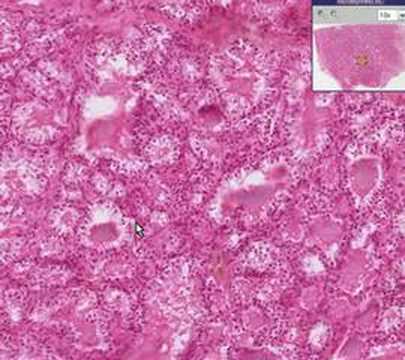
When you look at the microscopic morphology of thyroid tissue affected by Graves disease under a microscope, you see some really striking stuff. Here’s what stands out:
- Follicular Hyperplasia: The thyroid normally has these little sacs called follicles that store hormones. In Graves disease, these follicles can become enlarged and more numerous. Imagine if your favorite snack suddenly came in huge quantities—you’d notice that change, right?
- Lymphocytic Infiltration: This condition attracts immune cells like moths to a flame! There’s an increase in lymphocytes infiltrating the tissue around the follicles. Basically, they are tiny soldiers of your immune system hanging around where they shouldn’t be!
- Colloid Resorption: You might find less colloid (the stuff stored in those follicles) because it gets absorbed more quickly than usual. It’s as if those little snacks are disappearing before you can grab them!
- Glycosaminoglycan Accumulation: There’s also an increase in glycosaminoglycans (GAGs), which are fancy molecules involved in hydration and tissue structure. They can make the thyroid tissue look swollen or even gelatinous, adding to that overall “bulged” appearance.
One time, I read about a patient who didn’t realize their racing heart and weight loss were linked to this disease until someone pointed out their bulging eyes—known as exophthalmos—which is another side effect. When we look at the histology of those eyes and connect it back to the thyroid’s morphology changes, everything kind of clicks together.
In summary, when scientists peek at tissues from a person with Graves disease under a microscope, they see changes that tell a story about what’s going on inside. From hyperplasia to lymphocyte invasion—each element forms part of this intricate puzzle.
It might seem overwhelming sometimes with all these terms flying around! But just remember: what happens microscopically really shapes how our bodies behave day-to-day! So next time someone mentions Graves disease or talks about thyroid health like it’s just another topic… now you’ll know there’s tons happening behind the scenes!
Distinctive Features of Graves’ Disease: A Comprehensive Scientific Overview
Graves’ disease is this autoimmune condition that messes with your thyroid, which is a little butterfly-shaped gland in your neck. This gland plays a big role in your body’s metabolism by producing hormones. When Graves’ kicks in, it’s like your thyroid gets a turbo boost, producing too much hormone. You might feel restless or even experience weight loss, rapid heartbeats, and anxiety. But let’s break this down even more.
One of the standout features of Graves’ disease is the **hyperplasia** of thyroid follicular cells. So, if you imagine the thyroid as a local diner, hyperplasia is when more cooks jump in to whip up dishes at once! Basically, your body thinks it needs to make more cells to deal with all that hormone production. When doctors look at thyroid tissue through a microscope from someone with Graves’, they see these crowded areas of cells that are all busy working way too hard.
In addition to hyperplasia, you also have something called **lymphocytic infiltration** happening there. This means immune cells known as lymphocytes invade the thyroid tissue like uninvited guests who just won’t leave the party! These immune cells contribute to damage and inflammation of the gland because they mistakenly attack healthy tissues. It’s like your body’s defense system goofed up and thought its own team was the enemy.
Another cool feature is how these patients often show **colloid degradation** in their follicles. Colloid is this jelly-like substance where thyroid hormones are stored until needed—think of it as the pantry where ingredients are kept till you’re ready to cook! In Graves’ disease, this pantry gets messed up; they find less colloid than normal because it’s being used up faster than it can be replenished.
It’s also worth mentioning **thyroid-stimulating immunoglobulins (TSIs)**. These little troublemakers are antibodies that actually activate TSH receptors on the follicular cells—basically telling them to produce even more hormones! Imagine someone yelling at those cooks in our diner to make more food when they’re already swamped. It creates this nasty feedback loop that just spirals out of control!
So basically:
- Hyperplasia: More follicular cells cranking out hormones.
- Lymphocytic infiltration: Immune cells invading and causing inflammation.
- Colloid degradation: Less storage material for hormones.
- Thyroid-stimulating immunoglobulins: Antibodies boosting production without control.
In short, if you’re looking at histological features from someone with Graves’ disease under a microscope, you’re seeing a website full of busy workers who seem overwhelmed by chaos rather than doing their jobs calmly and effectively. This condition impacts not just how you feel but how your body operates on such a fundamental level—it’s quite fascinating!
Histological Examination of the Thyroid Gland: Key Features and Insights in Endocrine Science
Sure! Let’s chat about the thyroid gland, shall we? This little butterfly-shaped organ in your neck does a lot of heavy lifting when it comes to your body’s metabolism and overall health. It’s super important that we understand what’s going on with it, especially when stuff like Graves’ disease pops up.
So, **what’s histology all about?** Basically, histology is the study of tissues. When we look at the thyroid gland through a microscope, we can see its structure and how it changes in different conditions. In Graves’ disease, which is an autoimmune disorder, this examination can reveal some seriously interesting changes.
Let’s break down some key points about the histological features of thyroid tissue affected by Graves’ disease:
- Follicular Hyperplasia: In Graves’ disease, you’ll often find that the thyroid follicles (those little sacs where hormones are made) are hyperplastic. This means they’re growing more than usual. It’s like they’re in a growth spurt that makes them bigger and more numerous.
- Colloid Depletion: The colloid is like the jelly filling inside those sacs. In patients with Graves’ disease, sometimes this colloid gets depleted or decreased in amount because it’s being used up faster than usual to make excess hormones.
- Lymphocytic Infiltration: Here’s where it gets a bit sad. Since it’s an autoimmune condition, there are more immune cells (like lymphocytes) hanging out in the tissue than normal. It’s their way of attacking what they mistakenly think is something harmful.
- Increased Vascularity: You’ll notice there’s increased blood flow in these tissues too—more blood vessels! This happens because your body is trying to keep up with the demand for hormone production.
- Epithelial Changes: The epithelial cells lining those follicles might be taller and more active than usual. They’re working overtime to churn out hormones but sometimes can get stressed from all that effort.
Thinking back to a time I visited my friend’s clinic—she was struggling with fatigue and anxiety. After some tests, she found out she had Graves’ disease! The relief when she learned what was happening was palpable; understanding her condition gave her some control over those overwhelming feelings.
Anyway, back to our thyroid: these histological features not only help us diagnose Graves’ disease but also give insights into how this condition affects hormone levels throughout the body.
You see? By examining these tiny details under a microscope, we can piece together a big picture of health or illness in relation to our hormones and metabolism. It highlights just how interconnected everything really is!
So, let’s chat about Graves’ disease for a bit. It’s this autoimmune thing that messes with your thyroid—this little butterfly-shaped gland in your neck that does a ton of important stuff. When you have Graves’ disease, your immune system kinda goes haywire and decides to attack the thyroid as if it were some kind of invader. It’s like your body is throwing a surprise party, but not the fun kind, you know?
When doctors look at the thyroid tissue under a microscope in cases of Graves’ disease, they see some pretty distinctive histological features. There’s this wild increase in cells called follicular cells, which are basically the workers of the thyroid. These cells get super hyperactive because they’re trying to crank out more hormones, leading to this sleek little condition called hyperthyroidism.
Another thing is that you can spot lymphocytes everywhere. They usually hang around looking for trouble, but in Graves’ disease, they seem to be having a full-blown party in there! The presence of these immune cells is a big hint that something’s off. Imagine opening up a fridge and finding it stuffed with random ingredients meant for cake-making when all you wanted was milk.
I remember chatting with a friend whose mom had Graves’ disease. She talked about how her mom had always been full of energy, almost like she was perpetually on espresso shots! But then came the mood swings and those weird symptoms that seemed to pop out of nowhere—like suddenly feeling hot or losing weight without trying. That whole experience made me realize how much our bodies can change due to something as tiny as our immune system getting confused!
And here’s another cool bit: when they check the tissue closely, there’s often this thing called “scalloping” around those follicular structures. It’s almost like they’re waving goodbye as the hormone production ramps up! But let me tell you; while all these features paint an interesting picture of illness at a microscopic level, they also remind us just how interconnected everything is—how one small part can cause such big effects in our lives.
So yeah, looking at these histological features doesn’t just help doctors diagnose and manage Graves’ disease; it also sends us on a deeper journey into understanding ourselves and what happens when our body goes off-script. It’s fascinating stuff—how nature works at such small scales—and reminds us that even our smallest organs can have huge impacts on how we feel day-to-day! Pretty mind-blowing if you ask me!