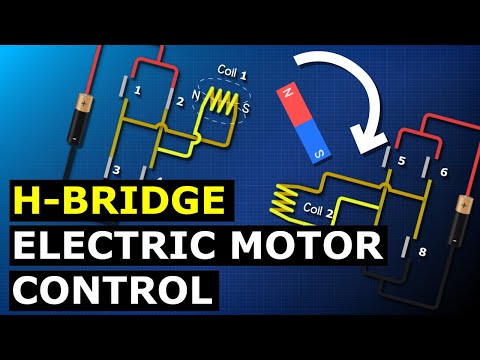
You know that moment when you’re trying to figure out how to make your toy car zoom in both directions? Yeah, I totally struggled with that as a kid! Turns out there’s this nifty little thing called an H-bridge circuit that makes all that magic happen.
Imagine being able to control a motor so it spins one way and then instantly flips to the other. It’s kind of like having a remote for a toy car, but way cooler. Seriously, these circuits are the unsung heroes of modern electronics.
H-bridges are everywhere, from your favorite gadgets to robotics and even electric vehicles. They’re the brain behind letting systems switch directions seamlessly. Exciting, right? So let’s dive into how these circuits work and why they’re such a big deal in our tech-filled lives!
Exploring the Diverse Applications of Bridge Circuits in Scientific Research and Technology
So, bridge circuits, huh? They’re super interesting and have a ton of applications in both scientific research and technology. Let’s break it down a little.
First off, you’ve probably heard of **H-bridge circuits** before. These nifty little setups allow you to control the direction of a motor’s rotation, which is super useful in robotics and automation. Basically, they work by using four switches arranged in an ‘H’ configuration. When different pairs of switches are closed, you can change the path of the current through the motor. This lets you make it spin forward or backward, which is pretty neat!
Now, one major application is in **robotics**. Imagine a simple robot that needs to move around—whether it’s picking up something or avoiding an obstacle. With H-bridges, it can easily switch directions on the fly. For instance, if the robot bumps into a wall while moving forward, it can quickly reverse its motors and back away. Pretty clever, right?
But wait! There’s more! H-bridges aren’t just about motors. They also come into play in **sensor systems**. Let’s say we’re dealing with temperature sensors or pressure sensors that require some calibration. By using bridge circuits like Wheatstone bridges (which are classic examples), scientists can measure tiny changes in resistance very accurately due to external conditions.
You know how sometimes small changes matter a lot? That’s especially true in **medical devices** too! For instance, when monitoring glucose levels for diabetic patients with sensors that operate on bridge circuits—you really want precision! The H-bridge allows these devices to communicate vital data reliably.
Another area that’s really buzzing with activity is **audio technology**. Ever thought about how your speakers produce sound? H-bridges help drive speaker systems by controlling how electrical signals power them—creating those sweet sounds we love so much! When they’re combined with digital signal processing, they help in amplifying audio without distorting it.
And let’s not forget about renewable energy systems like solar panels! They often utilize these circuits for maximum efficiency when converting solar energy into usable electrical power. By switching configurations through an H-bridge setup, they optimize energy flow based on varying sunlight conditions.
In sum, bridge circuits—especially H-bridges—are like silent heroes behind many technologies we use daily:
- Robotics: Allowing directional control of motors.
- Sensor systems: Ensuring precise measurements.
- Medical devices: Providing accurate monitoring capabilities.
- Audio technology: Driving speakers effectively.
- Renewable energy systems: Optimizing power conversion.
So yeah, whether you’re sipping coffee while listening to music or stepping into a fancy new medical device at the clinic—don’t forget those trusty bridge circuits working behind the scenes!
Exploring the Various Types of H Bridges in Electrical Engineering: A Comprehensive Guide
So, H-bridges in electrical engineering, huh? They’re super interesting and essential when it comes to controlling motors. You know, if you’ve ever played with a remote-controlled car, there’s a good chance it had an H-bridge doing all the heavy lifting. Let’s break down what these circuits are all about.
To start with, an H-bridge is a circuit that allows you to control the direction of a motor. Imagine a letter “H” — that’s pretty much the layout of this circuit. At its simplest, you can think of it as a way to make sure electricity can flow either forward or backward through your motor. So it can spin in both directions!
You can find H-bridges commonly used in applications where you need precise control over motors. This includes:
- DC Motors: For driving small motors used in toys or robotics.
- Stepper Motors: Ideal for precise movements like those found in 3D printers.
- Brushless Motors: Used in drones and electric vehicles.
Now there are different types of H-bridges, and they come with their unique features.
First up, we have the **Passive H-Bridge**. This one is pretty straightforward and doesn’t use any fancy components like transistors to control the direction of current flow. Instead, it relies on mechanical switches or relays. While it’s super simple and inexpensive, it’s not ideal for high-speed applications because relays tend to wear out fast.
Then there’s the **Active H-Bridge**, which uses transistors (either BJTs or MOSFETs). This type is more versatile and efficient than passive ones since they can be controlled by digital signals from microcontrollers. They’re capable of quick direction changes without much wear on components—like giving your car a turbo boost when turning left!
An even cooler version is the **Full-Bridge** configuration that lets you control two motors at once! It packs more punch when you need more torque or speed from dual-motor setups—think about small robots navigating tough terrains.
So why do we care about controlling motor direction? Well, think back to that remote-controlled car: if you only had one way for your motor to spin, you’d just go forward all day long! The possibility of going backwards means better maneuverability—less crashing into things and more smooth driving.
But here’s something important: with great power comes great responsibility… Or so they say! Proper design considerations are key when working with H-bridges. You gotta ensure you don’t have any short circuits happening while switching between directions; otherwise, boom!
One last thing worth mentioning is “PWM, or Pulse Width Modulation.” It plays nicely with H-bridges by controlling speed along with direction. By rapidly turning the current on and off, you get various speeds without changing voltage levels directly—pretty slick!
In summary, whether you’re tinkering around at home or working on advanced robotics projects, understanding how these H-bride circuits function opens up a whole new world of possibilities in electronics! So next time you see something zooming past powered by electric motors—you might just have an idea of what’s going on behind the scenes!
Exploring the Importance of H-Bridge Implementations with Arduino in Scientific Applications
When you’re messing around with robotics or any project that needs to control motors, an H-bridge is like your best buddy. Seriously! It’s that little circuit that lets you move a motor in both directions. Think about it: if you want to move a car forward and backward, you gotta have a way to flip the direction of the current flowing through the motor, right? That’s where an H-bridge comes into play.
Basically, an H-bridge lets you control the speed and direction of a DC motor using only a few pins from your Arduino. This means you can turn it one way for forward motion and then switch the current to turn it around and go back. Pretty neat!
Now, let’s touch on some key things about H-bridges:
- Direction Control: You can easily reverse the motor’s direction by switching which pins are sending power. Think of it like having a remote for your toy car.
- Speed Control: With techniques like Pulse Width Modulation (PWM), you can actually vary how fast the motor runs. By changing how long the signal is on versus off, you can make it zip around or go as slow as molasses.
- Simplicity: H-bridges are pretty compact compared to building separate circuits for each function. You just wire up your components according to some diagrams online, and boom—you’re ready to control motors.
You remember that time in school when we built those little robots? Yeah! The excitement was real! One of my friends—let’s call him Mike—had trouble getting his robot to move in circles because he had no idea how to control his motors properly. Once he added an H-bridge with Arduino, everything changed! He could steer that thing like a pro!
And let’s not forget about efficiency. Using an H-bridge can help save power because it’s designed specifically for managing currents in both directions without wasting too much energy.
In scientific applications—or really any projects involving motion—H-bridges open up possibilities. From robots exploring Mars (well, maybe not yet) to tiny drones buzzing around your living room, they are crucial in giving them life through movement.
So next time you’re tinkering with something that spins or rolls or buzzes, keep this little piece of circuitry in mind. The world of electronics is all about making things happen, and with an Arduino-powered H-bridge at your fingertips, you’re pretty much golden!
You know, when I first stumbled upon H Bridge circuits, I thought they were just some fancy tech stuff that only engineers cared about. But the more I learned, the more I realized how crucial they are in making our everyday gadgets work. Seriously, these circuits are like the unsung heroes of modern electronics.
Picture this: you’re at a friend’s place, and they’re showing off their new robot vacuum. It zooms around the floor, dodging furniture and making its way to the charging station. What you might not see is that little H Bridge circuit hidden away inside it, controlling those motors that drive its movement. Isn’t it cool how something so complex can happen behind the scenes?
So here’s the scoop on what an H Bridge does. It’s basically a circuit that lets you control the direction of a motor’s rotation. You can make it spin one way or another just by changing how electricity flows through it. Think of it like flipping a switch for your toy car – if you want it to go forward, you turn on one switch, and if you want it to reverse, you flip another one.
Now, why is that important? Well, many devices today rely on motors for movement—everything from drones to electric cars uses them. An H Bridge makes that possible in a neat and efficient way. It allows us to harness electrical energy in an effective manner without needing bulky gears or levers.
I remember tinkering with a little toy robot I built back in school; it was so much fun! But when I got to wiring up those motors, oh man… I had no clue where to start! Eventually, after some trial and error—and maybe a few too many burnt out wires—I figured out how to control them using an H Bridge circuit. The first time my robot moved exactly how I’d imagined felt awesome! It’s amazing what understanding these little quirks of electronics can lead to.
And here’s something even cooler: H Bridges can be found all over your life—from printers and washing machines to electric bikes—making our world more interactive and efficient. They’re like this silent force driving innovation in robotics and automation.
So yeah, next time you’re using some gadget or seeing robots zooming around—remember there’s likely an H Bridge working hard behind the scenes! It’s quite comforting knowing that something so small plays such a big part in shaping our tech landscape today.