So, imagine you’re trying to decide what to eat for dinner. Do you go for pizza, sushi, or maybe a good old burger? Just like making that tough choice, scientists and mathematicians face problems where they need to find the best answer out of a whole bunch of options.
Enter the Nelder-Mead algorithm! It sounds fancy, right? But it’s really just a clever way to help us optimize things without needing all the bells and whistles of calculus. Seriously, this method is like having your personal guide at an all-you-can-eat buffet of possibilities.
You can think of it as a way to navigate through a maze where each turn can lead you closer to the best outcome—or away from it. Whether you’re tweaking designs in engineering or improving funky algorithms in coding, this little gem comes in handy.
So buckle up! We’re going on a journey through optimization techniques and see how the Nelder-Mead algorithm helps us make those brainy decisions easier. You with me?
Optimizing Scientific Problems: A Comprehensive Example of the Nelder-Mead Method in Action
The Nelder-Mead method is a nifty little tool often used in optimization problems. You know, when you’re trying to find the best solution or minimize a cost function? It’s especially handy when the function you’re dealing with is complex or doesn’t have a straightforward derivative. It’s like finding your way around a maze without a map—you use your instincts and surroundings to guide you.
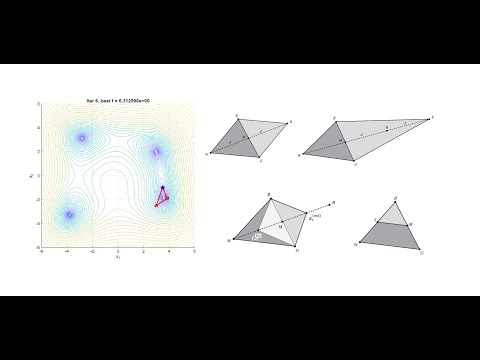
So, let’s break it down. The Nelder-Mead algorithm operates in the realm of simplex methods. Now, what’s a simplex? Picture it as a shape formed by connecting points in space. For example, in two dimensions, it’s just a triangle; in three dimensions, it’s a tetrahedron. The algorithm works by moving these vertices around to “search” for an optimal solution.
Here are key steps of the Nelder-Mead method:
- Initialization: You start with an initial simplex, which means you pick several random points in your problem’s space.
- Reflection: Once you evaluate these points (like checking who got the highest score), you reflect the worst point over the centroid of the others.
- Expansion: If reflection looks promising—meaning it scores better than before—you can expand that point even further.
- Contraction: If not, pull back (contract) and see if moving closer to other points helps.
- Shrinkage: If all else fails and no new points work out, shrink your simplex down towards the best point you’ve found so far.
It might sound complicated at first glance, but think of it as hiking up a hill: sometimes you take the scenic route, sometimes you discover hidden paths that lead you uphill faster!
Here’s where it gets emotional for me—imagine being lost on a mountain trail. You’re tired and frustrated. Then you remember your friend has been here before and gave you tips on shortcuts. That feeling of hope when discovering an easier path is akin to how the Nelder-Mead method refines its search with each iteration.
Let’s see some applications! Researchers use this technique for various problems—from optimizing product designs to tuning machine learning models. Say you’re designing an engine; you’d tweak parameters like size or fuel efficiency until everything runs smoothly—just like adjusting that optimal triangle as you move along.
In conclusion—or just as I say “wrapping things up,”—the Nelder-Mead algorithm represents an elegant blend of geometry and intuition for optimization tasks. It doesn’t require derivatives or complicated math skills but relies on evaluating simple shapes’ movements toward an ideal solution. It’s proof that sometimes simple approaches can yield powerful results!
Optimizing Scientific Research: Implementing the Nelder-Mead Method in Python for Efficient Parameter Estimation
The Nelder-Mead method is super popular in the world of optimization, and it’s fascinating how it helps in parameter estimation. This technique is handy when you’re working with functions where derivatives are hard or impossible to calculate. So, let’s break it down—keeping it breezy and clear.
First off, what exactly is the Nelder-Mead method? Imagine you’re trying to find the bottom of a valley but can only see your immediate surroundings. You take steps towards lower ground—this is kind of what the Nelder-Mead algorithm does. It’s a simplex-based method that uses a shape (the simplex) made up of (n+1) points in (n)-dimensional space. Pretty neat, right?
Now, you might be wondering how this applies to Python for parameter estimation. Well, Python has some awesome libraries that make implementing the Nelder-Mead method a breeze! One such library is SciPy, which provides a straightforward way to optimize functions using this technique.
Here’s a quick rundown on how you could set this up:
1. Define your objective function: This is where you’ll describe what you want to minimize or maximize.
2. Choose initial parameters: You need starting points for the optimization process.
3. Call the optimization function: Use SciPy’s `optimize.minimize` with the Nelder-Mead option.
Here’s an example snippet that illustrates these steps:
“`python
import numpy as np
from scipy import optimize
# Define your objective function
def objective_function(x):
return (x[0] – 1)**2 + (x[1] – 2)**2
# Initial guess
initial_guess = [0, 0]
# Optimize using Nelder-Mead method
result = optimize.minimize(objective_function, initial_guess, method=’Nelder-Mead’)
print(result)
“`
In this code snippet, we define a simple quadratic function—like finding that lowest point in our imaginary valley—and then we use our initial guess to start searching for that minimum.
Now let’s talk about why you’d want to use this technique in research! Well, research often involves making sense of complex data where traditional analysis methods fall short. The Nelder-Mead algorithm shines here because it doesn’t require gradient information; instead, it evaluates just the function values at specific points!
One memorable moment I had while coding involved applying this method to data from a climate model. It was like piecing together a puzzle where each piece represented different parameters influencing global temperatures! Watching those parameters get optimized felt like watching magic unfold before my eyes as insights emerged from what seemed like chaos.
Of course, there are limitations too. The method can struggle with high-dimensional problems or functions that have many local minima—those tricky spots that can lead us astray if we’re not careful! But despite those challenges, it remains a go-to tool for many researchers looking for efficient ways to estimate parameters and improve their models.
So next time you’re knee-deep in data and searching for answers behind complex relationships or trends, consider giving the Nelder-Mead algorithm a shot! It just might help illuminate paths you’d never considered before while keeping your code clean and succinct.
Comprehensive Guide to the Nelder-Mead Algorithm: Insights and Applications in Scientific Optimization
The Nelder-Mead algorithm, also known as the simplex method, is a nifty technique used in mathematical optimization. It’s like a guide for finding the best solution when you’re not quite sure where to start or how to get there. Imagine you’re trying to find the highest point in a hilly landscape without being able to see it clearly. That’s what this algorithm does!
Now, let’s break down how it works, shall we? The algorithm is a bit like playing around with different shapes on the ground—specifically, a triangle in 2D or a tetrahedron in 3D. You begin with some points that form this shape and then move these points around based on their performance (or their “height” if we stick with our hill analogy).
Here’s what happens step-by-step:
You keep repeating these steps until you converge on an optimal solution. Pretty neat, right?
Now, why would you use this? Well, it’s useful when your function is non-differentiable or noisy—like trying to find the best recipe when anyone can throw in random ingredients! For example, scientists might use this method for tuning parameters in machine learning algorithms where traditional methods hit walls due to complex landscapes.
And here’s an interesting anecdote: a friend once used this algorithm while optimizing a drone flight path for capturing stunning aerial photos. At first, they were stuck with some really bad routes that caused delays and missed shots. But after applying Nelder-Mead effectively—like gliding across those hills—they found smooth paths that resulted in fantastic images from above!
In conclusion (not that I’m officially concluding), if you’ve got an optimization problem that feels tricky or messy—especially one that’s not so straightforward—give the Nelder-Mead algorithm a shot. It might just be the helping hand you need to scale those peaks and find what you’re really looking for!
So, let’s chat about the Nelder-Mead algorithm. Sounds fancy, right? But it’s really just a tool for optimization—finding the best solution for a problem when you’re not quite sure where to look. It’s particularly handy when you’re dealing with problems that don’t have an easy mathematical formula to work with.
Picture this: Imagine you’re trying to find your way through a maze with no map. You can only see a few steps ahead and have to figure out where to go by trial and error. That’s kinda how the Nelder-Mead algorithm works. It starts with a set of points, evaluates them, and then decides which direction to move based on those evaluations. You can think of it as kind of an adventurous explorer in search of the optimum treasure hidden somewhere in the landscape of your problem.
One time, I tried applying this method while working on a personal project—a small garden layout for my house. I wanted to optimize space while still getting enough sunlight for my plants. It was tricky; there were so many variables to consider! What I liked about using this algorithm was that it didn’t require me to calculate gradients or anything overly complicated. Instead, it used simple evaluations and adjustments based on what worked best in each step.
The neat thing is that Nelder-Mead doesn’t just stick to one discipline; it pops up everywhere—from engineering designs to machine learning! But hey, it’s not all sunshine and rainbows; sometimes it gets stuck or doesn’t find the absolute best solution, especially if the landscape is super bumpy or has lots of hidden valleys. That said, even then, it often finds pretty good solutions quickly.
So yeah, whether you’re navigating your way through optimization problems at work or trying to create the ultimate layout for your backyard tomatoes, this little algorithm has got your back! It’s like having a buddy who’s really good at finding shortcuts but might not always hit the jackpot—still worth having around when you’re lost in complexity!