Okay, so picture this: you’re sitting at a coffee shop, sipping your latte, and the guy next to you starts talking about how light can actually be a particle and a wave at the same time. Sounds like something out of a sci-fi movie, right?
Well, that’s the wild world of Quantum Electrodynamics (QED) for you! It’s all about how light and matter dance together on a teeny-tiny scale. Seriously, it’s like they’re in their own secret club that we can’t fully see.
Now, I know what you might be thinking—this sounds super complicated! But hang tight because understanding QED is like peeling back the layers of an onion; it can bring a tear to your eye but also reveal something kinda beautiful underneath.
So let’s just chill for a sec and explore how this mind-bending theory has become one of the cornerstones of modern physics. It’s not just about fancy equations or nerdy scientists; it actually helps us figure out everything from electronics to your favorite superhero movies! And who doesn’t love that?
Understanding Quantum Electrodynamics: A Deep Dive into the Foundations of Modern Physics
Alright, let’s talk about **Quantum Electrodynamics** (QED). It sounds complicated, but it’s basically about how light and matter interact at the tiniest scales. Imagine a tiny dance floor where particles like electrons and photons—those are the particles of light—are twirling around. They’re constantly exchanging energy and momentum in a really complex way.
Now, quantum electrodynamics is a part of a bigger theory called **quantum field theory**. Here’s where it gets interesting: QED helps us understand how light behaves as both a wave and a particle. It combines ideas from *quantum mechanics* (which deals with the weirdness of tiny particles) and *special relativity* (that whole thing about how speed affects time and space).
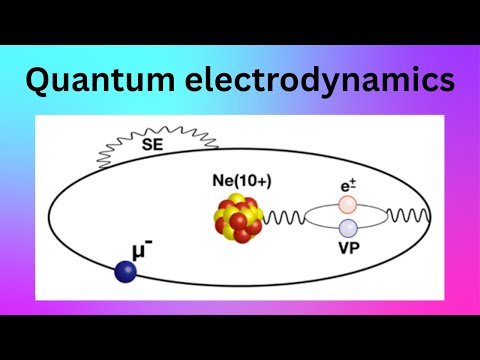
One of the key points in QED is this concept of **virtual particles**. Picture these guys as temporary guests at our dance party—they pop in and out super fast, doing their thing without us noticing. They help explain forces between real particles without having to be there all the time.
So why does this even matter? Well, it turns out QED has made some seriously accurate predictions about how things work at the quantum level. Like, when scientists measured the electron’s magnetic moment—a property related to its spin—they found that QED gave predictions that matched experiments to an unbelievable precision! We’re talking like 12 decimal places here!
Also, consider this: QED has led to advancements in technology too! Things like lasers and semiconductors depend on understanding these quantum principles. Without QED, we might still be stuck with old-school tech.
But wait! It doesn’t stop there. The implications for our understanding of the universe are enormous. QED forms the foundation for what we now call the *Standard Model of particle physics*, which explains how all known fundamental forces and elementary particles interact—with some serious depth!
In summary:
- Quantum Electrodynamics is about light-matter interaction.
- It merges ideas from quantum mechanics and special relativity.
- Virtual particles play a major role in particle interactions.
- QED’s predictions are incredibly precise!
- This theory has influenced many modern technologies.
To wrap it all up, think of quantum electrodynamics as one big tapestry woven from tiny threads of energy exchanges between light and matter. Each thread represents something fundamental to our universe—a universe where every little interaction can lead to something monumental!
Exploring Electrodynamics: Its Impact on Everyday Life and Technological Advancements
Electrodynamics, you know, is a pretty cool part of physics that deals with the way electric charges and magnetic fields interact. It sounds kinda nerdy, but it’s actually all around us! Think about it: every time you flip the switch on a light, you’re engaging with electrodynamics in action.
Now, let’s break this down a bit. At its core, electrodynamics combines two big concepts: electricity and magnetism. Electricity is what powers our devices, while magnetism plays a major role in how those devices work. Imagine a world without your phone or laptop—yeah, it’s hard to picture, right? Well, this interaction shapes many technologies we use every day.
You might have heard of quantum electrodynamics (QED). It’s a branch of electrodynamics that dives into the quantum level. I mean, particles behaving all weird and wonderful! QED helps us understand how light interacts with matter at that tiny scale. It tells us things like why the sky is blue or how lasers work—seriously cool stuff!
So let’s talk about some everyday impacts of electrodynamics:
- Electronics: Ever wonder how your favorite gadget works? From smartphones to computers, they rely heavily on principles laid out by electrodynamics. The movements of electrons inside semiconductor materials are guided by these laws.
- MRI Machines: When you’re at the hospital getting an MRI scan, you’re benefiting from electrodynamics! These machines use powerful magnets and radio waves to create images of your body.
- Communication: Every time you send a text or hop on Wi-Fi, it involves electromagnetic waves traveling through space. Yup! Electrodynamics makes sure those signals get where they need to go.
- Transportation: Ever heard of maglev trains? These trains float above tracks due to magnetic levitation—thanks to electromagnetism! They can zoom at crazy speeds without touching the ground.
It’s interesting how something so fundamental can drive advancements in technology and medicine. Like when I was younger, my grandma had this old radio that would only work if you fiddled with the antenna just right. That was basic electromagnetism; now we’ve evolved from that into wireless communication!
But what’s really eye-opening is how understanding these concepts leads to advancements like renewable energy technologies too. Wind turbines generate electricity through electromagnetic induction—another principle stemming from electrodynamics!
So yeah, basically everyday life ties back to these intense scientific ideas way more than we often realize. Electrodynamics isn’t just some dry textbook topic; it’s alive in our lives daily! You see how science isn’t just for lab coats and chalkboards? It shapes our world in fascinating ways—and that’s pretty awesome if you ask me!
Understanding the Significance of Quantum Mechanics in Shaping Modern Physics
Let’s talk about **quantum mechanics** and why it’s a big deal in the world of modern physics. You know, it’s one of those topics that sounds super complex, but once you break it down, it’s kind of mind-blowing.
First off, quantum mechanics is like the rulebook for the tiny particles that make up everything around us—atoms, electrons, photons. These aren’t just little marbles; they behave in ways that can totally mess with your head. Imagine a particle acting like both a particle and a wave at the same time! That’s just one of the quirks that makes this field so fascinating.
Now, let’s get to **quantum electrodynamics (QED)**. This is basically the theory that describes how light (or electromagnetic radiation) interacts with charged particles like electrons. To picture this, think about how a dance party might go down: light shines on electrons, they move and groove around each other, interacting in ways we can measure and predict. It sounds cool, right? But seriously, QED gives us equations to figure out how these interactions happen.
Why does QED matter? Well, it helps explain phenomena that seemed impossible to understand through classical physics alone—things like why an electron doesn’t just fall into the nucleus of an atom despite being attracted by its positive charge or how lasers work so smoothly. It helps us grasp concepts like **virtual particles**, which are fleeting and pop in and out of existence during interactions. These virtual buddies are crucial for describing forces at play even when they aren’t directly observable.
Another key point? QED has been tested more than almost any other theory in physics! Scientists have done experiments where they measure things down to crazy levels of precision—like testing predictions within parts per billion accuracy! And guess what? Every time it holds up. This level of validation really speaks to its reliability.
You might ask how all this connects to **modern physics** as a whole. Well, quantum mechanics and its spin-off theories have reshaped our understanding not only of tiny particles but also of larger systems. Things like superconductors (materials that can conduct electricity without resistance) owe their existence to principles from QED.
Oh! And let’s not forget technology; without these quantum principles, there’d be no smartphones or computers as we know them today! They rely on transistors which operate on quantum principles to function properly.
In summary:
- Quantum mechanics governs the behaviors of particles at incredibly small scales.
- Quantum electrodynamics (QED) explains interaction between light and charged particles.
- The accuracy of QED predictions has been tested extensively—like, super accurate!
- This field has led to advancements in technology we use every day.
So yeah, grasping quantum mechanics—especially through QED—gives you insight not just into the universe’s tiniest bits but also into groundbreaking tech developments we often take for granted. Pretty wild when you think about it!
Alright, so quantum electrodynamics, or QED for short—sounds super fancy, right? But let’s break it down a bit. Imagine you’re at a party, and everyone’s buzzing with energy, like tiny sparks connecting in the air. That’s kind of what QED is all about—how light (which is basically made of particles called photons) and matter interact.
You know, when I first stumbled upon this topic during college, I was totally lost in the math. I mean, particles dancing around equations? It felt like trying to juggle while riding a unicycle! But then it hit me: QED isn’t just this complicated math game; it’s the framework that helps us understand so much about our universe. It explains how electrons and photons interact with each other in such amazing detail that it has led to predictions we can test right here on Earth.
Think about how crucial this is for stuff we take for granted every day. Your smartphone? Yep, rooted in principles from QED. The lasers used in doctors’ offices? Those work off quantum electrodynamics too! It’s like this secret sauce behind modern technology—stuff that changes lives but flies under the radar.
Here’s where it gets even cooler. QED doesn’t just stop at predicting interactions; it does it with precision that blows my mind! In fact, some of the calculations yield results that match experimental outcomes to an incredible degree of accuracy. Like, seriously? That’s some next-level science!
Of course, there are still mysteries lurking out there. Sure, QED explains a lot about the electromagnetic forces but doesn’t fully account for gravity or dark matter—those cosmic puzzles are still waiting for some smart cookies to figure them out.
Honestly though, even with its complexities and gaps, thinking about quantum electrodynamics brings a sense of awe for me. Picture all those tiny particles buzzing around us every day—it’s like they’re playing their own version of hide and seek in a universe full of wonders. And while we may not see them directly, knowing they’re there working their magic makes me feel connected to something much bigger than myself.
So yeah, QED might sound daunting at first glance but really it’s just one more piece in this huge puzzle we call physics—the one that reminds us how interconnected everything is!