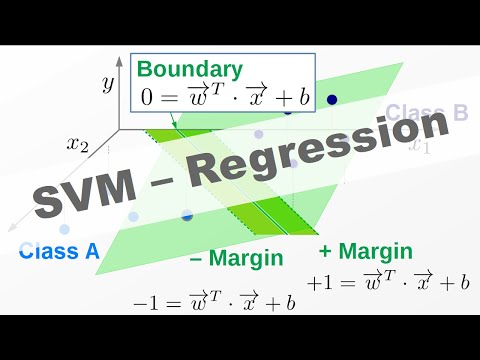
You know that moment when your friend tries to guess your age? They keep throwing out numbers. Some are way off, and you’re just cringing. That’s kind of what prediction is like in the data world—sometimes you just miss the mark!
Now imagine if that friend had a super-smart calculator that could analyze all kinds of patterns and help them get it right. That’s where Support Vector Regression comes in. It’s like having a math genius on speed dial, ready to help with all sorts of predictions.
This tool is becoming a real game-changer in scientific research, helping scientists make sense of mountains of data. Think about it: complex problems solved with a bit of number-crunching magic!
So, let’s unpack this thing together and see how Support Vector Regression is shaking up the research scene. Curious? Keep reading!
Leveraging Support Vector Regression for Enhanced Predictive Modeling in Scientific Research: A Comprehensive Guide
Support Vector Regression, or SVR for short, is a powerful technique that’s making waves in scientific research. It’s like having a super smart friend who helps you understand complex patterns in your data. So, let’s break it down into simpler pieces to see how it works and why it’s helpful.
First off, what is Support Vector Regression? Well, SVR is a type of machine learning algorithm that specializes in predicting continuous outcomes. Imagine you’re trying to forecast the temperature for tomorrow based on past data. SVR can help you make that prediction with impressive accuracy.
Here are some key features of SVR:
- Flexibility: It can handle both linear and non-linear relationships. That means whether your data forms a straight line or a curve, SVR can adapt.
- Margin of Tolerance: Unlike other methods that try to minimize error exactly, SVR focuses on keeping predictions within a certain margin of error. It’s all about being practical and realistic.
- Robustness: This method is pretty resilient to outliers—those pesky data points that don’t fit well. In research situations where data isn’t perfect, this quality shines.
Now, imagine you’re in a lab trying to predict how much a plant grows based on sunlight and water levels. Traditional models might struggle if the relationship isn’t straightforward. But with SVR, you can create a model that accommodates the nuances. You just feed it your historical data about sunlight levels and growth measurements.
Another cool thing about SVR is its kernel trick—yup, that sounds fancy! Basically, this allows it to operate in high-dimensional spaces even when we’re working with lower-dimensional data. So if your research involves multiple factors influencing an outcome, like age and exercise levels affecting health metrics, SVR can still find those hidden patterns.
But let’s not forget one important aspect: feature selection! When you’re dealing with lots of variables (like hundreds), picking the right ones to include is crucial. Too many irrelevant features can make your model sluggish or less effective. With techniques like cross-validation combined with SVR, researchers can fine-tune their models for better performance.
And hey, I’ve got this little story for you! One time in grad school, I worked on predicting soil moisture based on weather patterns using various methods. It was super tricky until my advisor suggested giving SVR a go—what a game-changer! It helped unravel the complexities so we could accurately predict moisture levels weeks in advance!
So yeah, applying Support Vector Regression can elevate predictive modeling in scientific research significantly; it’s like turning on the lights in a dim room full of complicated data! The approach is not only robust but also flexible enough for diverse fields—from ecology and biology to economics and engineering.
To sum up:
SVR is valuable because:
- It adapts well to different types of relationships.
- Keeps predictions realistic through margins.
- Resists disruption from outliers.
- Simplifies complex multi-factor scenarios.
This blend of reliability and adaptability makes Support Vector Regression an essential tool for researchers seeking deeper insight into their complex datasets! And remember—the more you practice using it alongside other machine learning techniques, the better you’ll get at making accurate predictions!
Understanding the Support Vector Regression Formula: A Comprehensive Guide to Its Application in Scientific Research
So, let’s chat about Support Vector Regression (SVR). It’s a cool method used in data analysis, especially in scientific research. You might be wondering what that even means. Well, it’s basically a type of machine learning technique that helps us predict outcomes based on data.
What’s the Deal with SVR?
At its core, SVR is designed for regression tasks, which means it looks at relationships between variables. Imagine trying to predict someone’s height based on their age. That’s regression!
The Formula Breakdown
The SVR formula is kind of like a mathematical recipe. It uses something called the epsilon-insensitive loss function, which says: “Let’s allow some errors but not too much.” So if your prediction is off by a little bit, that’s okay! But if it’s way off, it gets serious.
Here are the main pieces that make up the formula:
- w: This represents the weights assigned to each feature in your data.
- b: The bias term shifts the regression line up or down.
- x: Your input features—these could be any data points you’re using to make predictions.
- ε (epsilon): This is the threshold for how much error you’re okay with allowing.
Putting it all together, f(x) = w*x + b. Cool stuff, huh?
How Does It Work?
Think of SVR as drawing a line through dots on a graph. The goal? Make that line as close as possible to all those dots while keeping some wiggle room around them. When you have new data coming in, you can use this line to predict values based on where they sit relative to it.
The Kernel Trick!
Now here comes the magic: sometimes your data isn’t just sitting pretty in flat space; it’s all twisted and turned around. That’s where kernels come into play. A kernel takes your input data and transforms it into a higher-dimensional space where it’s easier to separate things out. It allows SVR to get really fancy and tackle non-linear problems too!
Imagine you’re sorting different types of fruit—apples vs oranges—in 3D space instead of just on a flat table; it makes finding differences way easier.
Why Use SVR?
Okay, so why should researchers care? Well, SVR can handle quite a bit of noise while still making reliable predictions—which is key when dealing with real-world data that’s often messy. It’s like trying to hear someone talking at a party; you filter out the noise and focus on what matters.
In scientific research contexts, say you’re working with environmental data predicting climate change impacts—you want accurate models even when conditions are unpredictable or noisy.
Anecdote Time!
I remember chatting with this ecologist who was trying to model animal migration patterns based on temperature changes. She was frustrated at first because her traditional models weren’t capturing wild fluctuations due to unpredictable weather patterns—like those sudden snowstorms ruining everything! Once she switched over to using SVR methods though, she found that predictions became so much more accurate and useful for planning conservation efforts.
This All Sounds Great! But…
It’s not all sunshine and rainbows—there’s always trade-offs in science! While SVR is powerful, selecting parameters and choosing an appropriate kernel can be tricky. Plus, if you have too many features or not enough data points—you might end up over-complicating things instead!
In summary? Support Vector Regression might seem complex at first glance but once you break it down into its components—and understand how those bits work together—it becomes an essential tool for scientists digging into predictive modeling. That mix of flexibility and strength makes it worth checking out for anyone involved in research!
An In-Depth Exploration of Support Vector Regression in Scientific Research
Support Vector Regression, or SVR for short, is like having a super-smart friend who knows how to predict stuff when you’re not sure what’s going on. This method is part of the bigger family of Support Vector Machines (SVM), which are usually used for classification tasks. But here, we tweak the idea a bit to tackle regression problems. Basically, it helps us guess or estimate numerical values based on input data.
Now, imagine you’ve got a bunch of points scattered on a graph—some representing the temperature over time in a city. You want to know what the temperature might be next week based on this data. So, SVR comes in and draws a curve that fits these points just right! It tries to find that sweet spot where it can minimize errors while still capturing the overall trend in your data.
One of the cool things about SVR is its ability to deal with non-linear relationships using something called kernels. Picture kernels as magic wands that transform your data into higher dimensions. This allows SVR to create more complex curves that fit your data much better than simple linear lines could. When you apply it, you can end up with smoother results even if your data is all over the place.
Key aspects of Support Vector Regression include:
A real-world example? Imagine you’re working on predicting stock prices based on past performance and various economic indicators. By applying SVR, you can get predictions that factor in those weird ups and downs more effectively than basic methods.
Still with me? Good! Another neat aspect is how customization works within SVR. You can tune parameters like C (which controls error tolerance) and epsilon (the width of your error margin). Adjusting these gives you control over how strictly you want your model to fit your training data versus leaving some wiggle room for future predictions.
In scientific research, this approach has found its home in areas ranging from biological data analysis to environmental science—like predicting pollution levels or modeling climate change trends based on various factors.
Overall, Support Vector Regression isn’t just another tool in the toolbox; it’s like having a well-rounded ally who understands both math and real-life applications really well! It takes some effort to understand at first but gets easier as you practice using it with different datasets—you’ll see those predictions get sharper every time!
So, you know when you’re looking at a complicated puzzle, and it’s just all over the place? Like, you can see the edges and some colors, but figuring out how they fit together feels impossible? That’s kind of the vibe in scientific research sometimes. You’ve got tons of data swirling around—numbers flying everywhere—and it’s on you to make sense of it. This is where stuff like Support Vector Regression (SVR) comes in, and let me tell you, it’s pretty neat!
Now SVR might sound super technical and intimidating. But basically, it’s a way for us to understand relationships between variables. Think about predicting the weather. If we want to know tomorrow’s temperature based on yesterday’s data—like humidity or air pressure—SVR helps draw that line through our scatterplot of numbers to give us a clearer picture.
I remember this one time at a science fair where I was tasked with predicting plant growth under different light conditions. I thought I had it all figured out until my results were all over the map! Some plants thrived while others drooped like they’d heard bad news. In that chaos, SVR would have been my best friend! It could have helped me find those hidden patterns instead of just staring at that data like a deer in headlights.
But here’s the thing: it’s not just about crunching numbers; it’s about context too! You have to understand what those numbers mean in real life. When scientists apply SVR, they’re often trying to answer questions that could help solve real-world problems—like climate change or healthcare issues.
It’s kind of empowering knowing there are tools out there that can help untangle the messiest of data webs. Of course, it doesn’t do all the thinking for you; researchers still need to interpret results carefully. But when used right, SVR can illuminate paths through confusion.
So yeah, whether you’re tracking asteroids or analyzing pollution levels in your city park, harnessing something like Support Vector Regression isn’t just about being fancy with math—it’s really about unlocking stories hidden within layers of information. And who doesn’t love a good story?