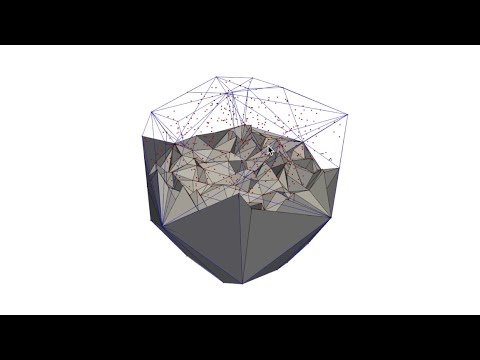
Imagine you’re at a party, and everyone’s crammed together in one corner. Kinda awkward, right? Well, Voronoi diagrams are like the social distancing of mathematics! They help figure out how to spread points or objects in space so that they can have their own personal bubble.
These funky geometric shapes aren’t just for nerds though— they’re seriously useful in the real world. From urban planning to biology and even computer graphics, Voronoi diagrams pop up everywhere!
You’ve got a flower garden? Those petals are positioning themselves like they’re following Voronoi rules. And trust me, once you see this stuff in action, it’ll change the way you look at everything around you. So grab a drink (or snack), and let’s dig into the wild world of 3D Voronoi diagrams!
Exploring Real-Life Applications of Voronoi Diagrams in Various Scientific Fields
So, Voronoi diagrams, huh? They’re pretty cool when you think about them. Basically, they’re a way to divide space into regions based on distance to specific points. Imagine a bunch of flowers in a garden. Each flower attracts bees, and the area around each flower is where the bees are most likely to be found. That’s your basic Voronoi diagram!
These diagrams pop up in various scientific fields, showing how versatile they can be. Let’s break down some real-life applications.
Geography and Urban Planning
In geography, Voronoi diagrams help map out everything from city planning to resource management. When urban planners design cities, they need to figure out how far people might have to travel for things like parks or grocery stores. Using Voronoi diagrams can help visualize the best spots for these services so everybody has reasonable access.
Biology and Ecology
In biology, there’s something called “cell biology.” Voronoi diagrams can describe how cells grow and spread in tissues. Think of it this way: when you look at a bunch of grapes, each grape is like a cell trying to claim its territory without overlapping too much with other grapes. This helps scientists understand how cells behave under different conditions or during growth.
Computer Graphics
Oh man, computer graphics! Voronoi diagrams are used in creating textures and patterns for things like video games or simulations. If you want a realistic-looking terrain or natural landscape—like mountains or oceans—these diagrams help create those organic shapes and patterns that look more appealing visually.
Robotics
In robotics, they come into play too! Imagine you’re programming robots to explore an area—like drones scouting out land for mapping. The robots can use Voronoi diagrams to figure out optimal paths or define territories so that they don’t collide with one another while doing their thing.
Chemistry and Material Science
Speaking of collisions, chemists have also found ways to use these diagrams! In material science, researchers study how materials break down at the microscopic level by using Voronoi tessellation to analyze particle arrangements. It’s kind of like figuring out why a cookie crumbles or doesn’t when you bite into it.
Astronomy
Even up in space! Astronomers can utilize Voronoi diagrams for analyzing the distribution of galaxies throughout the universe. By segmenting space this way, they get insights into cosmic structures just by studying how galaxies are spaced apart from one another.
So yeah, those are just a handful of applications where **Voronoi diagrams** make life easier in different scientific areas. Their ability to model complex relationships simply is what makes them so powerful across disciplines! Seriously impressive stuff when you start looking at how interconnected everything really is.
Exploring 3D Voronoi Diagrams: Applications and Implications in Scientific Research
So, let’s talk about these cool things called 3D Voronoi diagrams. You may not have heard of them before, but once you understand what they are, you might find yourself thinking, “Wow, that’s actually pretty neat!” Basically, a Voronoi diagram is all about dividing space into regions based on distances to a set of points. In 3D, you can imagine it as bubbles around each point in a space.
In simpler terms, if you have a bunch of points floating around in the air—like cities on a globe—the Voronoi diagram helps visualize how these points influence the areas around them. Each bubble represents the space closest to its respective point. If you moved the points around? Yep! The bubbles would change shape and size. That’s part of what makes it so interesting.
Now let’s dig into some real-world applications. Here are a few areas where 3D Voronoi diagrams make a splash:
- Biology: Scientists can use Voronoi diagrams to model cell structures. Think about how cells pack together in tissues. By mapping out their growth and organization with these diagrams, researchers get insights into how they behave.
- Geography: In urban planning or environmental studies, planners use 3D Voronoi structures to determine optimal locations for services like hospitals or fire stations. It helps in visualizing how accessible those services are to residents.
- Computer Graphics: Artists and designers use these diagrams for simulating natural phenomena like landscapes or fluid movements. It provides realism by creating complex patterns that resemble nature.
- Robotics: Think about robots or drones navigating through environments. They can utilize Voronoi diagrams to avoid obstacles and optimize routes effectively.
But hold on! What’s even more amazing is the wider implications of using these diagrams in research. For example:
– **Data Analysis**: When analyzing large datasets, scientists can apply Voronoi algorithms to gather insights about patterns within spatial data.
– **Materials Science**: Researchers study materials at the microscopic level using Voronoi tessellations to understand grain structures and properties.
This isn’t just some dry math stuff; it affects numerous fields! I remember reading about one researcher who was working on improving city layouts using Voronoi models after observing traffic congestion in their own neighborhood. Imagine that moment when they realized they could actually visualize solutions—how cool is that?
In summary, 3D Voronoi diagrams aren’t just fancy shapes; they’re powerful tools with practical applications across various scientific fields. From biology to robotics, these diagrams help us figure out complex spatial relationships while pushing the boundaries of understanding our world—a connection between thinking and reality that’s super exciting!
Exploring the Application of Voronoi Diagrams in Biological Research and Analysis
Voronoi diagrams are pretty cool, if you think about it. They’re like a way to break up space based on distances. Imagine you have a bunch of points—like flowers in a garden. A Voronoi diagram will help you figure out how to divide the garden so that each flower gets its own little section of land, based on how far it is from the others.
In biological research, these diagrams are super useful. You see, living things aren’t just randomly placed; they often follow patterns. Here’s where Voronoi diagrams come into play. They help scientists visualize and analyze these patterns in nature.
To give you an idea, let’s say we want to study how cells are distributed in a tissue sample. By using a Voronoi diagram, researchers can map out each cell’s territory. It’s like seeing who has the biggest claim on the turf! This helps in understanding cell interactions and behaviors within tissues.
But it gets even more interesting when you look at applications in three dimensions. 3D Voronoi diagrams take this idea up a notch by adding depth to our analysis—literally! For instance, when examining the structure of complex organs or systems like lungs and brains, 3D diagrams can reveal how cells and structures fit together in space.
Another example relates to ecology. Scientists can use Voronoi diagrams to understand animal territories or food distribution among species. Imagine tracking a pack of wolves across a forest—we’d want to know how they divide their hunting grounds and what influences those boundaries.
So why do these diagrams matter? Well, they provide insights that can lead to better conservation strategies or improved understanding of disease mechanisms in tissues. Knowing how things interact spatially is pretty key for both biology and medicine.
In summary, whether it’s studying tissues at a microscopic level or mapping out animal habitats in ecosystems, Voronoi diagrams serve as an essential tool for researchers tackling complex biological questions. They help create connections between data points that might otherwise seem disconnected—and connections are where the magic happens!
Alright, so let’s talk about Voronoi diagrams in 3D. You might be thinking, “What even is that?” Well, imagine you have a bunch of points scattered in space—kind of like if you tossed a handful of marbles into a box. A Voronoi diagram basically helps you figure out the space around each point where it’s king or queen. Like, if you were standing at one marble, this diagram shows you exactly where your influence ends and your neighbor’s starts.
Now, these diagrams are super handy in various scientific fields. Have you ever played a strategy game where positioning is everything? That kind of thinking goes into things like urban planning and resource management. With Voronoi diagrams, scientists can predict how populations might spread or determine which areas would be best to place resources—like parks or hospitals—ensuring they’re as accessible as possible to the people who need them.
Here’s an emotional bit for you: I once visited a city that was using Voronoi diagrams in real-time to analyze traffic patterns. They wanted to figure out how to distribute buses more effectively. Seeing everything come together made me realize how mathematics can really touch people’s lives on such a practical level. It’s not just numbers; it’s about making places better for everyone.
In environmental science, Voronoi diagrams also play a role. Let’s say researchers are studying wildlife habitats; they can map out territories using these diagrams to see how animals interact with their surroundings. It gives them insights into conservation efforts by showing us which areas might need more protection.
And get this—there’s even potential use in the realm of technology, especially with machine learning and computer graphics! When designing 3D models for animations or virtual environments, artists use these diagrams to create realistic representations of spaces and materials.
So yeah, while it might sound like something only math nerds get excited about (and fair play to them), Voronoi diagrams are way more than just pretty pictures. They’re tools that help us understand our world better—from city planning to wildlife conservation—and they remind us how interconnected everything really is. And isn’t that something worth appreciating?