You know that moment when you open your fridge and see a half-eaten sandwich staring back at you? You’re like, “Ugh, is this still good?” Well, it’s kinda like that with molecules too.
Take CH2O for instance. It might not seem like much at first glance, but this little guy is the star of some big chemistry stories. It’s all about how these molecules are shaped—like the awkward dance moves at a wedding. Seriously, they each have their own style!
So, what gives CH2O its quirky geometry? Why does it matter? Stick with me! We’re gonna unwrap some of the cool stuff about molecular shapes and discover why they’re more than just pretty patterns. Buckle up; it’s gonna be a fun ride!
Molecular Geometry of Carbon in Formaldehyde (H2CO): Understanding Shape and Structure
So, you’re curious about the molecular geometry of carbon in formaldehyde (H2CO)? Awesome! Let’s break it down in a simple way. Formaldehyde is a small organic compound known for its use in a variety of industries, but its fascinating structure is what we’re focusing on here.
Carbon is like the superstar of organic chemistry. It can make four bonds because it has four electrons in its outer shell. In formaldehyde, carbon is sitting at the center, bonded to two hydrogen atoms and one oxygen atom. The chemical structure looks like this:
H2C=O
The double bond between carbon and oxygen is crucial. It changes how everything else arranges itself around the carbon atom. This brings us to hybridization.
In formaldehyde, the carbon undergoes sp² hybridization. This means that one s orbital and two p orbitals mix together to form three new equivalent sp² hybrid orbitals. These three orbitals arrange themselves in a plane around the central atom. Picture them like slices of pizza spread out evenly on a table—you follow me?
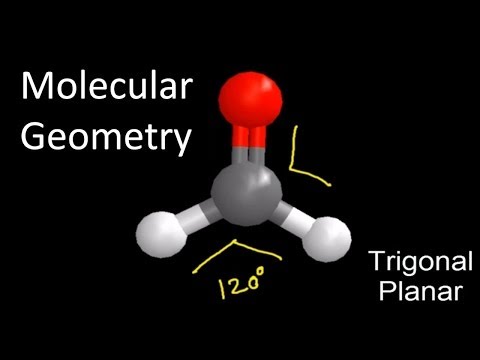
This leads to a trigonal planar geometry. It essentially means that all three bonding regions around the carbon are sitting at about 120 degrees apart from each other. So, you’ve got the two hydrogen atoms forming one side of this triangle while oxygen pulls on another side through that double bond.
- The molecular shape is trigonal planar.
- The bond angles are approximately 120 degrees.
- The presence of the double bond influences how everything sits around carbon.
This arrangement is not just for aesthetics; it actually plays a significant role in how formaldehyde reacts with other molecules. For example, this geometry helps formaldehyde behave as a reactive species when interacting with amines and other nucleophiles—molecules that love to attack electron-deficient sites like our carbon here.
I can remember my first chemistry class when we were taught about shapes and bonds. I was so confused looking at all those diagrams! But seeing it all come together made me realize how cool these tiny structures really are; they define so much about reactivity and properties at larger scales!
So, next time you hear about formaldehyde or grab something containing it, think about that little trigonal planar shape working behind the scenes! It might look simple at first glance, but there’s an entire world of interactions happening thanks to its molecular geometry.
Understanding VSEPR Theory: A Comprehensive Analysis of CH2O’s Molecular Geometry in Chemistry
Understanding VSEPR Theory is all about figuring out how molecules are shaped. The term stands for “Valence Shell Electron Pair Repulsion” theory. It’s a pretty neat way to visualize molecular geometry, and it’s essential for understanding compounds like CH2O, also known as formaldehyde.
So, here’s the deal: every atom has electrons buzzing around it. These electrons want their space! What VSEPR tells us is that the shape of a molecule is determined by these electrons pushing each other away. It’s like arranging people in a crowded room—everyone wants some personal space.
Now, let’s talk about CH2O specifically. This molecule consists of one carbon (C), two hydrogens (H), and one oxygen (O) atom. The carbon is at the center because it has four valence electrons, which means it can bond with other atoms quite well.
In the case of CH2O:
- The carbon atom forms two single bonds with hydrogen atoms.
- It also forms a double bond with the oxygen atom.
So that gives us a total of three bonding regions around the central carbon atom. But don’t forget about lone pairs! In formaldehyde, there are no lone pairs on the carbon—they’re all engaged in bonding.
When we apply VSEPR theory, we see that these bonding regions adopt a specific arrangement to minimize repulsions. For CH2O, this leads to a **trigonal planar** geometry. Picture this: if you were to draw it out, you’d have your central carbon in the middle with one double bond pointing up to oxygen and two single bonds going off to either side toward hydrogen atoms.
This arrangement results in bond angles close to **120 degrees**, which is typical for trigonal planar molecules. It’s kind of like arranging three pieces of furniture in a cozy way so that they’re not bumping into each other!
You know what’s interesting? When I was learning about molecular geometry back in school, I was baffled by how simple shapes could mean so much in science. Like, just because something looks flat doesn’t make it any less complex!
So yeah, understanding CH2O through VSEPR theory not only helps us visualize its shape but also lays down some groundwork for predicting how it will behave chemically and physically as well. This knowledge can come in handy for everything from chemical reactions to understanding properties like polarity.
In short:
- VSEPR theory helps predict shapes based on electron pair repulsion.
- CH2O has one central carbon bonded to two hydrogens and one oxygen.
- This molecule adopts a trigonal planar shape due to its bonding arrangement.
That’s basically how you break down **CH2O**’s molecular geometry using VSEPR!
Exploring the Molecular Geometry of CH2O: Is It Bent or Not?
When you look at the molecule CH₂O, also known as formaldehyde, it’s like opening a tiny book of geometry. You see, the way atoms bond and arrange themselves gives us clues about their shape, which is called molecular geometry.
First off, let’s talk about what makes CH₂O tick. It has one carbon (C) atom at the center, surrounded by two hydrogen (H) atoms and one oxygen (O) atom. The carbon atom forms **single bonds** with both hydrogen atoms and a **double bond** with the oxygen atom. So, you might wonder how all these bonds come together to shape the molecule.
Now, to get a clear picture, you want to consider valence shell electron repulsion theory (VSEPR). Basically, it says that electron groups around a central atom repel each other and will arrange themselves as far apart as possible. In CH₂O:
- Carbon has four valence electrons.
- Hydrogen contributes one electron each for a total of two.
- Oxygen brings in six electrons.
Adding them up, we have 12 valence electrons. These electrons create three regions of electron density around carbon: two from the H atoms and one from the double bond with O.
So what does this look like in 3D? Instead of forming a flat line or being bent in an awkward way like some molecules can be, we have a trigonal planar geometry. Each bond is trying to go in its own direction as much as possible! The angle between these bonds is about 120 degrees.
Here’s where it gets kind of interesting: even though you might think “Oh! There are lone pairs,” in this case, there aren’t any on carbon that would push things around! That means our molecular shape remains neat and clean.
To directly answer your question: CH₂O is not bent; it has a trigonal planar shape. Picture standing at a picnic table—you have your friends sitting across from you, all spaced out nicely so that everyone can enjoy their food without elbowing each other!
In short:
- The central carbon atom connects to two hydrogens and one oxygen.
- The arrangement is influenced by VSEPR theory.
- The ideal angles are observed because there are no lone pairs on carbon.
- This gives CH₂O its trigonal planar arrangement rather than being bent.
So there you have it! The molecular geometry of CH₂O isn’t just some dry fact; it’s also pretty colorful when you picture those little atoms dancing around!
Okay, so let’s talk about something a bit nerdy but super cool: the molecular geometry of CH2O compounds. You know, CH2O is the chemical formula for formaldehyde, which sounds kind of scary but is actually all around us. It’s in things like the air, some disinfectants, and even in certain food products.
So here’s a little anecdote—once, I walked into an old library with those classic wooden shelves and dusty books. You could almost smell history in the air! Turns out, that distinct scent was partly due to formaldehyde. It has this weird ability to stick around and give off that nostalgic vibe. Anyway, back to chemistry!
When you look at CH2O, you’ve got one carbon atom bonded to two hydrogen atoms and one oxygen atom. The arrangement of these atoms creates something called molecular geometry. Basically, it’s how these atoms are positioned in space relative to each other.
The molecular shape is trigonal planar! That means all three atoms attached to the central carbon are spread out evenly around it—like if you were throwing a frisbee with friends standing in a triangle formation. This arrangement helps minimize electron repulsion between bonds. So yeah, it makes the whole molecule stable.
One cool thing about CH2O is that it has polar bonds because of that electronegative oxygen pulling the electron cloud closer to it. It’s kind of like when you’re sharing fries with a friend who just never seems to let go of them! This polarity gives formaldehyde some unique properties—like being soluble in water.
And here’s where it gets even more interesting: different structures or arrangements can lead to diverse properties and reactions. In chemistry, it’s all about that structure-function relationship! Just like how your personality might change based on your surroundings or who you’re hanging out with.
So yeah, unraveling something like the molecular geometry of CH2O can totally open up doors into understanding how compounds behave in our world—and even how they affect us emotionally (hello again, library smell!). Isn’t science wild?