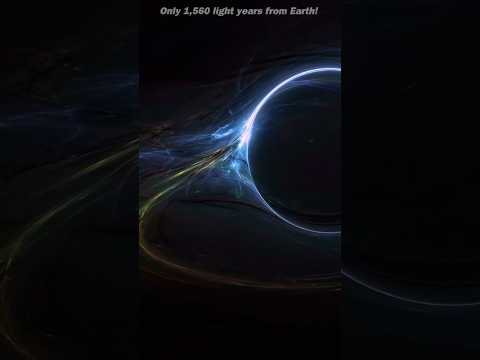
So, picture this: You’re lying back on a clear night, stars twinkling above like diamonds scattered on velvet. Ever glance up and wonder if there’s something lurking out there? Like, maybe a black hole? Yeah, they’re real and way more fascinating than you might think.
Now, let me tell you about Gaia. It’s this super cool space mission that’s out there mapping our galaxy. And guess what? It’s turning its gaze towards black holes! Seriously. It’s like sending your best friend to a party where all the secrets are hidden.
These cosmic monsters aren’t just dark voids swallowing everything; they’ve got stories to tell us about how our universe works. I mean, could learning about them give us clues about how we got here? It’s wild to think about.
So buckle up! We’re diving into Gaia’s observations and what they mean for our understanding of the cosmos. You ready for this cosmic ride?
Insights from Gaia BH1: Unraveling the Mysteries of Black Hole Formation in Astronomy
You know, black holes have always been one of those mind-bending mysteries of the universe. And now, with Gaia BH1, we’ve got some pretty cool insights into how these cosmic giants form. It’s like peeking behind the curtain at one of the universe’s best-kept secrets!
Gaia BH1 is a black hole that was spotted by the Gaia spacecraft. This mission is all about mapping our galaxy in detail, and it’s like having a super high-def camera for astronomy. What’s exciting about Gaia BH1 is that it seems to be the closest black hole to Earth, sitting about 1,600 light-years away. Can you believe that? It’s almost like finding out there’s a hidden treasure chest in your backyard!
Now, what’s really fascinating here is how scientists think this particular black hole formed. Traditionally, we’ve thought that black holes are born from massive stars collapsing under their own gravity after they run out of fuel. But Gaia BH1 challenges some of those ideas.
So here’s where things get interesting: it looks like this black hole could have formed from a binary star system. Picture two stars dancing around each other, and then one of them goes supernova and leaves behind a black hole! The remaining star can actually end up orbiting this newly formed black hole. That connection gives us clues about the life cycle of stars and how they evolve.
Now let’s break down some key points about what we’re learning from Gaia BH1:
- Proximity: Since it’s so close to us, studying Gaia BH1 helps astronomers understand more about our cosmic neighborhood.
- Mass: This black hole has a mass roughly 10 times that of our Sun—definitely not small!
- Binaries: The detection highlights the importance of binary systems in understanding how these monsters come to be.
- The state of astronomy: With good data from missions like Gaia, astronomers can refine existing theories and maybe even create new ones!
One emotional aspect worth mentioning—imagine standing under a starry sky and knowing there are enormous structures up there that could swallow entire stars! It kind of puts your place in the universe into perspective, doesn’t it?
And as we dig deeper into the formation processes thanks to observations like those from Gaia BH1, we might uncover even more hidden stories woven into the fabric of space-time itself! Researchers believe studying black holes isn’t just about understanding these objects but also unlocking secrets about galactic evolution.
So yeah, keep an eye on developments coming from data linked to Gaia BH1 and similar missions! They have so much potential for reshaping our understanding of not only black holes but also the entire cosmos around us!
Exploring Gaia: Discovering Celestial Objects 1500 Light Years Away in Astronomy and Space Science
So, let’s talk about Gaia, right? It’s this incredible space mission that’s all about mapping our galaxy like a cosmic address book. Launched by the European Space Agency back in 2013, it’s been peering deep into space to discover stuff we didn’t even know existed! Imagine standing on Earth and looking up at the night sky. That vastness can be hard to grasp, but Gaia is literally uncovering secrets from 1500 light years away!
What makes this mission super cool is that it can pinpoint the positions of stars with *amazing* precision. We’re talking about billions of stars! To give you an idea, Gaia is estimating the locations and movements of over one billion stars in our Milky Way galaxy. This means we’re getting a clearer picture of our cosmic neighborhood.
Gaia isn’t just spotting stars. It’s also on the lookout for black holes. Black holes are these mysterious regions in space where gravity is so strong that nothing—not even light—can escape. Sometimes they swallow nearby stars or even merge with other black holes, which creates ripples in spacetime known as gravitational waves!
- Black Hole Observations: One thing Gaia does is help identify potential black holes by tracking their gravitational effects on nearby stars. Even though black holes themselves can’t be seen directly, their presence can be inferred by observing how they influence other celestial objects.
- Anomalous Movements: When stars are moving in unusual paths or at unexpected speeds, it might mean there’s a black hole lurking nearby, pulling them around like a cosmic puppet master.
- The Role of Dark Matter: These observations feed into a bigger picture involving dark matter—a mysterious substance that makes up much of the universe but doesn’t emit light or energy we can detect directly. It’s kind of like trying to understand what a shadowy figure is doing behind a curtain!
A cool anecdote here: Imagine being an ancient astronomer looking up at those very same stars and wondering if anything else was out there. Fast forward to now—thanks to technology like Gaia, we’ve not only discovered new stars but also hinted at things like black holes and dark matter mountains beyond our reach.
The implications? Huge! Understanding black holes helps scientists refine models of how galaxies evolve over time and how they interact with their surroundings. Plus, insights from these observations could lead us to rethink some fundamental ideas about physics itself. Cool stuff!
So yeah, whether you’re gazing up into the night sky or diving into data from missions like Gaia, remember—you’re part of this ongoing journey toward understanding our place in the universe.
Impact of Gaia BH1 on Its Companion Star: Insights into Stellar Interactions and Cosmology
Alright, so let’s talk about Gaia BH1 and its companion star. It’s a pretty cool topic that dives into how black holes interact with nearby stars. You might wonder, how does one star even affect another? Well, buckle up!
Gaia BH1 is actually a black hole that was spotted by the Gaia satellite. This satellite is like an astronomer’s best buddy, mapping stars and gathering data from all over the Milky Way. What makes Gaia BH1 special is that it’s not just floating around in space alone; it’s got a companion star whirling around it. And that’s where things get really interesting.
When two stars are close together like this, they start to influence each other’s behavior. It’s like when you’re at a party and your friend decides to get up and dance; suddenly everyone else feels like shaking their hips too! In this case, Gaia BH1’s gravity pulls on its companion star, changing its path and speed.
- The gravitational pull from the black hole can cause the star to wobble in its orbit.
- This influence can also lead to changes in the light we see from the companion star. Sometimes it dims or brightens because of how the black hole is tugging on it.
- If Gaia BH1 were actively pulling material away from its companion star, we’d see some pretty wild cosmic fireworks as matter spirals down in an accretion disk!
Cosmologically speaking, studying these interactions helps us understand how black holes form and grow over time. You see, scientists aren’t just looking for shiny objects—they’re piecing together a bigger picture of our universe by observing these starry relationships. By examining Gaia BH1 and its buddies (yes, celestial bodies can also have friends!), researchers gain insights into galaxy formation and evolution.
There’s something kind of poetic about this too. Just think about it: even in death—when a massive star collapses into a black hole—it’s still part of an intricate dance with another star. It’s like nature’s way of reminding us that everything has an interconnected role in this vast cosmos.
So next time you hear about Gaia BH1 or any black hole interacting with other stars, remember—there’s more than meets the eye! There’s gravity pulling at heartstrings here… well, stellar strings at least!
So, let’s talk about black holes for a second. These mysterious giants of the universe are like the cool kids of astrophysics. Seriously, they’re everywhere in sci-fi movies and yet, we actually know so little about them. You ever just stare at the night sky and wonder about all those stars? What if I told you there’s more going on up there than we can even see?
Recently, Gaia, which is this nifty space observatory launched by the European Space Agency, has been gathering some impressive data. Now, its main gig is mapping the Milky Way galaxy—and trust me, it’s incredible to think about what that means. Imagine trying to draw a detailed map of your neighborhood but instead of streets and houses, it’s filled with billions of stars and cosmic wonders.
What really gets my mind buzzing is how recent observations from Gaia are shedding light on black holes lurking in our galaxy. It’s like opening a box that has been locked for ages! From the data collected, scientists have started getting better estimates on things like how many black holes might be out there and how they’re spread across our galaxy. This isn’t just math; it’s huge for understanding cosmic evolution.
I remember standing outside one chilly night, looking up at those twinkling dots above me. It felt surreal to think that each star had its own story—some might have planets orbiting them, others might be sitting quietly beside a massive black hole.
The implications? Well, they’re mind-blowing! Understanding these cosmic monsters could make us rethink everything we know about gravity and formation of galaxies. You know how a teacher would say that everything in science connects? Black holes challenge us to rethink that connection. They might be distant, but their influence is powerful; they affect star formation and help shape galaxies.
And yeah! There’s a poetic beauty in it—light bending around these entities because they’re so strong that not even light can escape their grasp. Kinda gives you goosebumps when you think about it.
At the end of the day, Gaia’s observations are not just numbers and graphs; they’re clues to unlocking secrets of our universe and our place within it—a reminder that we’re all connected in this vastness called space. And who knows what else lies waiting to be discovered? The universe feels alive with possibilities!