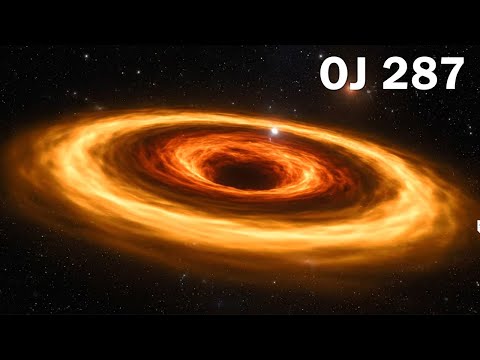
Alright, so picture this: you’re at a party, right? And someone starts talking about black holes. Most people would zone out, but not me! I get excited.
Black holes are like the universe’s ultimate mystery box. Seriously, they’re such weird and wild things. One of the coolest (and super odd) black holes out there is OJ 287. It’s not just your run-of-the-mill black hole; it has this cosmic story that’ll keep you on your toes.
I mean, can you imagine a giant space vacuum that gobbles up everything in sight? Yeah, that’s OJ 287 for you! No wonder scientists are all worked up about it. We’re talking about stuff that could change how we see the universe.
So, grab a snack and let’s dig into this cosmic conundrum together. You’ll never look at black holes the same way again!
Exploring Messier 87: A Deep Dive into Galactic Phenomena and Astrophysical Discoveries
Have you heard of Messier 87? It’s this incredible galaxy located about 53 million light-years away in the Virgo cluster. What makes it so fascinating? Well, for starters, it’s home to one of the largest black holes ever discovered—this beast is about 6.5 billion times more massive than our Sun! That’s right, billion with a “b.”
This black hole, called M87*, isn’t just any black hole; it actually became famous back in 2019 when scientists released the first-ever image of its event horizon. Seeing that fuzzy ring around a pitch-black center was like peeking into the cosmic abyss. How wild is that?
Now, let’s talk a bit about what makes M87 so unique. For one, it emits powerful jets—like cosmic fire hoses—of particles shooting out at nearly the speed of light! This happens because as matter spirals into the black hole, it heats up and gets ejected outwards along its rotational axes. The physics behind this is mind-boggling!
- The Eddington limit: It’s kind of a cap on how bright celestial objects can get without blowing themselves apart.
- Accretion disks: This is where all that swirling matter goes before getting gobbled up by the black hole!
- Relativistic jets: These are those super-fast jets I mentioned earlier. They can extend thousands of light-years into space!
You might be asking yourself how scientists even study these distant galaxies and their secrets. One tool they use is radio telescopes. They can detect radio waves emitted by objects in space, which gives clues about what’s happening light-years away from us.
The OJ 287 black hole comes into play here because it’s another active galactic nucleus that’s also super interesting! It’s known for its periodic outbursts and happens to be quite similar to M87*. When studying such galaxies, researchers often draw parallels between them to better understand how these monstrous black holes behave.
An emotional angle? Think about connecting with others who stare up at the night sky and share that awe-inspiring feeling. Imagine being part of a community trying to grasp these mysteries together; it really feels like you’re reaching out across time and space.
The thing is, understanding galaxies like M87 helps us grasp our own cosmic narrative. It reveals not just how galaxies evolve but also how our universe works at large scales—from dark matter to cosmic expansion!
If you’re intrigued by all this galactic wonder, just know: every telescope point towards places like Messier 87 brings us closer to answering essential questions about existence itself. So keep looking up—you never know what other mysteries are waiting in the dark!
Exploring the Size and Characteristics of the OJ 287 Black Hole: Insights from Modern Astrophysics
OJ 287 is one of the most intriguing black holes out there. Located about 3.5 billion light years away in the constellation Canes Venatici, it’s part of a binary system. That means it’s not alone! It’s paired with another black hole, and their dance around each other reveals a lot about the mysterious nature of these cosmic giants.
One thing that stands out about OJ 287 is its size. This black hole has a mass of about 18 billion times that of our Sun! To put that into perspective, if you were to somehow gather up all the matter in OJ 287, it could weigh more than entire galaxies put together. Pretty mind-boggling, right?
Now, when we talk about black holes, we’re usually discussing two key characteristics: mass and spin. OJ 287 has both in spades. Its massive size makes it a supermassive black hole—these guys are often at the centers of galaxies and play a huge role in their formation and evolution.
A cool thing to know is that OJ 287 goes through dramatic bursts of brightness every 12 years due to accretion events. Basically, this means it’s sucking in material from its surroundings. When this happens, it heats up the accreted material so much that it starts emitting radiation across various wavelengths—from radio waves to gamma rays.
What’s even more interesting is how astronomers discovered this pattern of periodic outbursts! They’ve been tracking OJ 287 for over a century now. Imagine spotting your favorite star on the way home every day and noticing it shines brighter on certain days—this was kind of like what they did!
You might wonder why studying OJ 287 matters? Well, by understanding these massive black holes, scientists can learn more about gravity itself and how it behaves under extreme conditions. It also helps us grasp how galaxies evolve over time since most big galaxies have one lurking at their center.
Astrophysicists have employed advanced tools like gravitational wave detectors to study events involving black holes—even pairings similar to OJ 287’s twin system! And there’s still so much we don’t know.
In terms of challenges in astrophysics, measuring distances in space isn’t just “take a ruler and measure.” The universe is vast and full of strange phenomena that can affect our observations—influence things like light bending or redshift due to cosmic expansion.
So next time you look up at those twinkling stars above you, think about OJ 287 and other mysterious black holes out there doing their cosmic ballet. They’re not just sucking in everything around them; they’re teaching us significant lessons about our universe!
In short:
- Location: About 3.5 billion light years away.
- Mass: Roughly 18 billion times the mass of our Sun.
- Burst Cycle: Experiences brightness bursts every 12 years.
- Twin System: Works alongside another massive black hole.
- Astronomical Techniques: Scientists use advanced technology to study these phenomena.
Black holes like OJ 287 remind us just how little we truly understand about space—and maybe that’s part of what makes it all so exciting!
Comparative Analysis of OJ 287 and TON 618: Insights into Supermassive Black Holes
So, let’s chat about supermassive black holes, specifically two heavyweights in the universe: **OJ 287** and **TON 618**. Both are fascinating examples, but they hold some pretty distinct characteristics that can tell us a lot about how these cosmic giants work.
First off, size matters. TON 618 is a real heavyweight champ, clocking in at an estimated **66 billion solar masses**. That’s like having a black hole that weighs more than 66 billion suns! On the flip side, OJ 287 is much smaller by comparison—it comes in at around **18 billion solar masses**. While both are massive, the sheer scale of TON 618 is mind-boggling.
Now, you might be wondering how we know these sizes. The thing is, scientists can estimate the masses of black holes by studying their surroundings. They look at how fast stars are orbiting around them. Faster orbits usually mean a heavier mass! It’s kind of like watching a merry-go-round: the faster it spins, the more forceful you feel being pulled to the edge.
Another important detail is their growth histories. OJ 287 has this neat little backstory where it experiences periodic outbursts every few years. It’s like clockwork! These flares are believed to be caused by interactions with another black hole in its core—a smaller one that spirals in and gets gobbled up over time. This process gives us insights into how black holes can grow and evolve.
In contrast, TON 618 doesn’t show such regular outbursts; instead, it appears to have steadily accumulated mass over eons by munching on gas and dust from its environment. It’s thought to be less dynamic than OJ 287—more of a “slow and steady wins the race” kind of black hole.
Now let’s talk energy output. When OJ 287 flares up during those outbursts, it releases tons of energy! Some estimates suggest it could outshine entire galaxies during these times. The radiation from such events helps astronomers study not only OJ 287 but also provides clues about the physics of black holes in general.
Meanwhile, TON 618 may not have such dramatic flares but its unbelievable mass means it’s still incredibly influential on its surroundings. The accretion disk—the swirling mass of material falling into it—can still produce significant energy output even if it’s not as flashy as what we see with OJ 287.
When we consider location, both reside far away from Earth. OJ 287 hangs out about **3 billion light-years away**, while TON 618 is even further—around **10 billion light-years** distant! This distance adds another layer to our understanding because observing them gives us insight into different eras of cosmic history.
In conclusion (not supposed to say that though), comparing these two supermassive black holes sheds light on different aspects of cosmic growth and behavior! They represent two sides of the same coin: one that’s all about dramatic change and energetic outbursts versus one that quietly grows over time with an immense gravitational presence. It’s wild how studying them can reveal so much about our universe’s past—and help us question what mysteries lie ahead among those stars!
So, let me take you on a little journey into the cosmos, specifically to a black hole called OJ 287. It’s not just any black hole—this one has some pretty wild mysteries swirling around it. Picture this: a giant cosmic vortex, sucking in everything nearby, like that one friend who just can’t share snacks at a movie night.
OJ 287 is situated about 3.5 billion light-years away in the constellation Canes Venatici. Seriously, that’s so far you’d need a spaceship from a sci-fi movie to get there! It’s also what’s known as a blazar—basically a supercharged black hole that spits out jets of energy into space. These jets are powerful enough to outshine entire galaxies, which is mind-blowing if you think about it.
What’s really intriguing is how OJ 287 has been observed “pulsating.” Every 12 years or so, it gets brighter, then dims down again in this rhythmic dance. Scientists think this might be caused by another smaller black hole orbiting it, kind of like how our Earth orbits the Sun while doing its own funky spin. The thought that there’s such complex and chaotic behavior going on billions of light-years away is both beautiful and humbling.
I remember once watching a documentary about black holes. They explained how these cosmic giants could warp spacetime itself—like bending a piece of fabric with your fingers—and I was just sitting there, jaw dropped, eyebrows raised like I was witnessing magic for the first time! The idea that something so distant can affect our understanding of physics here on Earth really gets me thinking about our place in the universe.
And here’s where things get even more philosophical: while we learn more about OJ 287 and other celestial wonders, we’re reminded of how much we still don’t know. Each discovery opens up new questions that make you wonder if we’ll ever have all the answers or if some mysteries are just meant to stay mysteries!
Like I said before, thinking about OJ 287 challenges our perception of reality and time itself. It prompts us to look beyond our everyday lives and consider something grander than ourselves—a cosmic tapestry full of threads we’re still trying to untangle. Isn’t that what makes science so compelling? The endless quest for knowledge in this vast universe keeps us curious and connected!