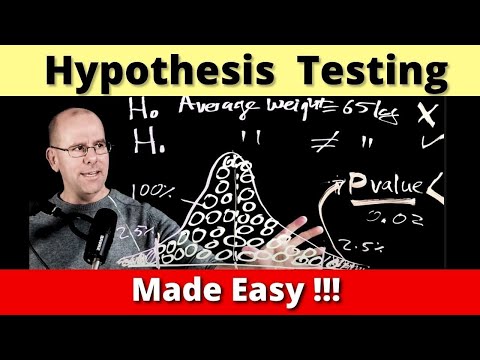
Have you ever tried making a guess about something, only to discover that it was totally wrong? Like, you thought your friend was going to bring tacos to the party, but they showed up with sushi instead? That’s kind of how hypothesis testing works in statistics.
Imagine you’re like a detective, piecing together clues to figure out if your guess is spot on or way off base. It’s all about making informed decisions based on evidence! Seriously, it’s not just numbers and equations; it’s like a game where you test your gut feelings against hard facts.
So, let’s unpack this idea together! Why do scientists even bother with hypothesis testing? Well, it helps them sift through data and find out what’s real and what’s just noise. Stick around, and I’ll walk you through why this tool is so vital in the world of science.
The Significance of Hypothesis Testing in Statistical Analysis: A Key Tool for Scientific Discovery
Hypothesis testing is like the detective work of the science world. When scientists want to understand if a theory holds up against real-world data, they turn to hypothesis testing. It’s all about making decisions based on evidence.
So, what exactly is hypothesis testing? Well, it starts with a statement—called a hypothesis—that you want to test. You have two main types here: the null hypothesis (often denoted as H0) and the alternative hypothesis (H1). The null hypothesis usually represents a statement of no effect or no difference, while the alternative suggests that something is going on.
To make things clear, let’s say you’re curious if a new plant food helps plants grow taller than usual. Your null hypothesis might be “this plant food has no effect on growth,” while your alternative would be “this plant food does help plants grow taller.”
Once you’ve got your hypotheses laid out, you gather data through experiments or observations. This is where it gets exciting! You analyze the data using statistical tests to see if there’s enough evidence to reject the null hypothesis in favor of the alternative one.
Here comes the fun part: significance levels! This is usually set at 0.05 or 5%, which means you’re saying, “I’m willing to accept a 5% chance of being wrong.” If your data shows that there’s less than a 5% chance that your results happened by random chance alone under the null hypothesis, you can reject it and say your findings are statistically significant.
Why does this matter? Well, think about how breakthroughs happen in science. For instance, if a new drug shows significant results in reducing symptoms of an illness during trials, researchers can feel more confident moving forward with studies and potential treatments. Without proper testing and analysis, we’d be stumbling around in the dark!
Another significant factor to consider is Type I and Type II errors. A Type I error happens when we incorrectly reject the null hypothesis when it’s actually true—like thinking our plant food really works when it doesn’t! On the flip side, a Type II error occurs when we fail to reject a false null hypothesis—basically missing out on something important.
Hypothesis testing isn’t just for academics either; it’s everywhere! Think about elections; pollsters use similar techniques to determine if one candidate truly has more support than another based on survey data.
So yeah, hypothesis testing plays a crucial role in scientific discovery by providing methods for determining whether our observations make sense or not. It’s how we sift through noise and find patterns that matter.
In summary:
- Forms hypotheses: Establishes what you’re looking to prove.
- Tests: Analyzes data against those hypotheses.
- Decides significance: Helps determine whether results are meaningful.
- Avoids errors: Minimizes incorrect conclusions.
There you have it! Hypothesis testing keeps science grounded and ensures we’re building knowledge on solid foundations rather than guesswork.
Understanding the Statistical Significance of Hypothesis Testing in Scientific Research
So, let’s chat about statistical significance and hypothesis testing. It’s a cornerstone of scientific research, but it can sound pretty dry if you just look at the jargon.
First off, you’ve got your **hypothesis**. That’s basically an educated guess about what you think will happen in your study. For example, you might think that plants grow taller in sunlight than in shade. Your **null hypothesis** (often called H0) says there’s no difference between these two conditions. Meanwhile, your **alternative hypothesis** (denoted as H1) claims there is a difference.
Now, when researchers test their hypotheses, they usually collect data and then run some statistical tests to see what the numbers say. But here comes the tricky part: how do they know if their findings are meaningful or just by chance? This is where **statistical significance** steps in.
Statistical significance helps determine whether the results from your data are likely to be true or whether they could’ve happened by random chance alone. Researchers often use a p-value for this purpose. The p-value tells you the probability of observing your results—or something more extreme—if the null hypothesis is true.
– If the p-value is low (commonly below 0.05), it suggests that your findings are significant; it’s unlikely they happened by mere luck.
– A high p-value indicates that you don’t have enough evidence to reject the null hypothesis.
But hey, it’s not all black and white! Just because something is statistically significant doesn’t mean it’s practically significant too. A study might find that a new drug lowers blood pressure by a tiny amount that’s statistically significant but doesn’t really change patient care much in real life.
Here’s where emotional context really helps: imagine a doctor finding out their new treatment improves survival rates from 1% to 2%. Statistically significant? Sure! But let me tell ya, those odds may not feel good when someone’s life is on the line.
Another thing to understand is that while statistical tests can tell you about relationships or differences between groups, they can’t give you causal conclusions directly. So if an experiment finds that exercise leads to weight loss with statistical significance, it doesn’t mean that exercise *causes* weight loss—it could also be influenced by diet changes or other factors.
In short:
- Hypothesis testing involves guessing what might happen and then seeing if data backs it up.
- Statistical significance shows whether your findings are likely real or just random noise.
- A low p-value suggests strong evidence against the null hypothesis.
- Don’t forget about practical significance—it matters too!
It boils down to both being smart with stats and knowing when to look deeper into implications of those numbers in real life situations. Understanding this dance between hypotheses and statistical outcomes makes for better scientists—and better decisions down the line! So next time you’re crunching data or reading research papers, keep these distinctions in mind; it’ll make everything clearer and way more interesting!
Understanding Hypothesis Testing in Statistics: A Crucial Tool for Scientific Research
When we talk about **hypothesis testing**, we’re diving into a key part of how scientists figure things out. Seriously, it’s like the secret sauce for sifting through mountains of data to find something meaningful. You know?
So, what’s a hypothesis? Well, think of it as a smart guess. Imagine you’re trying to find out if a new fertilizer makes plants grow taller. Your hypothesis might be: “This fertilizer helps plants grow taller than without it.” Simple enough, right?
Now, once you’ve got your hypothesis, you need to test it. And this is where the magic of statistics comes in! You collect data—like measuring plant heights with and without that fertilizer.
Key terms in hypothesis testing involve two central ideas:
- Null Hypothesis (H0): This is like saying there’s no effect or difference. In our example, it would be: “The fertilizer has no effect on plant height.”
- Alternative Hypothesis (H1): This is what you’re trying to prove. We’d have: “The fertilizer does help plants grow taller.”
Next up, you run some statistical tests! It sounds fancy, but basically, you crunch numbers to see if your results are significant—meaning they didn’t happen just by chance. Picture flipping a coin ten times; getting heads 10 times is wild and definitely worth checking out!
Now let’s say your results show that the fertilized plants did indeed grow taller than those without. Here’s where decisions come into play—do you reject H0 (the null)? If the data backs up H1 enough—bam! You have evidence supporting your theory!
But hold on; there’s a twist. Sometimes results can be due to random chance or other factors messing with your experiment. That’s why scientists set significance levels (commonly at 0.05). If the probability that your results happened by chance is less than 5%, then they consider their findings statistically significant.
Why does this matter? Well, imagine if no one tested these hypotheses scientifically—people might continue using ineffective fertilizers or worse, lead to harmful practices! How many decisions hinge on accurate science? Tons!
It can feel a bit dry sometimes when staring at numbers, but at its core, hypothesis testing is all about curiosity and discovery—it helps us learn more about our world while also keeping us grounded in facts instead of just guesswork.
In short: hypothesis testing isn’t just some boring statistic thing; it’s crucial for figuring stuff out scientifically! It informs decisions in medicine, engineering, psychology—you name it! So next time someone mentions stats or experiments—even if your eyes glaze over for a sec—just remember how important that little process can be in understanding life around us.
You know, when you hear people talk about statistics, it often sounds all fancy and complicated, right? Like, who even wants to wade through a bunch of numbers and graphs? But then there’s hypothesis testing, which is kind of like the detective work of the scientific world. Seriously. It’s that moment when researchers take a hypothesis—like a hunch that there’s some kind of effect or relationship going on—and put it to the test.
I remember this one time in high school science class when we had to figure out if plants grew better with more sunlight or less. We set up two groups: one got tons of sunshine while the other was kept in the shade. The anticipation was real! At the end of our little experiment, we were all buzzing with excitement to see if our hunch (or hypothesis) was right. That feeling of discovery reminded me how important hypothesis testing is; it’s basically about turning guesses into knowledge.
Basically, when scientists come up with a theory, they’re not just throwing spaghetti at the wall and seeing what sticks. They propose a null hypothesis (which says there’s no effect) and an alternative hypothesis (which says, “Hey, maybe there is!”). It’s kind of like setting up a stage for an epic showdown: toss in some data collection, analyze everything statistically—maybe using p-values or confidence intervals—and BAM! You either reject the null hypothesis or fail to do so.
But let me tell you—the beauty lies not just in finding an answer but in knowing that there’s always uncertainty involved. If you reject your null hypothesis, it doesn’t mean you’ve found absolute truth; it just means you have enough evidence to say your original hunch might hold water. That’s why this stuff matters! It gives structure to our curiosity and helps us draw conclusions without diving headfirst into chaos.
Of course, things can get confusing sometimes as well; not every test leads to clear-cut answers. There are those moments when results can feel ambiguous—like staring at a puzzle with missing pieces—and that’s okay too! It’s all part of what makes science such a cool journey.
So yeah, next time someone mentions hypothesis testing in statistics, remember: it’s not just numbers and formulas—it’s about exploring questions that matter and figuring stuff out together as we go along. And honestly? That feels pretty vital for making sense of our world.