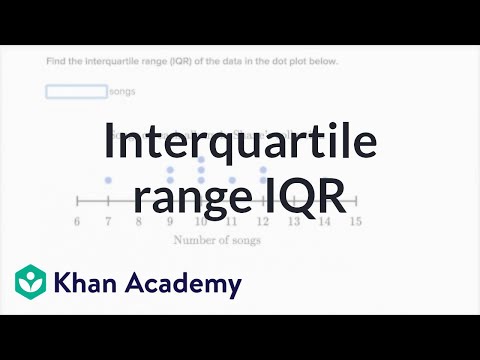
You ever try to make sense of a group of friends’ test scores? Like, you’ve got some super high achievers and a few who, well, let’s say they missed the mark? It gets messy, right? That’s where the Inter Quartile Range, or IQR as cool kids say, comes in.
It’s like the secret sauce for figuring out where most of your data hangs out. Instead of stressing over every single score, you can zoom in on the middle scores and get a solid idea of what’s really going on. Pretty neat, huh?
So let’s take this journey together! I’ll break it down nice and easy. You’ll see how this little number can help you make sense of chaos in data. Excited? Me too!
Mastering the Interquartile Range: A Scientific Guide to Data Interpretation
Understanding the Interquartile Range (IQR) is like having a secret weapon in your data toolkit. It’s this nifty statistic that helps you make sense of a bunch of numbers, especially when you want to see how spread out they are without getting thrown off by super high or low values. So, let’s break it down!
The IQR is essentially the range between the first quartile (Q1) and the third quartile (Q3) in a dataset. Quartiles divide your data into four equal parts. Q1 marks the 25th percentile, meaning that 25% of your data points fall below it. Q3, on the other hand, is the 75th percentile—so 75% of your data points are below this point.
Okay, so how do we find these quartiles? First thing you do is arrange your dataset in ascending order. It’s like lining up for a photo; everyone’s got to be in order! Then, you identify Q1 and Q3:
- Q1: Locate the median of the lower half of your data (not including the overall median if there’s an odd number of data points).
- Q3: Find the median of the upper half in a similar way.
Once you’ve got both quartiles, calculating the IQR is super easy: just subtract Q1 from Q3!
IQR = Q3 – Q1
For example, imagine you have test scores from a math exam: 60, 70, 80, 85, 90. After sorting them (which they already are!), you’d find:
– The median score (the middle one) is 80.
– For Q1 (the lower half), it would be 70.
– For Q3 (the upper half), it would be 90.
So here’s how that looks:
IQR = 90 – 70 = 20. Pretty simple!
Now let’s chat about why this matters. The IQR gives you a better picture of where most values lie in relation to outliers—those pesky extreme values that can skew averages and give misleading insights. If you’re looking at income levels or something like test scores again, IQR tells you about typical variation without letting those wild exceptions mess things up.
Also, another neat thing about IQR is its role in identifying outliers! If any data point falls below (Q1 – 1.5 * IQR) or above (Q3 + 1.5 * IQR), it gets flagged as an outlier. This can really help when you’re trying to clean up your datasets before diving deeper into analysis.
In summary:
- The interquartile range helps show how spread out your middle values are.
- You find it by subtracting Q1 from Q3.
- IQR protects against outliers skewing your results.
Getting comfy with concepts like these opens doors for deeper insights! So next time you’re wrangling with numbers, think about adding that IQR perspective to really sharpen up your analysis game—it can make all the difference!
Understanding the Purpose of the Interquartile Range (IQR) in Scientific Data Analysis
The interquartile range, or IQR, is like the unsung hero in the world of data analysis. It tells you about the spread of the middle half of your dataset. Imagine you’re at a party and only some friends are sharing their stories while others are just hanging back. The IQR captures that story-sharing vibe—focusing on where most experiences live.
So, what exactly does it do? First off, it helps in understanding data variability. You see, when you look at a dataset, there can be extreme values or outliers that really skew things. Those outliers can throw your average way off track, making it seem like everything’s fine when it’s not. The IQR gives you a clearer picture without letting those extreme cases mess with your perception.
The IQR is calculated by taking the difference between the first quartile (Q1) and the third quartile (Q3). You can think of quartiles as breaking down your data into four equal parts:
- The first quartile (Q1) is where 25% of your data points fall below.
- The median divides your dataset in half—50% on each side.
- The third quartile (Q3) marks where 75% of the data falls below.
So basically, IQR = Q3 – Q1. If you had a dataset showing the ages of people at that party, say they ranged from toddlers to grandparents, calculating the IQR helps you focus just on those who are in their prime party years—cutting out both ends.
Now why is this important? Well, if you’re trying to understand typical ages at that gathering for planning future events, focusing on ages between Q1 and Q3 gives a clearer picture. You wouldn’t want to base your planning around one wild uncle who shows up every now and then!
Another cool thing about IQR is its use in spotting outliers. If any data point lies outside 1.5 times the IQR above Q3 or below Q1, it’s considered an outlier. This means that any age way older than most people there could skew how you perceive the crowd’s age—and we don’t want that kind of confusion!
In summary, by focusing on just what’s happening within that middle slice of data—the heart of it all—the interquartile range helps to present an honest view without funny business from extremes. It’s super helpful for making informed decisions based on sound stats rather than being misled by quirky extremes! You follow me? This simple yet powerful tool is essential for anyone diving into statistical waters or just trying to make sense of all those numbers floating around in scientific research and analysis!
Understanding the Interquartile Range: Insights into Data Distribution in Scientific Research
The interquartile range (IQR) is like a data detective, helping you understand how spread out your numbers are. It’s super handy in scientific research, especially when you’re working with a bunch of data points and want to focus on what really matters—basically, the middle stuff.
So, what’s the deal with IQR? Well, it’s a measure of statistical dispersion that tells you how far apart the middle half of your data is. Imagine you have a big jar of jellybeans in all sorts of colors. The IQR helps identify where most of those jellybeans are concentrated.
To figure out the IQR, you start by finding the first quartile (Q1) and the third quartile (Q3). Q1 is like that friendly neighbor who lives at the 25th percentile—basically, 25% of your data falls below this point. On the flip side, Q3 hangs out at the 75th percentile, meaning 75% of your data points are below it.
Here’s how it goes down:
- Step 1: Organize your data in ascending order.
- Step 2: Find Q1 and Q3.
- Step 3: Calculate IQR by subtracting Q1 from Q3: IQR = Q3 – Q1.
This means if your Q1 is at 10 and your Q3 is at 20, then your IQR would be 20 – 10 = 10. So what does this tell you? It shows that the middle half of your data spans a range of 10 units. Pretty cool, right?
One reason why IQR matters so much in science is that it helps identify outliers—those pesky values hanging way outside the norm. You know those jellybeans that are weird colors or shapes? They’re like our outliers. If a number is lower than Q1 – (1.5 x IQR) or higher than Q3 + (1.5 x IQR), it’s an outlier!
Knowing about IQR can help scientists present their findings more clearly without getting distracted by extreme values. It’s not just about having a lot of knowledge; it’s about making sense of that information too.
Consider this scenario: Imagine you’re studying plant growth under different conditions. You collect growth measurements from multiple plants across different environments. Some plants grew exceptionally well while others barely sprouted—those extreme numbers could skew your findings if you’re not careful.
By using IQR here, you’ll focus on the plants that fall within that more typical growth range and get a better understanding of what works best without loud distractions from those unusual cases.
So yeah! The interquartile range isn’t just some random math concept; it’s super useful for making sense out of scientific data! You’ll find it to be an essential part in interpreting research results and keeping things balanced when analyzing distributions.
So, you know when you’re looking at a bunch of numbers and trying to figure out what they really mean? Like, maybe you took a survey or gathered some stats for a project? Well, that’s where the interquartile range (IQR) comes into play. It’s like a hidden gem in the world of data science—kinda like finding the last piece of chocolate cake at a party.
The IQR helps you understand how spread out your data is by focusing on the middle 50%. Imagine you’ve got test scores from your classmates. If most of them scored between 70 and 90, but there are a couple of outliers that bombed and got 20 and 30, just looking at the average score might make everything seem alright. But when you calculate the IQR, you’re only considering those who are closer to each other. It gives you a better sense of how everyone actually performed without letting those extremes mess with your head.
Let me tell you a quick story. Back in school, we had this project where we analyzed our grades over the semester. Some friends were stressed out because they’d failed one test while others seemed to float along fine. But when we looked at the IQR? Wow, it was eye-opening! It showed us that, while there were some real highs and lows, most scores hung out right around the same area—so it wasn’t as dire as people thought.
So yeah, calculating the IQR is pretty simple: You basically find where your first quartile (Q1) and third quartile (Q3) are—those split your data into quarters—and then subtract Q1 from Q3. That little number gives valuable insight into consistency in any set of data.
And here’s another cool thing: Using IQR can help spot outliers too! You look at those numbers that are way higher or lower than usual outside of the range defined by Q1 – 1.5 times IQR and Q3 + 1.5 times IQR. This means if something seems way off in your dataset, there’s a good chance it’s not just random noise; it might be worth investigating further.
So next time you’re knee-deep in data analysis remember this nifty tool! The interquartile range isn’t just math; it’s like having your own personal guide through all those confusing numbers—and let’s be real: understanding the bigger picture never hurt anybody.