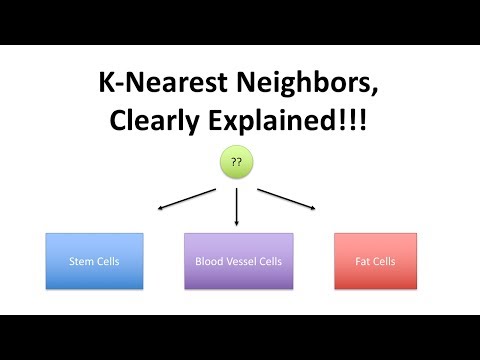
You know that moment when you’re at a party, trying to find your friends in a crowd? You scan the room, looking for familiar faces. Well, that’s kind of how the K Nearest Neighbor algorithm works!
Imagine it’s a super-smart buddy who helps you decide which people (or data points) are most like the one you’re checking out. Super handy, right?
This little gem of an algorithm is like having your own personal data detective. It takes all kinds of scientific data and helps sort it out based on similarity.
Whether you’re diving into genes or predicting weather patterns, K-NN is there to lend a hand. It’s simple but powerful—and trust me, once you get how it works, you’ll be calling it your new best friend in data analysis!
Leveraging K Nearest Neighbor Algorithm in Python for Advanced Scientific Data Analysis
Alright, let’s talk about the K Nearest Neighbor (KNN) algorithm and how to use it in Python for advanced scientific data analysis. Seriously, this stuff can be super helpful when you’re trying to make sense of complex data.
KNN is a **simple yet powerful algorithm** used for classification and regression tasks. The way it works is pretty neat: It looks at the ‘k’ closest points in your data set to classify or predict the outcome of a new observation. If you imagine a group of friends at a party, you’d probably hang out with those who share similar interests. That’s basically how KNN rolls.
When it comes to implementing KNN in Python, you typically use the Scikit-learn library, which is like your trusty toolbox for machine learning. Let’s break down some key steps and concepts:
- Data Preparation: First off, you need clean data. If your dataset has missing values or irrelevant features, that can throw everything off. Cleaning it up will help your model perform better.
- Choosing ‘k’: Deciding how many neighbors to consider is crucial. A small ‘k’ makes the model sensitive to noise, while a larger ‘k’ can smooth out variations but might ignore small groups in the data.
- Distance Metric: This algorithm relies on measuring distance between points. Common choices are Euclidean distance or Manhattan distance—think of them as different ways to measure how far apart two points are.
After you have all that settled, it’s time to roll up your sleeves and code! Check this out:
“`python
from sklearn.model_selection import train_test_split
from sklearn.neighbors import KNeighborsClassifier
from sklearn.datasets import load_iris
# Load dataset
iris = load_iris()
X = iris.data
y = iris.target
# Split data into training and testing sets
X_train, X_test, y_train, y_test = train_test_split(X, y, test_size=0.2)
# Create KNN classifier instance
knn = KNeighborsClassifier(n_neighbors=3)
# Fit model
knn.fit(X_train, y_train)
# Make predictions
predictions = knn.predict(X_test)
“`
Pretty straightforward stuff! You load your dataset (like Iris flowers in this case), split it into training and testing sets so you can evaluate performance later on.
Once you run this code and get predictions back from your test set, it’s time for evaluation! You want to see how well your model did with metrics like accuracy or confusion matrix.
Now here’s where things get interesting: **real-world applications**! KNN can be used across various fields:
- Biology: Classifying different species based on their characteristics.
- Astronomy: Grouping stars by their spectral types.
- Medicine: Predicting diseases based on patient symptoms and medical history.
Imagine being able to predict patient outcomes by analyzing historical health records—you could seriously change lives!
But remember: even though KNN seems simple and effective, it’s not always perfect. For large datasets or high dimensions (think lots of features), it can become slow because it calculates distances from every point during prediction.
Anyway! That was a quick overview of using K Nearest Neighbor with Python for scientific analysis. The beauty lies in its simplicity mixed with powerful applications—definitely a tool worth having in your toolbox!
Exploring K-Nearest Neighbor Algorithm: An Example of Scientific Data Analysis in Research
The K-Nearest Neighbor (KNN) algorithm is a way to categorize things based on their similarities. You know how when you’re trying to find your lost socks, you look for other socks that are similar in color or texture? Well, KNN does something kinda similar with data.
How does it work? Basically, KNN looks at a point in a dataset and checks the closest points around it. You pick a number, usually called “k,” which decides how many neighbors you want to pay attention to. If k is set to three, for example, the algorithm will look at the three nearest points and figure out what they mostly are. If two of them are red apples and one is a green apple, then KNN will say, “Hey! This point looks like an apple too!”
Let’s break down the steps:
Imagine you’re in a garden filled with flowers. Some are daisies and others are sunflowers. If you find a new flower and you’re not sure if it’s a daisy or sunflower, KNN helps figure that out by looking at which existing flowers it’s closest to.
A quick example:
Let’s say researchers are studying different iris flowers based on their petal lengths and widths. They have lots of measurements from various types of irises: Setosa, Versicolor, and Virginica. When they discover a new iris with specific measurements that don’t perfectly match any known type yet—KNN can identify its type by checking nearby recorded measurements! If two out of three nearest irises turn out to be Setosa flowers—the algorithm just labels this new flower as Setosa too.
But hold up! It’s not perfect. Sometimes choosing an inappropriate value for k can lead you astray or make it sluggish with huge datasets because it has to calculate distances for so many points each time.
Overall though? The K-Nearest Neighbor algorithm offers simplicity when handling scientific data analysis by leveraging proximity for classification tasks—and that’s pretty neat! You can almost think of it as using friendship dynamics but applied mathematically!
Exploring the K Nearest Neighbor Algorithm for Enhanced Scientific Data Analysis on GeeksforGeeks
Alright, let’s chat about the K Nearest Neighbor (KNN) algorithm. It’s one of those cool tools that helps us analyze scientific data. Imagine you’re trying to figure out what kind of fruit you got in your basket just by looking at it. You’d probably compare it to the fruits you already know, right? Well, that’s kind of how KNN works!
The idea is simple. Given a bunch of data points, KNN looks at the “K” closest points and makes a guess based on them. Here’s how it all goes down:
- Data Points: You have a set of known data points with their labels (like known fruits: apple, banana, etc.).
- Distance Measurement: KNN calculates how far new data points are from these known points. Common methods for this include Euclidean distance, which is just the straight line distance between two points.
- Selecting “K”: You decide how many neighbors to look at—this is your “K”. A small K might make things too sensitive to noise while a large K could smooth things too much.
- Majority Vote: Finally, it checks which label is most common among these nearest neighbors and gives its best guess!
You know, I remember my first time trying this out. I had a dataset with lots of different plant species and some measurements like leaf size and color. When I ran the KNN algorithm, it felt like magic! Seeing how accurately it grouped similar plants opened my eyes to the power of algorithms in biology.
KNN can be used for various tasks in science: predicting species classification, diagnosing diseases based on symptoms, or even analyzing climate data! Seriously! It has so many applications.
You might be wondering about its challenges though—and rightly so! One big hiccup is when the dataset gets super huge. The more data points you have, the longer it takes to calculate distances. This can slow down your analysis significantly.
- Sensitivity to Noise: If there are outliers or incorrect labels in your dataset, they can swing results unfairly since KNN only cares about nearby points.
- No Training Phase: Unlike some other algorithms that learn from training data before making predictions, KNN doesn’t have that phase—it just memorizes everything!
The cool thing about KNN is that it’s pretty easy to implement as well. Many programming languages and libraries support it; think libraries like scikit-learn if you’re dabbling in Python.
Your choice of “K” makes a difference too. If you’re unsure what number to pick, you can test different values using cross-validation—this helps ensure you’re not biased towards one particular guess!
If you’re into science or any kind of data analysis, getting familiar with something like K Nearest Neighbor algorithm could definitely boost your skills. It’s fun seeing how computers can help solve problems by learning patterns from data around us—it feels like unraveling a mystery piece by piece.
K Nearest Neighbor, or KNN, is one of those algorithms that you might hear about tucked away in the corners of data science discussions. It’s kind of like that friend who always shows up at the best parties but never steals the spotlight. So, what’s the deal with KNN?
You see, at its core, this algorithm is all about finding patterns in data by looking at proximity. Imagine you’re in a crowded room full of people. You’re trying to figure out which group to join, right? You’d probably look for folk who vibe with you—people who share similar interests or backgrounds. That’s how KNN works! It checks out the ‘k’ closest points (or neighbors) to a specific data point and then makes predictions based on the majority class those neighbors belong to.
Now, let me tell you about this time when I was knee-deep in a project trying to classify different types of plants based on their features like leaf shape and color. It was like being handed a massive jigsaw puzzle without knowing what the picture even looked like! But when I applied KNN, it was like flipping on a light switch. By measuring how close each plant’s features were to one another, I could sort them into categories effortlessly.
The cool part is that KNN doesn’t assume anything about the underlying data distribution—it just lets the data speak for itself! But here’s where it gets tricky: choosing the right value for ‘k’ can be a bit of an art form. Too small and your model can be sensitive to noise; too large and you might overlook those neighborly gems that could really change things up.
But just because it’s easy to grasp doesn’t mean it’s perfect! There are some limitations too. For huge datasets? Yikes! The computation time can skyrocket because it checks every single point each time you want to make a prediction. And then there’s the issue of dimensionality—let’s just say more dimensions can turn what seems simple into something much more complex.
When I look back at my experience with KNN, it’s kind of heartwarming how this humble algorithm opened doors for me in understanding relationships within data. It’s approachable yet powerful enough to tackle some serious scientific inquiries if used correctly.
So yeah, K Nearest Neighbor might not be your flashiest tool in the box, but when it comes down to analyzing scientific data and uncovering hidden patterns, it’s honestly got some serious charm—and maybe even wisdom hidden away under its unassuming exterior!