So, imagine you’re sitting there, trying to find a common thread in your favorite songs. Like, “Hey, did you notice how many of them mention love?!” It’s a puzzle! And puzzles are everywhere in life—especially when it comes to programming.
Now, dynamic programming might sound like something only computer geniuses get hyped about. But hold on! It’s actually kinda cool and easier than you’d think. Think of it as a way to solve problems step by step—breaking them down into smaller pieces until they make sense.
Take the Longest Common Subsequence method, for example. It’s all about figuring out what two things have in common without scrambling everything together. Like finding a shared playlist between you and your best buddy. Pretty neat, right?
So grab a snack and let’s unpack this a bit more! You’ll see—it’s not just for the coding whizzes; it can be fun for everyone!
Exploring Dynamic Programming: A Comprehensive Guide to the Longest Common Subsequence Method in Scientific Research (PDF)
So, let’s talk about this thing called **dynamic programming**, shall we? It sounds fancy, but really, it’s just a way to solve problems by breaking them down into simpler subproblems. You use what you’ve already figured out to help tackle more complex challenges. It’s kind of like when you’re trying to solve a big puzzle – you focus on one piece at a time!
Now, one classic example of dynamic programming is the **Longest Common Subsequence (LCS)** method. This is super handy in scientific research, especially when it comes to comparing sequences — like DNA strands or even sentences in text analysis. The idea is simple: you want to figure out the longest sequence that appears in both strings without rearranging any characters.
Here’s how the LCS works in a nutshell:
- The first step is to create a table that will store solutions to these smaller subproblems.
- Next, you look at two sequences: let’s say you have “ABCBDAB” and “BDCAB”.
- You compare characters from both sequences one by one.
- If they match, you add 1 to the diagonal value from your table. If not, take the maximum of the left or above value.
Okay, but here’s where it gets interesting! Picture this scenario: imagine you’re working on comparing genetic sequences for some research about hereditary diseases. Let’s say that you’re analyzing DNA from family members who share certain conditions. By applying the LCS method, you’d be able to uncover how much of their genetic code overlaps—did they inherit something specific? This can lead you down an important path in understanding those diseases better.
And guess what? The beauty of dynamic programming lies in its efficiency. Instead of recalculating values repeatedly (which would be super tedious), it stores results as it goes along. So every time you solve part of your problem, that solution’s saved for later! Think about how much time we save because we don’t need to keep checking past work; isn’t that wild?
Some folks might get intimidated by all these algorithms and terms flying around but don’t sweat it! Once you get the hang of LCS and dynamic programming principles, they provide powerful tools for data analysis across many fields—be it biology or linguistics.
In summary:
- Dynamic Programming: A way to solve complex problems by breaking them down into smaller pieces.
- Longest Common Subsequence: A method used for finding similarities between sequences.
- This technique is crucial in various scientific fields including genetics and textual analysis.
So there you have it! Whether you’re looking at genes or sentences, dynamic programming and LCS can give you insights that are fascinating—and maybe even life-changing!
Exploring Dynamic Programming: Implementing the Longest Common Subsequence Algorithm in Python for Scientific Applications
So, let’s talk about dynamic programming and, more specifically, the Longest Common Subsequence (LCS) algorithm. You’ve probably encountered situations where you need to find similarities in sequences—say, in DNA strands or version control for software. The LCS algorithm helps us figure out the longest sequence that appears in both strings while maintaining their order, without rearranging characters.
Dynamic programming, in essence, is a method for solving complex problems by breaking them down into simpler subproblems. It’s about remembering past results to save time on future calculations. Think of it like studying for a big exam: instead of cramming all the material at once, you’d review sections periodically and keep notes. This way, when test time comes, you’re well-prepared!
Let’s break it down further with an example. Imagine you have two strings: “ABCBDAB” and “BDCAB”. The longest common subsequence between these two is “BDAB”. Pretty neat, huh? Now, let me explain how we implement this using Python.
- Create a 2D array: First off, we need to create a 2D array to store lengths of LCS solutions for various substrings. The size of this array would be (m + 1) x (n + 1), where m and n are the lengths of the two strings.
- Fill the array: Loop through each character of both strings. If characters match, update the cell with one plus the value from its diagonal left cell (i.e., `lcs[i][j] = lcs[i-1][j-1] + 1`). If they don’t match, take the maximum value from either left or above cell (i.e., `lcs[i][j] = max(lcs[i-1][j], lcs[i][j-1])`).
- Extracting LCS: Once we fill up our array, we can backtrack from `lcs[m][n]` to find the actual longest common subsequence by checking where matches were made.
This might sound technical but here’s a quick Python implementation for clarity:
def lcs(X , Y):
    m = len(X)
    n = len(Y)

    # Create a table to store lengths
    lcs_table = [[0] * (n + 1) for _ in range(m + 1)]

    # Building the table
    for i in range(1, m + 1):
        for j in range(1, n + 1):
            if X[i - 1] == Y[j - 1]:
                lcs_table[i][j] = lcs_table[i - 1][j - 1] + 1
            else:
                lcs_table[i][j] = max(lcs_table[i - 1][j], lcs_table[i][j - 1])

    # Reconstructing LCS
    index = lcs_table[m][n]
    lcs_string = [""] * index
    i, j = m, n

    while i > 0 and j > 0:
        if X[i - 1] == Y[j - 1]:
            lcs_string[index - 1] = X[i - 1]
            i -= 1
            j -= 1
            index -= 1
        elif lcs_table[i - 1][j] > lcs_table[i][j - 1]:
            i -= 1
        else:
            j -= 1

    return ''.join(lcs_string)
You could plug this code into your Python interpreter and give it some test strings! It feels cool when you see it work; just imagine your computer sorting through data as efficiently as possible.
The applications? Oh boy! The LCS algorithm isn’t just good vibes on paper; it has real-world implications! For instance:
- You could use it in bioinformatics to compare genetic sequences.
In software engineering—think about comparing different versions of documents or source code.
Even in natural language processing! It helps with text similarity checks.
A little story here—once I was helping a buddy who was working on a project involving DNA sequencing. He was struggling with how to match gene sequences efficiently. We implemented this algorithm together over coffee (plus some snacks). Watching his face light up when he finally got correct matches was unforgettable!
The Longest Common Subsequence algorithm shows us how powerful dynamic programming can be when tackling complex problems efficiently. So next time you’re faced with sequence comparisons or trying to optimize something similar—think LCS!
Exploring Dynamic Programming: An In-Depth Example of the Longest Common Subsequence Method in Computational Science
So, let’s chat about dynamic programming. It’s like this really clever technique often used in computer science to solve problems by breaking them down into smaller, simpler problems. You know how sometimes you have a big project due tomorrow, and instead of freaking out, you tackle it piece by piece? That’s the idea behind dynamic programming!
One classic example where dynamic programming shines is the Longest Common Subsequence (LCS). Picture this: you’re comparing two strings—maybe “ABCBDAB” and “BDCAB”. You want to find out the longest sequence that appears in both strings in the same order but not necessarily consecutively. So, from our example, “BCAB” would be an LCS because those letters show up in both strings.
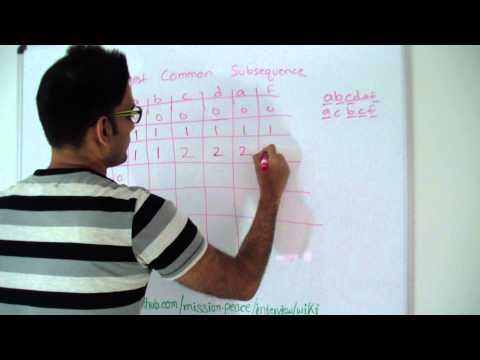
To get into the nitty-gritty of how this works, let’s break it down. First off, we need to create a 2D table, something like a chessboard where we’ll keep track of our progress: rows for one string and columns for another. Every cell in this table will represent how much of a common subsequence we’ve found up to that point.
So when you start filling out your table:
- If characters match (like ‘B’ from both strings), you take the value from the diagonal cell (that’s adding on to your LCS) and add 1.
- If they don’t match, you take the maximum value from either left or above the current cell. This means you’re considering what you’ve already found.
This way, as you fill in your table step by step, you’re essentially building upon previously solved subproblems. It’s like laying down bricks to build a wall! After you’ve filled out this table completely, your longest common subsequence length will be right there in the bottom-right corner of your matrix.
An emotional moment for many who work with LCS can happen when they realize just how powerful this technique is—not just for strings but for solving numerous complex problems! Like comparing DNA sequences or even crafting better version control systems in coding.
The final part is reconstructing that actual subsequence. You trace back through your filled-out table until you reach the top left corner. This path helps reveal what letters form that common sequence! And honestly? It feels pretty great when all those bits come together!
Dynamic programming isn’t just about efficiency; it fosters creativity too. So whether you’re looking at string comparisons or any other complex issue requiring optimization over time—remember that breaking things down can often lead to surprising solutions! It’s almost poetic if you think about it!
Alright, so let’s chat about dynamic programming and this cool concept called the longest common subsequence, or LCS for short. It sounds super technical, I know, but stick with me — it can get really interesting!
Okay, picture this: you and your buddy are sorting through a massive pile of old photos. You both want to find the pictures that tell the story of your epic road trip from back in the day. But here’s the catch: you can’t just sort through them haphazardly. You need a strategy to find those memories that overlap between you two without pulling out every single image.
That’s where LCS comes into play! Basically, it helps you figure out the longest sequence of stuff that appears in both lists—in this case, your different stacks of photos—without having to mess around with everything else. So if one of you has pictures from a campfire and the other has some from hiking, LCS will help you find that sweet spot where those moments intersect.
Now, dynamic programming is like a smarter way to tackle problems. Instead of starting from scratch every time you hit a subproblem (like finding common sequences), it saves previously solved problems so that next time they come up, you’re not wasting time redoing work you’ve already done. It’s kinda like saving an unfinished draft on your computer; when you’re ready to pick up where you left off, it’s right there waiting for you.
So how does this all connect? Well, when you’re using dynamic programming with LCS, what you’re really doing is breaking down a big problem into smaller pieces. You tackle each piece by looking at smaller subsequences until you’ve built up to the longest one possible without having to go through all those comparisons over and over again.
I remember trying to learn this in school—man! I was sitting there with my textbooks spread across my desk like some sort of chaotic war zone. It felt overwhelming at first because math and algorithms were never my strong suit. But then I began to see how elegant it was—like finding a hidden path in a maze! With each step forward that made sense, I felt more connected to what I was learning.
So why care about all this? Well, think about how much we rely on data these days—from social media posts to genetic information. Being able to understand and extract relationships within sequences can lead us closer to answers in some pretty complex situations, whether that’s matching strings in programming or even understanding human DNA sequences.
In short? Dynamic programming paired with techniques like LCS can turn mountains of data into manageable nuggets that make sense and tell a story—the kind we’d want to capture in our old photo albums! And isn’t that pretty awesome?