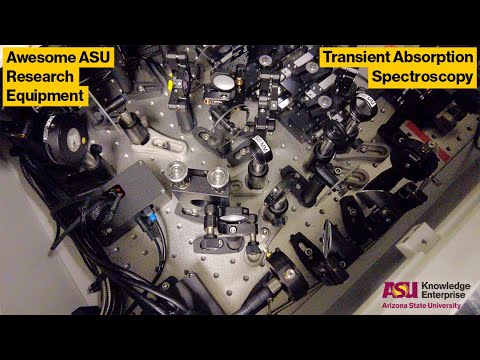
So, you ever stared at the sky and wondered what makes rainbows pop? Yeah, it’s all about light and how it interacts with stuff. Pretty wild, huh? Well, speaking of light, have you heard about transient absorption spectra?
It sounds super complicated but hang tight! Imagine a cool science party where you get to see how different materials absorb light in really short bursts. It’s like time travel for photons!
This whole thing is essential for understanding a bunch of modern tech—like solar panels and lasers. So buckle up, because diving into this topic can be as thrilling as catching the perfect wave!
Exploring Transient Absorption Spectra: Insights and Applications in Modern Scientific Research
Transient Absorption Spectroscopy (TAS) is like a super high-speed camera for studying molecules, particularly during chemical reactions or energy transfers. You might be wondering why this is important. Well, when we dive into the world of molecules, understanding how they behave under different conditions gives us key insights into everything from solar energy conversion to drug development.
So, what’s the deal with transient absorption spectra? Basically, the idea is to shine a quick pulse of light on a sample and then analyze how that light gets absorbed over time. When you hit that sweet spot of timing just right, you can catch fleeting states of matter that hang around for just millionths of a second.
Key points about transient absorption spectra:
- Reaction Mechanisms: They help us figure out how fast reactions happen and what intermediates are formed. Think about it like pausing a movie at just the right moment to see what’s going on behind the scenes.
- Energy Transfers: TAS can reveal how energy flows through systems—like observing sunlight as it moves through a plant to power photosynthesis.
- Molecular Dynamics: By studying transient states, researchers can understand how molecules twist and turn during reactions. It’s like watching dancers at a party; some do crazy spins while others glide smoothly.
- Able to Measure Fast Phenomena: The technique captures rapid changes in electronic states which are crucial for developing new materials, such as better batteries or more efficient solar cells.
Now let’s talk about some cool applications that pop up in modern research. In photovoltaics, scientists use TAS to study how solar cells absorb light and convert it to electricity efficiently. If there’s inefficiency in the system? They spot it faster than you can say “renewable energy!”
Plus, there’s also exciting work being done in biosensing. For instance, detecting pathogens rapidly using TAS could be game-changing in healthcare! Imagine catching an infection before symptoms even appear.
And here’s something that gets me all excited—TAS has potential in understanding Chemical Reaction Dynamics. Ever heard about enzymes? These are biological catalysts speeding up reactions in our bodies. Studying their transient states allows scientists to marvel at how they perform miracles at atomic speeds.
But wait! It doesn’t end there; researchers are constantly tweaking techniques and technology related to TAS to make them even better at capturing those elusive moments when atoms and molecules dance through their transformations.
So yeah, exploring transient absorption spectra isn’t just for the lab-coat crowd—it touches every facet of science where minute changes have major implications! The results can influence not only academic progress but also lead businesses down new paths with technology that shapes our lives daily.
In summary, as we continue unwrapping the layers of transient absorption spectroscopy through modern scientific research, we’re not just looking at pretty graphs; we’re trying to crack codes that could improve energy storage solutions or create new drugs! Who knows where this fascinating journey will take us next?
Advancements in Transient Absorption Spectroscopy: Unlocking Insights in Molecular Dynamics and Energy Transfer
Transient absorption spectroscopy is like having a superpower that lets scientists peek into the fast-paced world of molecules. Imagine capturing a snapshot of a moving car while it’s speeding down the road. That’s what this technique does for molecules and their processes, revealing how they interact and transfer energy in real-time.
So, here’s the gist: when you shine a light on a sample, it can absorb that light and get excited. This excitement can lead to all sorts of fascinating behaviors—like transferring energy or even changing shape! Transient absorption spectroscopy measures these changes over incredibly short time frames, often in the realm of picoseconds (that’s one trillionth of a second!).
What makes this technique so special? Well, it’s all about timing and precision. By recording how light is absorbed at various moments after the initial excitation, researchers can create detailed timelines of molecular dynamics. This helps them figure out what happens when molecules absorb energy and how they manage to pass it along to others.
Key advancements in the field have been impressive:
A neat example comes from studying photosynthetic organisms. Scientists use transient absorption spectroscopy to understand how plants convert sunlight into energy—a process vital for life on Earth. They’ve discovered just how quickly these organisms transfer energy between pigments, helping us appreciate nature’s efficiency.
But it’s not just about plants! This technique finds applications in fields ranging from pharmaceutical development to renewable energy technologies. For instance, understanding how solar cells operate at a molecular level might lead to better designs for capturing sunlight more effectively.
Of course, this tech doesn’t come without its challenges. The systems are complicated. But researchers are constantly innovating and finding ways around these hurdles!
In summary, transient absorption spectroscopy opens up new windows into the molecular world with its precise timing and powerful insights into dynamics and energy transfer processes. Every breakthrough leads us closer to unlocking secrets about everything around us—from fundamental biology to advanced materials science. Isn’t that incredible?
Comprehensive Guide to Transient Absorption Spectroscopy: Key Concepts and PDF Resources
Alright, let’s chat about transient absorption spectroscopy. This technique is a way of studying fast processes that happen in molecules, like when they absorb light and then quickly release energy. Picture a dance party, where the lights go on for just a blink of an eye. You want to capture those quick moves without missing them!
In this method, we shine a laser pulse onto our sample and create what’s called an “excited state.” It’s like flipping a switch on the dance floor; the molecules get all hyped up! After a tiny delay, we measure how much light gets absorbed by these excited molecules. The cool part? We can watch how their behavior changes over time.
So, what are some key concepts in transient absorption spectroscopy?
- Excited States: These are temporary states where electrons have jumped to higher energy levels. Think of it like someone jumping off the ground in excitement.
- Pulsed Lasers: They create short flashes of light to excite the sample. Imagine strobe lights at that dance party—quick bursts that capture every moment!
- Time Resolution: This refers to how fast we can take measurements after the initial pulse. We’re talking picoseconds and femtoseconds—super tiny timescales!
The journey doesn’t end here! After capturing that data, scientists analyze it using something called spectrum analysis. Essentially, they’re trying to make sense of what happened when those molecules got excited. They look at how much light was absorbed at different times after the initial pulse.
This technique is not just a fancy trick; it has real-world applications! For instance, in studying photosynthesis, researchers can track how plants convert sunlight into energy. Fascinating stuff! And guess what? It also helps in designing better solar cells or understanding chemical reactions really well.
If you’re itching to learn more or dive deeper into this topic, there are tons of PDF resources out there. Universities often publish papers that detail experiments done using transient absorption spectroscopy. Just poke around Google Scholar or check out scientific journals related to chemistry and physics.
The thing is, although it sounds complex, transient absorption spectroscopy opens up huge doors for research across various fields—from photochemistry to biophysics—allowing scientists to explore rapid processes like never before. So next time you hear about it, you’ll know it’s not just about fancy lasers; it’s all about understanding the tiny dance moves of molecules in action!
Okay, so let’s chat about transient absorption spectra and why they’re kinda important in modern science. I mean, it sounds super technical, right? But hang with me for a sec; it’s actually pretty cool.
Imagine you’re at a concert, and the lights go dim. Suddenly, a brilliant spotlight shines on your favorite band. In that moment of brightness, you catch all the little details—how the guitarist’s fingers dance over the strings or how the drummer’s hair bounces with every beat. That moment captures your attention before it slips back into darkness as another song starts. Transient absorption spectra work sort of like that spotlight for scientists studying molecules!
When researchers shine light on molecules really quickly—like way faster than a blink—they can measure how those molecules absorb energy at different times. Basically, by looking at how light interacts with matter over super short timescales (we’re talking picoseconds and femtoseconds here!), they can understand what’s happening during chemical reactions or even how energy travels in materials.
You might be thinking: “Why does this matter?” Well, let me tell you a quick story from my old college days. I was part of a chemistry lab where we tried to figure out how plants convert sunlight into energy through photosynthesis. It was this wild process that required us to capture transient signals from chlorophyll molecules. Watching my professor expertly manipulate this high-tech equipment reminded me of an artist working on their masterpiece. Each tiny adjustment led to new insights about how life harnesses light energy!
These techniques are also helping scientists innovate in areas like solar cells or photoactive materials—basically things that can soak up sunlight and turn it into usable energy. With the challenges posed by climate change, understanding these processes deeply is crucial for creating better solutions.
So yeah, while “transient absorption spectra” might sound like something only hardcore scientists care about, what they reveal is pretty essential for our future! It opens doors to technologies we might not even fully grasp yet but could fundamentally change how we live. Just goes to show that sometimes those complicated terms hide fascinating stories waiting to be told!