Alright, so here’s a little story for you. Imagine you’re at a bake sale, right? You grab a cookie, but it’s the size of your face! Then someone else gets this tiny crumb. Crazy unevenness, huh?
Well, that kinda madness happens in data too. It’s like when you’ve got a bunch of numbers and they don’t really tell you much on their own. That’s where the interquartile range jumps in—like your trusty scale for those cookies!
Basically, it helps you figure out how spread out things are without getting too tangled up in all that noise. Like finding out which cookies are worth the calories! Let’s break it down together and see how it works in science (and maybe even bake sales)!
Mastering Data Interpretation in Science: A Comprehensive Guide to Understanding IQR (Interquartile Range)
So, let’s chat about the interquartile range (IQR). It’s a handy tool when you’re trying to make sense of all those numbers in science. You know how sometimes, data can feel overwhelming? Well, the IQR helps break it down, making it super manageable.
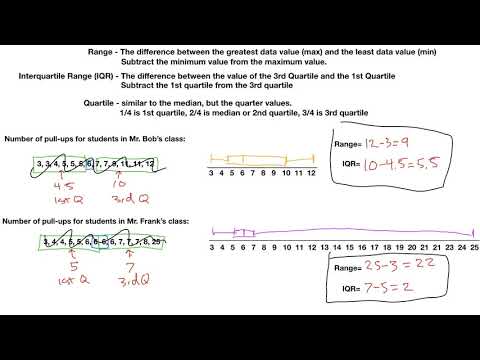
First off, what exactly is IQR? It’s basically a measure of statistical dispersion. In other words, it tells you how spread out your data is around the median. The IQR focuses on the middle 50% of your data points—so it’s not swayed by extreme values or outliers. That’s pretty neat, right?
Here’s how you calculate it:
1. Start by organizing your data in ascending order. This means you want to line things up from lowest to highest.
2. Next, find the median value of your data set; this is like the center point.
3. Then, identify the first quartile (Q1) and third quartile (Q3). Q1 is the median of the lower half of your data and Q3 is for the upper half.
4. Finally, subtract Q1 from Q3. The result is your interquartile range: IQR = Q3 – Q1. Easy peasy!
Let me throw an example at you to make this clearer. Imagine you’ve got test scores from a biology class: 55, 62, 68, 70, 72, 75, 78, and 90.
– First up, organize that: We already have it sorted!
– The median here is 72 (the average of 70 and 75).
– Q1 would be 68 (the median of scores below the median), while Q3 would be 78.
– Now subtract: IQR = 78 – 68 = 10.
So there you have it! An IQR of ten means most students scored within a ten-point range around those middle values.
What makes IQR so useful? For starters:
Let’s say you’re studying plant growth under various lighting conditions. Using IQR could help determine if certain light conditions produce consistent results across test samples or if some plants are really thriving while others are struggling.
It’s kind of like being a detective with numbers! You gather clues and piece together what they’re telling you without getting distracted by anomalies that don’t represent most cases.
In summary: The interquartile range takes a bunch of numbers and finds meaning among them—it emphasizes what really matters in your dataset while brushing aside that noise on either end. So next time you’re faced with interpreting complex datasets in science—or anywhere really—don’t forget about good ol’ IQR; it’s on your side!
Understanding the Interquartile Range: Key Insights for Analyzing Data Spread in Scientific Research
The interquartile range (IQR) is like a secret weapon when it comes to understanding how data spreads out in scientific research. Seriously, if you’re analyzing a bunch of numbers, figuring out the IQR can give you some pretty nifty insights. So let’s break it down!
First off, the IQR is all about the middle half of your data. Imagine you have a list of test scores from a class. Say the scores are: 56, 60, 67, 72, 75, 80, 85. To find the IQR, you first need to arrange these scores in order (which they already are). Then you find the first quartile (Q1) and the third quartile (Q3).
Q1 is basically where the lower quarter lies—it’s like finding out what score separates the lowest 25% from the rest of the scores. In our example above, Q1 would be around 67. Meanwhile, Q3 marks where the upper quarter starts—so for our class scores here, that would be about 80.
Once you have those two values, calculating the IQR is easy peasy: just subtract Q1 from Q3! For our example:
IQR = Q3 – Q1 = 80 – 67 = 13.
Why does this matter? Well, knowing your IQR helps you understand how much spread there is in your data without letting extreme values skew things too much. Like if one person scored a perfect hundred while nobody else did that well—sure that’s interesting info but it might not represent what’s going on with everyone else.
Now let’s talk about why this matters in real-life science situations. Take clinical trials for new medicines, for example. Researchers will often analyze patient responses or side effects—and let’s face it—responses can vary widely! Using IQR helps them pinpoint how varied those reactions really are without getting distracted by outliers.
Here are some key insights to remember about IQR:
- Robustness: Unlike other measures like average or standard deviation which can get thrown off by extreme values (outliers), IQR sticks to what’s normal.
- Simplicity: It gives a clear picture of where most data points lie by focusing on just that middle chunk.
- Comparison: You can easily compare different sets of data by looking at their IQRs—this can reveal important trends!
And here’s an emotional angle for ya: Imagine working late nights in a lab trying to figure out if a new treatment works better than something old and established. Every little number tells a story—the highs and lows of patients battling diseases—and finding out how consistent those responses are through tools like the IQR can feel both satisfying and illuminating!
So yeah, next time you’re sifting through some data in your scientific journey—don’t forget about that interquartile range! It might just help bring clarity when things seem all over the place.
Unlocking Data Insights: Understanding the Interquartile Range in Scientific Analysis
Alright, so let’s chat about the interquartile range, or IQR for short. It’s one of those cool statistical tools that really helps you make sense of data. Imagine you’ve got a pile of numbers, and you want to figure out what most of them are doing without getting distracted by the really big or really small ones. That’s where the IQR comes in handy.
What is the Interquartile Range? Basically, it measures the middle half of your data set. It tells you how spread out those values are between the first quartile (Q1) and the third quartile (Q3). In simpler terms, think of Q1 as the value where 25% of your data falls below it. Q3 is where 75% of your data is below it. So when you calculate the IQR, you’re subtracting Q1 from Q3. Easy peasy!
Why Does it Matter? Look, if you’re diving into some research or trying to understand trends in scientific data, knowing how spread out your middle values are can tell you a lot. If your IQR is small, it means most of your data points are clustered close together. But if it’s big? Well, you’ve got a lot more variation going on.
- Example: Let’s say you’re looking at test scores in a science class.
- Your scores are: 55, 60, 65, 70, 75, 85, 95.
- The first quartile (Q1) would be around 65 and the third quartile (Q3) around 80.
- The IQR here would be: Q3 – Q1 = 80 – 65 = 15.
Seeing a low IQR tells you that most students scored similarly—maybe they all understood the material well! But if your scores had been all over the place with some really low ones and some high ones mixed in too? You’d see a bigger IQR.
Now here’s another thing: IQR is great for spotting outliers. Outliers are those pesky points that lie far away from others—like that one kid who aced every exam while everyone else was struggling. To figure out where these outliers might be hiding, you can use the “fences” method:
– For potential low outliers: Q1 – 1.5 * IQR
– For potential high outliers: Q3 + 1.5 * IQR
So again using our previous example with an IQR of 15, you’d calculate:
– Lower fence = Q1 – (1.5 * IQR) = 65 – (22.5) = 42.5
– Upper fence = Q3 + (1.5 * IQR) = 80 + (22.5) = 102.5
Any score below 42.5 or above 102.5? Those would be considered outliers!
In research settings—like medical studies or environmental sciences—the interquartile range becomes super useful when trying to summarize data without letting extreme values skew your understanding.
To wrap it up:
The interquartile range gives you a clear picture of how concentrated or spread out your middle ground is in any dataset you’re analyzing—which can really help clarify trends and conclusions in scientific analysis! It’s like having a spotlight on what actually matters without getting distracted by extremes.
So next time you face a sea of numbers? Just remember to find that interquartile range and let it guide your exploration through data!
Alright, so let’s chat about the interquartile range, or IQR for short. It sounds super formal, but it’s actually a really handy tool when you’re dealing with data, especially in science. You may be thinking, “What even is that?” Well, let me break it down for you in a chill way.
So picture yourself in school, learning about the ages of all your classmates. You’ve got some kids who are 15 and others who are like 17 or 18. Now, if you just look at the average age, that might give you a basic idea. But what if one kid is 22? Suddenly, that average jumps up and doesn’t really reflect everyone else’s age anymore. That’s where IQR comes in! It helps to find a range that shows where most of your data hangs out.
Basically, the IQR is like focusing on the middle ground of your data set. You take your data points and split them into four equal parts—those quartiles. The first quartile (Q1) is where 25% of your values lie below it, and the third quartile (Q3) holds 75% under its belt. The IQR then is just Q3 minus Q1—easy peasy! So if you have a big spread between those two quartiles, it’s telling you there’s some spread out there; not everything is clumped together.
I remember this one time during my stats class—we were looking at some weather data for our town over a year. Some days were scorching hot while others were chilly. When we calculated the IQR for the temperatures over those months, it was eye-opening! It showed us there was more variation than we thought; we could see how many extremes we had compared to regular days.
Using IQR can be super helpful in scientific research too! If researchers are looking at something like brain sizes across different species or plant heights under various light conditions, finding out how spread out those measurements are can lead to better conclusions about trends or patterns without being skewed by those few odd cases.
So yeah, next time someone mentions interquartile range at a party (I mean… maybe not likely), you’ll know it’s more than just math jargon; it’s actually about understanding variability in our world! Isn’t it wild how something so mathematical can help us make sense of nature around us?