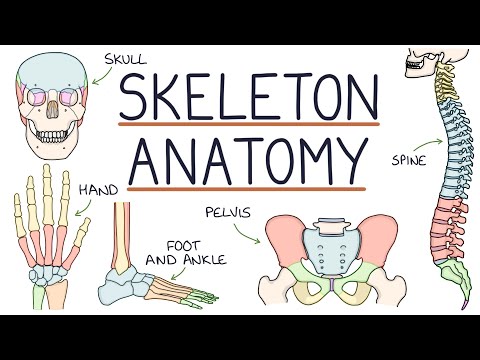
You know that feeling when you wake up in the morning and stretch, and your bones kind of crack? It’s like your body is having its own little symphony! Well, that’s a fun way to think about the anterior skeletal system.
This part of your body, which includes everything from your skull to your ribs, is basically the framework holding you up. Imagine it as your personal scaffolding! Seriously though, without it, we’d just be a pile of goo on the ground.
Every time you take a deep breath or laugh too hard at a joke—like when someone tells a dad joke—you’re using those bones in some pretty incredible ways. So let’s dig into how this skeletal crew plays a huge role in keeping us standing tall and moving around. Sound good?
Understanding the Anterior and Posterior Views of the Human Skeleton: A Comprehensive Guide to Human Anatomy
When you think about the human skeleton, it’s like getting a behind-the-scenes look at your body’s structure. You’ve got two main views to explore: anterior and posterior. Let’s break this down a bit.
The anterior view shows us the front side of our skeleton. This view gives insights into how our bodies are built to function in daily life. For instance, when you stand upright and face forward, the bones you see include:
- The skull: Protects your brain and supports your facial structure.
- The clavicles or collarbones: These connect your arm bones to your body and play a role in shoulder movement.
- The sternum (breastbone): It’s central to your ribcage and helps protect vital organs like your heart.
- The ribs: They form the protective cage around your chest area.
- The pelvis: It’s not just for support; it also houses reproductive organs.
This view is super important for several reasons. Think about it: when doctors examine a patient, they often assess injuries or conditions based on these anterior features. Like, if someone has a broken collarbone, that definitely affects how they move their arms!
Now let’s flip things around and look at the posterior view. This is everything from the back of our skeleton. It shows how well-balanced and aligned we are while moving or standing. In this perspective, you’ll notice:
- The vertebral column (spine): It runs along our back, protecting the spinal cord while giving us flexibility.
- The scapulae or shoulder blades: These are key for arm movement and provide stability to your upper body.
- The pelvic bones again: And yes, they show up here too! They’re essential for weight-bearing tasks.
- The femur (thigh bone): The largest bone in our bodies connects with both the pelvis and knee joint, playing a big part in standing and walking.
This posterior view reveals issues that might not be visible from the front. For example, someone with poor posture might have noticeable deviations in their spine here that aren’t as obvious when looking straight on but can lead to discomfort over time. I remember seeing my friend struggle with back pain; turns out his spine was pretty out of whack from sitting too much at his desk!
You see how both views tell different stories? The anterior view gives insight into functionality while we face the world. Meanwhile, the posterior view shows us balance and alignment—key players in our overall health! Understanding these perspectives not only helps in anatomy studies but also provides valuable information for activities like sports or rehabilitation exercises where posture is crucial.
So next time you’re admiring those anatomical charts or even just looking at a diagram online, remember: every detail matters! The human skeleton isn’t just about being bony; it’s all about supporting life as we know it!
Exploring the Three Primary Functions of the Axial Skeleton in Human Anatomy
The axial skeleton, you know, is like the central framework of our body. It’s made up of 80 bones and includes the skull, vertebral column, and rib cage. So let’s break down its three primary functions.
Support is the first big role of the axial skeleton. Imagine it as a strong scaffolding. It holds your body upright, allowing you to stand tall and move about confidently. The vertebrae stack together to form the spine, giving your body structure. Without it, we’d be a floppy mess!
Then there’s protection. This one’s super important! The axial skeleton acts like a shield for vital organs. For instance, your skull protects your brain from all sorts of bumps and knocks—literally saving our thoughts from getting scrambled! The rib cage doesn’t just look cool; it keeps your heart and lungs safe from harm while allowing you to breathe freely.
Lastly, we can’t forget about movement. Now that may sound a bit strange since you might think of limbs for movement. But hang on! The axial skeleton plays a crucial role here too—especially through the vertebral column. It allows us to twist, bend, or even just sit up straight. Valuable stuff when you consider how often we rely on our spines throughout each day.
So there you have it: support, protection, and movement—all key functions serving up a vital purpose in our anatomy! Isn’t it amazing how something we often take for granted does so much heavy lifting behind the scenes?
Exploring the Anterior Skeletal System: Its Role in Human Anatomy – Comprehensive PDF Guide
The anterior skeletal system is kind of the front-line player when it comes to our anatomy. It includes all those bones in the front part of your body, and, believe it or not, they play a major role in how we function daily. Let’s break it down a bit.
First things first, the anterior skeleton is primarily made up of the skull, the rib cage, and the vertebral column. This is where you can find some of the most vital bones. For instance, your skull protects that precious brain of yours. It’s like a helmet that also gives your face its shape.
Moving on to the rib cage, this bony structure not only protects your heart and lungs but also supports your breathing. Each time you take a deep breath, it’s your ribs that expand and contract. Have you ever thought about how often you breathe? It’s wild to think something so automatic relies on these bones.
Now let’s chat about the vertebral column. This part has a critical job too—it keeps you upright! The vertebrae stack up like building blocks to form your spine. If you’ve ever felt back pain, then you know just how essential these bones are for everyday life.
And hey, let’s not forget about the pelvis. It’s part of the anterior skeletal system too! The pelvis connects with your spine and supports your weight when you’re standing or sitting. Plus, it protects some key organs down there as well.
One important thing to mention is that all these bones work together as a framework for muscles and organs. Think of them like scaffolding supporting a building—they’re crucial for maintaining structure and allowing movement. Without this framework, we’d be just blobs of soft tissue!
Furthermore, many joints in the anterior skeletal system allow for movement—as in bending, twisting—and that flexibility is vital for everyday activities like picking up groceries or dancing at a party!
It’s wild how much we rely on these structures every single day without even thinking about it. And sometimes they need a little extra care too; injuries can happen if we’re not careful—like tripping and falling or even bad posture while binge-watching our favorite shows!
In summary, the anterior skeletal system isn’t just there for show—it plays essential roles in protection, support, movement and overall function. The complexity and interdependence of these bones highlight their importance in human anatomy.
So next time you’re moving around or taking a deep breath—give a thought to those amazing bones working hard behind the scenes!
So, let’s talk about the anterior skeletal system. You might be thinking, “What does that even mean?” Well, the anterior part refers to the front of our body—basically, everything you can see when you look in the mirror.
Your bones are like the framework of a house. They support everything and keep you standing tall. The anterior skeletal system includes bones like your skull, ribs, and the bones in your arms and legs. It’s pretty cool when you think about it because these bones do a lot more than just hold us up. They protect vital organs and give shape to our bodies.
I remember this one time in high school when I was captivated by a biology lesson about bone structure. The teacher had this huge model of a skeleton. Seeing how all those bones fit together was mind-blowing! I still think back to that day whenever I see someone playing sports or running around—you’re literally watching their skeletal system at work with every movement.
But here’s where it gets interesting. Bones are not just static structures; they’re living tissue! They can renew themselves and adapt based on how much we use them. If you lift weights or run often, your bones get stronger to handle that stress. Isn’t it wild? Your body is constantly adapting to what you put it through without you even realizing it.
Now, if something happens—like an injury or disease—that can affect this system, it can create real issues for movement or stability. Understanding how those bones work together helps doctors assess treatments for injuries or conditions like osteoporosis—a condition that can make your bones weak and fragile over time.
So yeah, we often overlook our skeletal system until something goes wrong or we bump into something hard—hopefully not too often! But appreciating how all these parts come together reminds us of how amazing our human anatomy is overall. You know? It’s all interconnected; one little issue can lead to bigger problems down the line.
Next time you do something active—like walking up the stairs or dancing at a party—take a second to appreciate that intricate framework inside you that makes it all possible!