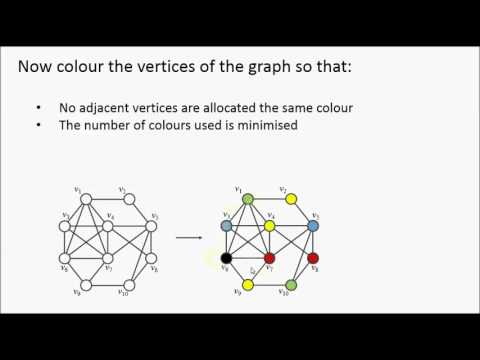
So, imagine you’re at a party, right? Everyone’s wearing different colors. You wanna make sure no one clashes. You need a plan! That’s kinda what graph coloring is like in the world of math and science. Pretty wild, huh?
Now, let’s get a little nerdy for a second. Graph coloring sounds all serious, but it’s actually super fun! You can think of it as giving each node in a network its own unique color so that no two connected nodes look the same. Seriously, this has some major applications in things like scheduling and even optimizing networks.
And here’s the kicker: people have come up with some really cool algorithms to make this whole process easier and faster. It’s like having cheat codes for math problems! So stick around; we’re about to explore how these innovative ideas are shaking things up in modern science.
Revolutionizing Graph Theory: Cutting-Edge Coloring Algorithms Transforming Modern Scientific Research
Graph theory might sound super technical and all, but it’s really just about understanding relationships. It helps us model everything from social networks to biological systems. One of the coolest parts? **Graph coloring algorithms**. These are like magical tools that help us solve problems by assigning colors to different elements without letting two adjacent ones share the same shade.
Now, let’s break it down a bit. Imagine you’re at a party, right? And you want to introduce your friends to one another but don’t want anyone feeling awkward if they already know each other. So you decide to group them in a way that no one who knows someone else stands too close together. That’s basically what graph coloring does for data points!
Using these algorithms can be seriously beneficial in different fields:
- **Resource allocation**: In computer networks, for instance, you can assign frequencies to antennas so they don’t interfere with each other.
- **Scheduling problems**: Think about school schedules or sports leagues where you need to ensure none of the players or students have overlapping commitments.
- **Map coloring**: You know how countries on a political map need different colors? That’s also graph coloring in action! It helps avoid confusion where boundaries are close together.
Cutting-edge algorithms come into play here. They’re not just any old methods; they’re refined and optimized for speed and efficiency. For example, one of the more innovative approaches is a **distributed algorithm**, where multiple processors work on a problem simultaneously—think teamwork.
You might be intrigued by some specific algorithms making waves recently, like **Greedy Coloring** or **DSATUR (Degree of Saturation)**. These aim for different kinds of efficiency based on what data they’re working with and how complex the relationships are.
Here’s an inspiring story: researchers trying to tackle the spread of diseases often use these graph theories. By mapping out infection paths through contact tracing—the links between people—they employ coloring algorithms for effective intervention strategies. In essence, they’re predicting outbreaks and ultimately saving lives!
So when folks talk about revolutionizing graph theory through innovative coloring algorithms, they’re really pointing out how these tools are reshaping various scientific landscapes— from computer science all the way to epidemiology.
And it’s not just fancy math talk; it affects everyday issues like urban planning or even internet security protocols! Who knew those numbers in textbooks could do so much? So every time you hear someone mention graph theory or its colorful algorithms, remember there’s a whole world behind those concepts that’s vibrant and transformative!
Advancements in Graph Coloring Algorithms: Transforming Scientific Research in 2022
Graph coloring might sound like a puzzle or a game, but it’s seriously important in the world of computer science and beyond. Imagine you have a bunch of connections that need to be organized, like scheduling classes or assigning frequencies to radio stations. That’s where graph coloring comes into play.
Basically, the idea is to color the nodes (or dots) of a graph so that no two adjacent nodes share the same color. Sounds simple, right? But in reality, finding the most efficient way to do this can be super complex. This is where advancements in **graph coloring algorithms** come into play.
In 2022, researchers made some serious strides. They developed new algorithms that are faster and more efficient than previous methods. One big leap was with **heuristic approaches**—these are strategies that give good enough solutions without having to check every possible option. Think of it like taking a shortcut rather than following the winding road.
Key advancements included:
- Hybrid Algorithms: Combining different strategies led to better performance.
- Machine Learning Integration: Using AI helped algorithms learn from previous problems, improving their speed.
- Parallel Processing: By breaking tasks into smaller pieces and solving them simultaneously, researchers sped up calculations significantly.
You might be asking, “Why does this even matter?” Well, let me tell you! A good example is in networking—especially 5G communications. With so many devices needing unique frequencies to avoid interference, advanced graph coloring algorithms help manage all those connections efficiently.
Another area where these algorithms shine is in **bioinformatics**. Researchers have to analyze complex molecular structures and interactions. Effective graph coloring can simplify this analysis, allowing scientists to focus on what really matters—like identifying potential treatments for diseases.
But here’s something cool: these advancements aren’t just limited to theoretical applications. They’re changing real-world scenarios! For instance, city planners can use improved algorithms for resource allocation during events—think about crowd management during concerts or sports events.
In essence, as these algorithms evolve and get smarter through cutting-edge techniques and technologies, they’re reshaping how we approach various scientific problems. It’s kind of exciting when you think about it! Like we’re on the edge of discovering new possibilities with each algorithm tweak.
So yeah—you see? Graph coloring isn’t just some academic exercise but rather an essential tool that’s transforming various fields today!
Advancements in Graph Coloring Approximation Algorithms: Enhancing Computational Efficiency in Graph Theory
So, let’s chat about graph coloring approximation algorithms. Sounds fancy, right? Well, it’s actually pretty cool stuff when you think about it!
Graph coloring is all about assigning colors to the vertices of a graph so that no two adjacent vertices share the same color. It’s like making sure no two neighbors paint their houses pink at the same time. Seriously, can you imagine that neighborhood? It could get chaotic!
The challenge is that finding the exact solution for larger graphs can be super tough and time-consuming. That’s where approximation algorithms come in handy—they help us find solutions that are “close enough” in a much quicker way.
Advancements in these algorithms have really sped things up! Researchers have been creating new techniques that improve how we tackle these problems without needing to check every single possibility, which is great for efficiency.
- Greedy algorithms: One of the simplest approaches is greedy coloring. It assigns colors to each vertex one by one, choosing the lowest available color for each vertex. While this doesn’t always give you the best answer, it gets the job done fast.
- Randomized algorithms: These are super interesting! They use randomness to decide how colors get assigned. Even though they might seem a little chaotic at first, they can produce results quickly and often surprisingly well.
- Local search algorithms: Picture this: You have a decent solution already. Local search methods tweak this solution bit by bit—like rearranging furniture—to find an even better outcome without starting from scratch.
Now, why does this matter? Well, think about tasks like scheduling classes in schools or assigning frequencies in wireless networks. Those pesky graphs pop up everywhere! The ability to quickly and efficiently color these graphs means we can optimize resources better.
A while back, I remember struggling with scheduling my classes at university. There were all these overlapping courses and limited rooms! If only they had used some graph coloring techniques back then… My friends and I had to double-check everything manually; it was such a mess.
Overall, advancements in graph coloring approximation algorithms aren’t just playing with colors on paper—they’re helping shape more efficient systems in real life! And as researchers keep tinkering with these techniques? Well, who knows what kind of awesome breakthroughs are still ahead? Isn’t that exciting?
Okay, so let’s chat about something that sounds, um, a bit nerdy but is actually pretty fascinating: graph coloring algorithms. Yeah, I know it sounds like a math class from high school, but hang with me!
You see, in the world of computer science and mathematics, graph coloring is all about assigning colors to nodes in a graph such that no two adjacent nodes share the same color. Okay, but why does this matter? Well, it turns out that this concept pops up in all sorts of places—like scheduling problems or map coloring. Imagine you’re planning classes for students and you need to make sure no one has overlapping schedules. Graph coloring helps with that!
The innovative algorithms being developed these days are game-changers. They’re faster and more efficient than what we had before. So like when computers can process data quicker and more accurately, it means better solutions for real-world problems! I remember sitting with my roommate back in college as we tried to figure out schedules for our study groups. We had sticky notes everywhere trying to keep track of who was free when—it was chaotic! If only we’d had those algorithms back then…
Now you might ask yourself how these fancy algorithms work their magic. Basically, they use clever strategies to minimize the number of colors (or resources) needed while ensuring everything works smoothly. Think of it like solving a jigsaw puzzle; some pieces just fit together better than others based on patterns.
And what’s super cool is that these advancements aren’t just theoretical. They’re being tested and applied across various fields—like biology for DNA sequencing or network design in tech companies. It’s pretty wild how a concept that seems basic has implications for complex scientific challenges today.
So yeah, if someone mentions graph coloring algorithms at your next get-together, you can totally chime in with some solid knowledge! It’s one of those subjects where deep down it’s all about finding solutions—solving puzzles of life—one colorful node at a time!