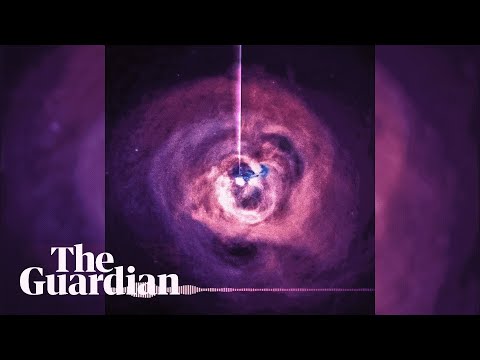
You ever think about what a black hole might sound like? Yeah, me neither, until I stumbled across this wild thing: NASA’s actually recorded the “sounds” of black holes. Like, cosmic music or something. Sounds crazy, right?
Imagine floating in space, surrounded by the vastness of the universe, and then—bam—you hear weird waves echoing all around you. It’s not just silence out there; it’s like a cosmic symphony! I mean, who knew that dead stars could vibe in such a way?
But here’s the kicker: these sounds aren’t like your favorite tunes on Spotify. They’re more like deep, mysterious growls that make you feel tiny and awestruck. Seriously! So come along on this wild ride. Let’s explore how NASA captured these haunting waves and what they really mean for us Earthlings hanging out at the edge of the Milky Way.
Exploring Cosmic Phenomena: Has NASA Captured the Sound of a Black Hole?
So, you’ve heard that NASA has captured the sound of a black hole? Sounds kinda spooky, right? But hold onto your space helmets, because it’s actually pretty cool and fascinating once you dig into it.
First off, let’s get one thing straight: black holes don’t produce sound waves like we experience on Earth. Sound needs a medium to travel through, like air or water. In space, which is basically a giant vacuum, there’s not enough stuff for sound waves to move around. So how can we say we’ve captured the “sound” of a black hole? Well, it’s actually more about translating data into something we can hear.
NASA’s super talented scientists took readings from the Chandra X-ray Observatory and other telescopes that monitor black holes. They didn’t record sounds in the traditional sense but gathered data about electromagnetic waves—these are generated by materials orbiting around a black hole. To make this data audible to us humans, they used a process called “sonification.” It’s like turning light into sound.
For example, when looking at the black hole in the Perseus galaxy cluster—one of the biggest clusters out there—NASA turned pressure waves from surrounding gas into something we can listen to. This specific black hole has been burping out sounds for billions of years! You might think that’s funny or eerie depending on how you view it.
So what do these sounds really tell us? They provide insight into how black holes influence their surroundings and help us understand cosmic events better. When things spiral towards a black hole and get heated up—like dust and gas—they create high-frequency vibrations similar to musical notes! Pitch changes depending on how fast things are moving and what types of materials are involved.
The process is kind of poetic when you think about it:
Oh, and when you listen to these sounds? It feels surreal! Imagine tuning into a cosmic symphony where every note tells a story about the universe’s history—a reminder that even in something as unforgiving as space, there’s harmony.
To wrap it all up (not like wrapping presents but you know what I mean), NASA capturing the “sound” of black holes isn’t so much about hearing them as it is about connecting dots in our understanding of cosmic phenomena. It’s amazing what creativity can do with data! That blend of science and art makes exploring these distant giants feel just that much closer. So next time someone mentions cosmic sounds, remember—it’s not just noise; it’s knowledge sung through the universe!
Exploring Stephen Hawking’s Predictions on Black Holes: Insights from a Legendary Physicist
Alright, let’s talk about Stephen Hawking and his mind-blowing ideas around black holes. You know, black holes are those mysterious regions in space where gravity is so strong that nothing, not even light, can escape. Imagine trying to push a boulder up a hill only to have it roll back down—except in this case, it’s like trying to escape a cosmic whirlpool!
Hawking made some seriously cool predictions about these celestial giants. One of the biggest things he proposed was Hawking radiation. Basically, he suggested that black holes aren’t completely black. They can actually emit radiation due to quantum effects near the event horizon, which is like the “point of no return.” Imagine that—a black hole losing mass and potentially evaporating over time! Can you picture that?
And here’s a fun tidbit: when NASA recently analyzed sounds from black holes using cosmic waves detected by instruments like the Chandra X-ray Observatory, it highlighted Hawking’s theories in a whole new light. Turns out these sounds aren’t literal music but rather variations in frequencies produced by particles around black holes. It’s wild how scientists have turned these cosmic signals into something we can almost “hear.”
- The Event Horizon: This is where all the action happens! Once you cross this boundary, there’s no turning back.
- The Singularity: At the core of a black hole lies this point where density becomes infinite and our understanding of physics breaks down.
- The Concept of Time: Near a black hole, time behaves differently—like, seriously different! The closer you get, time slows down compared to an outside observer.
- Black Hole Thermodynamics: Hawking helped connect thermodynamics with gravity by suggesting that black holes could have entropy and temperature—mind-blowing stuff!
You know what I think is super interesting? The idea that all these cosmic phenomena are tied together—it shows how intertwined everything is on a universal scale. You see? Black holes aren’t just voids; they’re keys to understanding the fabric of our universe!
If we dig deeper into Hawking’s insights through NASA’s findings about sound waves from black holes, it makes you realize just how much there still is to learn. There are echoes of Hawking’s theories all around us—the sounds ripple through space! So next time someone mentions black holes or even cosmic sounds, just remember: there’s so much more beneath the surface than meets the eye (or ear!).
This isn’t just a science lesson; it’s an invitation to keep wondering and exploring. Science isn’t static; it evolves as we do! And who knows what other secrets about our universe will be uncovered next?
Understanding Cosmic Rays: Insights from NASA on Their Impact and Significance in Science
So, cosmic rays, huh? They might sound like something from a sci-fi movie, but they’re actually a real deal in the world of space science. Basically, cosmic rays are high-energy particles that come from outer space and hit the Earth’s atmosphere. Think of them as tiny, supercharged bits of matter zipping around at almost the speed of light. Crazy, right?
What exactly are cosmic rays? Well, you’ve got your protons (which are part of atoms), along with some heavier stuff like helium nuclei and even electrons. These little guys can originate from various sources in space—like our Sun or exploding stars known as supernovae. Some cosmic rays even come from distant galaxies!
Now here’s where it gets intriguing: when these particles collide with our atmosphere, they create showers of secondary particles and radiation that we can study. It’s like a mini firework show up there! And guess what? These collisions can tell us so much about the universe’s most energetic processes.
NASA has been diving deep into the world of cosmic rays. Their research helps us understand not just how these particles affect Earth but also what they tell us about astrophysical phenomena. For example, when studying black holes—which you might have heard were getting their own sounds recorded—NASA is tapping into cosmic ray data to see how these intense gravitational forces affect matter and energy around them.
But you might be thinking: what’s the big deal about cosmic rays? Well, for starters:
- Health concerns: At high altitudes or during long space missions, astronauts are exposed to increased levels of cosmic radiation. Understanding this helps keep them safe.
- Astrophysics: The way cosmic rays are generated provides insight into fundamental processes happening in stars and galaxies.
- Technology: Cosmic rays can disrupt electronics on satellites—so studying them helps engineers design better tech!
A little anecdote for you: there was this one time when I was stargazing after a long day. I saw shooting stars and started thinking about those cosmic particles racing through space—suddenly it hit me how small we really are compared to the cosmos! It’s wild to think those same particles could be zooming around while we’re just living our lives down here on Earth.
In summary, cosmic rays play a vital role in expanding our knowledge. By studying them through missions backed by NASA and other institutions, we’re peeling back layers of the universe’s mysteries bit by bit. They connect everything—from health implications for astronauts to understanding powerful forces beyond our planet—and let’s be real: isn’t it cool to think we’re all part of that grand picture?
So, recently I stumbled upon this cool thing – NASA’s black hole sounds. Like, seriously? Sounds from black holes? At first, I thought, “How on Earth (or in space) could they even capture that?” But it turns out there’s a fascinating process behind it.
Picture yourself staring up at the night sky. Stars twinkling, maybe a comet zipping by (that’d be awesome!). But instead of focusing on pretty lights, think about those massive cosmic beasts – black holes. It’s wild how they exist in space, right? They’re like nature’s ultimate mystery boxes. You can’t see them directly since they suck everything in—even light – but scientists use clever tricks to study them.
NASA uses things like electromagnetic waves emitted by these black holes to create sound waves we can actually hear! Imagine taking all the invisible stuff happening around a black hole and transforming it into something you could listen to on your phone – mind-blowing! It’s not just science; it’s art. The sounds are often eerie or haunting and give you goosebumps thinking about the vastness of space.
I remember this one night lying on a rooftop with friends, sharing stories while stargazing. One of my buddies played some space sounds he found online—like cosmic radio stations! We were entranced. Listening to those vibrations felt strangely intimate, connecting us to a universe so much bigger than ourselves. That moment reminded me how curiosity fuels exploration and brings people together.
These NASA recordings invite us into that cosmic dance—a reminder that there’s always more to discover if we pay attention and listen closely. So next time you’re gazing at the stars or just chilling at home with some tunes, consider tuning into those celestial symphonies. They might just spark your imagination in ways you never imagined!